Tuesday, August 22, 2006

THE QUALITY OF THE BUSINESS ENVIRONMENT: THE BEST STATES FOR BUSINESS 2006

Economist's paramount concern is always to offer the most productive options in order to maximize the efficiency of economic agents. Macroeconomist is usually finding ways to maximize the efficiency of public finance. From this respect macroeconomic analysis entails constant monetary analysis as well as the issues of corporate and personal taxation. In turn, microeconomist’s general aim is to offer productive options to economic agents on the market (households, individuals) to spent and utilize their resources in the most efficient and productive way. Microeconomist is considering many samples in order to analyze agents’ behavior properly.

Each story of the economic success began at two different and separate levels. The first level is the level of government. Many nations are now adopting pro-growth and free-market policies of low taxation, minimal regulations and flexible labor markets. Estonia is a recent example of a little country that could. Instead of active fiscal policies many governments relied on the monetary issues. The results were impressive. Post-war German economic miracle is a perfect example of pro-growth economic policies. Hong Kong is still a champion in economic freedom. The tiny tiger opened its economy and with the principle of low and fair taxation and non-government intervention embodied an economic story of success. Another level where the story of economic success is measured is the level of firms. In turn, macroeconomic policies largely determine microeconomic decisions of firms and individuals. Where macroeconomic policy is stable and productive, microeconomic results are rocketing up. By and large, incomplete financial markets and the failure of government to commit policy enable government to use active fiscal policy in order to consolidate its power. The outcome of an unstable macroeconomic policy was usually a catastrophic failure seen as (1) a large fiscal deficit or public debt, like in Croatia nowdays, or as (2) a high inflation which occurred because government had to print more and more money in order to finance its budget activities.

However, if firms want to increase their competition on a large market they deserve the highest quality of business environment without setting governmental myths. One of such myths is a myth of trade balance. Accordingly, governments are hardly willing to understand trade as a market. They rather use it as a political weapon. Their soundest and the most emotional appeal to the public is to underpinning “trade deficit” with other countries, striving on every way to come into surplus. But trade balance is largely a result of a market. How do we gain from exports as consumers in the country where export has taken place? In turn, we gain a lot from imports. We wear Italian shoes, drive German automobiles, eat Chocolate made in Belgium, buy large Japanese LCDs, talk to our friends with Finnish mobile phones, hike around with bikes made in Taiwan and prepare a dinner with first-class wine from California. In fact, free market gives us a choice to choose whatever we prefer. Consider a perfect example. You own a company and sell computers. Suddenly, there’s a signal on the market when your customers demand for the latest laptops. You find out that this laptops are produced in China and that it is only possible to import directly from China. So you order the latest 100 laptops and introduce them on the market. According to government officials you accounted a deficit in foreign trade with China. But where is the added value created? Here, in your company. The wholesale company got a cut and after you sold those laptops to your customers, you got a cut.

There is another question. Why some companies can’t compete? Business analysts may tell you reasons. One reason may be an inefficient management, unknowledgeable misinformed and inexperienced executive which could be the major source of uncompetitive company. Another, more actual reason why some companies can’t compete very well is the presence of government in certain areas. Strong and powerful presence of government in businesses usually serves as an instrument of price controls and political allocation in several areas of businesses makes them sister companies of the government. As an economist, I believe that government should be used for something more useful and practical.

Governmental function should take place in reforming business environments in terms of promoting and adopting free-market and pro-growth policies with the privatization of health and social security system on top. The governmental function in the reform process must therefore be applied to improve the quality of business environments. Another extremely important area urgently undertaken to be reformed is the tax policy. Progressive taxes are used to punish the most productive people and to allocate tax revenue according to the political measures in terms of large welfare programs. Charity is a lot better than social security. Social security is a way of keeping those on the bottom in poverty while charity is a way to help those people getting out of bottom in a decent and more productive way. Thus social security is a way of prolonging poverty and there is no more direct way to increase poverty and material decrease of well-being as putting social security programs into practice. Instead of promoting active fiscal policy, government should rather focus itself on monetary issues with inflation targeting policies as a basis of monetary policy including the control of the quantity of money and of the money supply.

Over the past ten years, the United States has seen corporations move job after job overseas in search of cheaper labor. An equally large problem has been the corporate tax rate. Five years ago, the U.S. corporate tax rate of 39% was the sixth highest among Organization for Economic Co-operation and Development countries, according to the Tax Foundation. While other countries have lowered taxes, the U.S. rate hasn't budged, and today it has the highest rate among OECD countries, eclipsing former tax gougers such as Germany and Canada.
And when you start factoring in litigation costs, $250 billion per year or 2% of gross domestic product, it's amazing that any companies stay in the U.S. So, what is a company to do in this high-cost, antibusiness environment? Maybe minimize the damage by moving to a more business-friendly state.
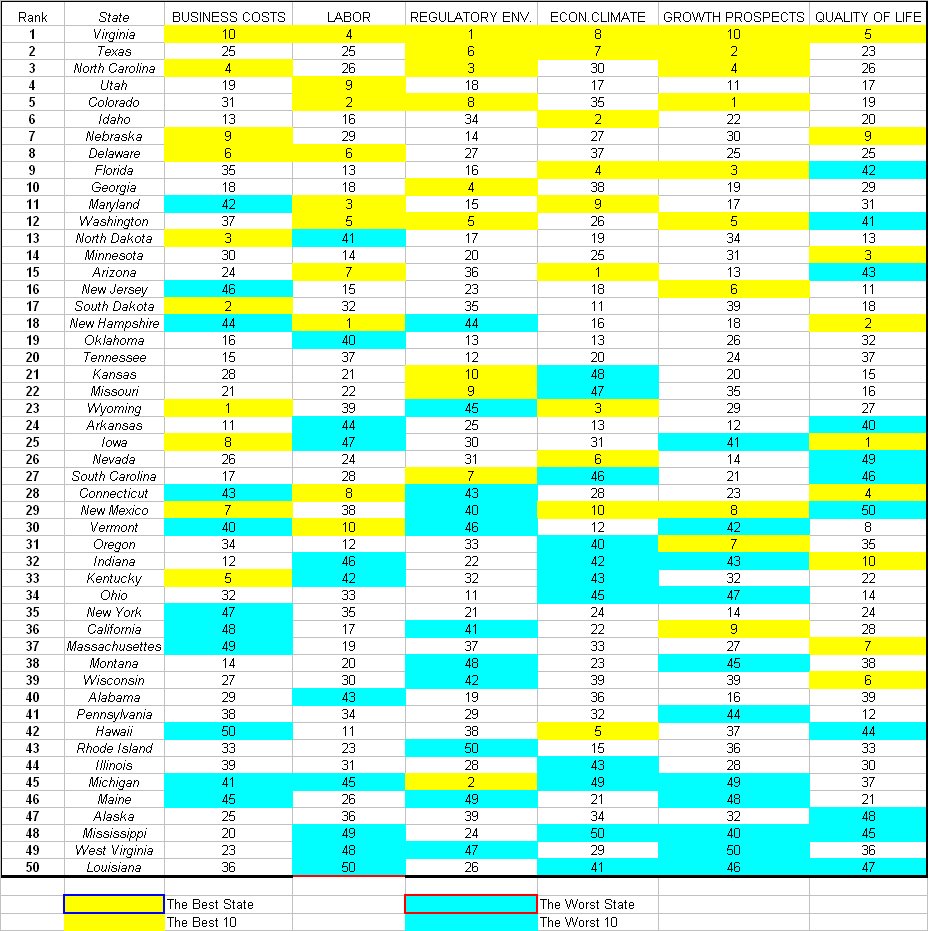
In the latest research conducted by Forbes 50 states were ranked from the bottom to the top according to their performance in six major categories:

Business costs
Economic climate
Growth prospects
The quality of life
Labor
Regulatory Environment


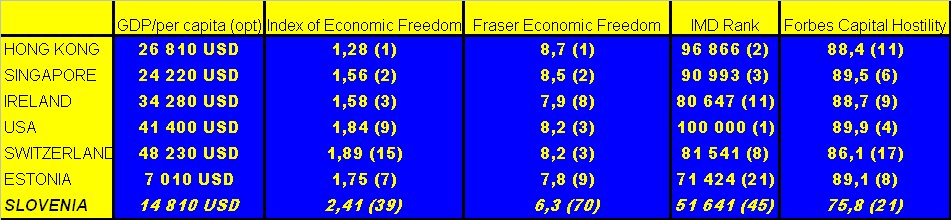
Business costs are essential to the firm. Economic climate often contributes its portion to the business costs. If banking system is inefficient, investors can hardly find a decent source of financial support for future joint-ventures. High and progressive income tax codes could do the unprecedented damage as well. Why should an investor build high-tech facilities in Slovenia where corporate tax rate equals 25% while he can choose Hungary with 16% corporate tax rate? Growth prospects can be decreased if the overwhelming regulation and tax system keep businesses away from putting their potential of growth into practice. If there is no productive labor supply that could ensure future growth of a company, companies will come and go. And if certain business environment is forecasted to grow, more and more fresh graduates will come there and try to give the best of their potential in an environment that grows. The quality of life is a very stimulating area which together with labor determines the mobility, capability and flexibility of workers in their performance. Rigid labor markets and state protection of the labor are the most damaging impacts that reduce the opportunity, choice and mobility as well. Good education score among students ensures companies a good supply of future labor force with highly sophisticated knowledge. Regulatory environment is a considerable area as well. Rigid regulatory codes could force investors to find the opportunities somewhere else. Extensive product market regulation decreases the ability of firms to focus on its market supply and innovation strategy. Instead, investors are often forced to go through thousands of pages of different rules, codes and acts. Inefficient, entrepreneurially hostile and enormously large state or local administration could additionally force investors to move into another place in order to find another place to invest. There would be no new jobs that would bring prosperity, choice and the opportunity for everyone for new graduates and consumers as well.

The outcome of the Forbes research “The Best States for Business” is a useful tool for investors, a sort of a guidebook that concerns where is the best location to do business, reflecting six main categories through which economists and analysts can find new and productive ways of specifying methodology that examines the question of measuring the quality of business environment.

So if you are an investor facing strongly rigid hindrances in the environment where you work I recommend you to come to Virginia where you can find the business environment of the first quality.

I remember how Allan H. Meltzer once perfectly captured the essence of difference between productive and unproductive people when he set the following statement: “The least productive people are those who are in favor of holding meetings.” I think he hit center of the target by telling this very vibrant truth.

LA VIE IMPOSSIBLE

France's government wants the world to know something. According to official figures, French citizens created a record 322,000 companies in 2005 -- and they're setting a similar pace this year. Is France, which invented the word "entrepreneur" but has been famously hostile to the breed, finally helping small-business people thrive?

Read the whole story here.

Tuesday, August 15, 2006

BERNANKE HAS IT EASY

Emerging markets and interest rates, Economist, Aug 3rd 2006

As investors become pickier, keen to distinguish one emerging market from another, they may begin to see Hungary in the same light as Turkey and South Africa. It too runs a big current-account deficit, which the IMF thinks will exceed 9% of GDP this year. Indeed, on fiscal matters, the comparison is rather to Hungary's disadvantage. Turkey may labour under heavy public debts, but it is at least running a heroic budget surplus, before interest payments, estimated at 6.4% of GDP. South Africa now runs a modest fiscal deficit, but its stock of debt is quite manageable. Hungary, on the other hand, has both high debts (almost 60% of GDP in 2005) and a wide budget deficit. Nouriel Roubini, of Roubini Global Economics, calls it an “accident waiting to happen”.

Read the whole story here.

Monday, August 07, 2006

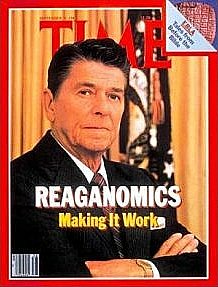
REAGANOMICS, THE ECONOMICS OF SUCCESS

The economic policy pursued by Ronald Reagan is often called “Reaganomics” or “supply-side” economics. Fortunately, this policy meant a radical cut of Keynesianism where consumption was stimulated with massive government spending. Keynes put the emphasis of economic policy on the demand-side (consumption). Reagan, by contrast, put the emphasis on the supply-side (production). Keynes believed that demand would create supply, but Reaganomics started from the opposite idea, namely that supply would create demand. In this way of thinking, the supply side of the economy (economic activity, production etc…) had to be stimulated in order to create wealth. The best way to do this was to cut the marginal tax rates on personal income. Such a tax cut would create a strong incentive to increase economic activity and would have spectacular effects on growth, investment, risk-taking and saving.
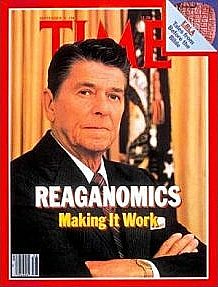


President Ronald Reagan’s stature will grow as his achievements come to be more widely recognized. It was Reagan’s confidence in capitalism, not his defense buildup that caused Soviet leaders to lose their confidence in further pursuit of destructively devastating state-controlled economy. Ronald Reagan took away the Soviets’ comfort factor when he said that the “Phillips curve” and falling US productivity were the results of the wrong policy mix, not inherent features of a market economy. The U.S. economy, in other words, could be easily fixed, but the Soviet economy could not. Later I will speak about Reagan’s slashing of tax rates from 70 to 28 percent. After imposing genius liberal economic reforms, Margaret Thatcher achieved similar results in reforming Keynesian legacy of British economy. Surprisingly, even French followed and pursued fueled privatization of their socialized economy. Reagan revitalized the U.S. economy. He abandoned the Keynesian policy mix of monetary expansion to stimulate demand and high tax rates to restrain inflation--which was obviously not being restrained by Keynesian demand management. Reagan got the supply-side message that high tax rates were restraining real output while money growth pumped up demand, thus causing inflation.


Reagan’s policy was a success. But at the time it was misunderstood. Accustomed to thinking of tax cuts as a demand-side measure to stimulate consumer spending, the entire economics profession, along with the Federal Reserve, the Republican Senate, and most of Reagan’s own government, predicted accelerating inflation. Reaganomics is probably the only economic doctrine that made its way into a pop song. In 1985, the British group Simply Red criticized the 'antisocial' policy of Reagan in their song “Money’s Too Tight To Mention” (actually, a cover version of an original American song by the Valentine Brothers from 1982).

The popular perception of Reaganomics is clear: an antisocial policy with a curtailment of social expenses. But criticizing Reaganomics is not the monopoly of the left. Even classical (i.e. pro free market) liberals and libertarians are convinced that although Reagan stimulated the economy, it came at the cost of an enormous budget deficit. Even George Herbert Walker Bush was initially very sceptical of the economic ideas of Reagan. In 1980 he spoke about “voodoo economics”. He changed course when Reagan chose him as running mate for the presidency.

In the sixties and seventies, Keynes' economic theory was applied on a large scale. Keynes developed his ideas in the deep economic recession of the thirties, with its high unemployment. Keynes argued that governments should stimulate aggregate demand by massive spending and infrastructure works in order to invigorate the economy. Through the “multiplier” effect every dollar spent by the government would create a multiple in income. Unemployment would vanish, the tax base would broaden, and the budget deficit would disappear, Keynes argued. But during the oil crisis of the seventies, it became clear that Keynesianism did not work. Higher public spending did not resolve unemployment. On the contrary, unemployment increased in line with the increase of government spending. Moreover, unemployment and inflation appeared simultaneously, a fact which could not be explained by the dogmas of Keynesian thinking. The only thing they were able to do, was to give it a name: “stagflation”, which meant that we had a combination of creeping inflation, recession and unemployment. During the Carter years, inflation was at a staggering 13%. Huge interest rates were necessary to fight it. The interest rate on credit facilities reached the unbelievable level of 21%. The drama was complete when taxes were increased to fight both inflation and government deficits. During the Carter years, the top marginal tax rate on personal income rose to the insane record level of 70%. Experts in Economic & Tax Policy did not know how to agree on any economic policy. They simply had no solution!

Many of the recent studies have indicated that high public spending as Keynes had advocated does not stimulate the economy. The main reason is that money that could otherwise be spent by private sectors, shags off with public jobs which offer very little or even zero return. Money to pay the deficit must come from somewhere else to paid-off and usually it is the taxpayer who must pay it. The fundamental basis of Keynesian logic is that it hardly makes sense to tax money away from productive people, thereby reducing their rewards, so as to spend it on unproductive goals. The United Kingdom which is the home of Keynesianism experienced it long years after the war. Keynesian economic policy was sticking and sticking and everybody seemed that there’s no way to stop it. Finally, Margaret Thatcher stopped putting continued Keynesian economic policy into practice. Another, more recently observed example is Japan. This country has provided one of history’s best demonstrations that the Keynesian demand stimulus is a deeply flawed economic philosophy. Despite huge government outlays, the Japanese economy is still wallowing in the slump that has afflicted it for more than ten years. According to the analysis of the relationship between and the size of governments in 16 European countries, the two main causes leading to poor growth performance are excessive government spending and a demotivating tax structure, which put a heavy burden on work, income and profit. This study has recently been confirmed and underpinned by multiple regression analysis, using econometrics tools to show the results.


There were four young economists who convinced Reagan to completely reserve the economic policy of that time. Those four economists were: Paul Craig Roberts, Robert Mundell, Norman Ture and Steve Entin. And there was another Journalist Jude Wanninski who contributed a great portion to the turnover of economic policy when Ronald Reagan started running his first mandate. The very basic point of view was that tax rates very extreme, too high and worked like a barrier, embodying a strong disincentive to work, risk and save. In a very popular point of view, “Economics of Discouragement” had to be translated into “Economics of Encouragement”. People are producing because it pays to do so. Consumption will not result in increased production when there are no incentives to do so. The logic is simple. When tax rates are becoming higher, people are loosing their interest in taxed working activities such as risk-taking, work and entrepreneurship. When tax rates fall down, people are starting to increase their participation in those activities since they see more incentives to participate in productive behavior and raise their incomes on a permanent basis. Only few people knew that Reagan had a major in Economics from Eureka College (Illinois) in 1932 The economic theory he was taught was untouched by Keynesian thinking and, as a consequence, very appropriate to the problems of the eighties. Reagan immediately took action. He lowered marginal tax rates from 70% in two phases: to 50% (Economic Recovery Tax Act of 1981) and in a later phase to 28% (The Tax Act of 1986).

These tax cuts created 18 million new jobs in 8 years, lowered inflation to 4.3% and cut unemployment from 9.7% to 5.4%. One of the longest and strongest economic expansions since World War II had begun, with an average annual growth rate of 3.5%. But the first two years (1981 and 1982) were lost for Reagan. Fed chairman Paul Volcker fought inflation with a tight monetary policy and high interest rates. The Reagan administration urged Volcker to decrease monetary growth by a maximum of 50%, in order not to kill the tax cut program. But as the Federal Reserve is totally independent, Volcker cut money growth by 75% in 1981. The recession became even worse, and unemployment rose further. But after inflation had been defeated, money growth resumed and the Reagan expansion took shape.

Many leftist critics claim that Reagan gave money away to the rich at the expense of poor. Under Reagan’s leadership the so called rich people paid-out comparatively more through income and corporate taxes than ever before. The economic position for the poor was suitable and enabled them to move-up because tax revenues paid by the poor went down. But the reason for that is very simple. Lowering tax rates enabled instant participation in productive behavior. If the rich worked more, they saved more and logically they paid more. Reagan’s tax policy was followed by a principle in which increasing tax rates will not result in an increase of tax revenue. If you want to increase tax revenue you must expand the tax base and consequently lower marginal rates in order to let the economy grow.

It is often claimed that the budget deficit had risen to enormous proportions during the Reagan years. But between 1981 and 1989 the budget deficit increased only slightly, from 2.6% to 2.9% of GDP. The deficit peaked in 1983 to 6.1% of GDP (the Volcker recession with tight money). During the same years the Belgian budget deficit varied between 7% and 13% of GDP. The average budget deficit for the G-7 countries was only slightly lower than that of the US. The public debt of the US as a percentage of GDP, remained below that of the G-7 countries, i.e. below 32% of GDP. But Belgian public debt, the result of years of Keynesian policy, was higher than 100% of GDP and remains around 100% at this moment.

Increasing social outlays doesn’t make sense when you have previously created poverty and unemployment with wrong and possibly destructive economic policy. Redistribution of wealth through high marginal tax rates has no clue. It distributes poverty.

Keynesian thinking explained the economic achievement in terms of the level of spending. Deficit spending will keep employment high and will stimulate the economy. Cutting the deficit (for the Keynesians) would reduce spending and throw people out of work, raising the unemployment rate, reduce national income and hence produce less tax revenues. Reagan on the contrary brought a totally new perspective to economic policy. Instead of putting the emphasis on spending, supply-side economists showed that tax rates directly affect the supply of goods and services. Lowering tax rates mean better incentives to produce, to save, to invest and to take risks. In other words lower tax rates stimulate supply and not demand. The broader tax base will compensate at least partially for the lost revenue caused by the tax cut. Higher savings will result in increased investment and unemployment will disappear. Instead of pumping up demand to stimulate the economy, reliance would be placed on improving incentives on the supply side.

Entire population couldn’t believe that former movie actor could enable the most explosive expansion of the growth of income with revolutionary economic policy that stepped with new supply-side approach.
But Ronald Reagan was not the only one leading a strong, productive and impressive economic policy considering supply-side mechanism. Ludwig Erhard put in practice supply-side economics in Western Germany in 1948. At that time he was in charge of economic policy. He introduced an economic shock therapy completely in line with Reaganomics. He abolished rationing and price-controls, although he restricted his own power with this measure. Erhard believed in the self regulation of the market.

Not only the Social Democrats were vehement opponents of the abolishment of price-control, but also Lucius D. Clay, the US. military governor, was furious. Erhard had pushed through the economic deregulation without ever asking the general. Clay called Erhard to account, thundering that the professor had infringed upon the Allies’ privileges by changing the rationing regulations. Erhard coolly responded : “you are mistaken, sir, I have not changed them, I have abolished them.” Later on Erhard, as secretary for the economy, cut the high marginal tax rate in two steps: first from 95% to 63% and afterwards to 53%. The first 8000 DM earned became tax free. The decisions taken by Ludwig Erhard allowed West-Germany to rebuild itself at a pace never seen. No surprise that he was called the “father of the wirtschaftswunder”. The German economic miracle cannot be explained by the Marshall Plan. Britain and France received Marshall money too, but they wasted their chances. Britain voted Labour, which brought rationing and price controls. France opted for economic protectionism, which prevented Marshal help to be used in an efficient way. After Reagan, the theory of supply-side economics was applied in numerous countries. In Iceland, David Oddson became prime minister in 1991. He inherited a poorly performing economy burdened by heavy income taxes. He lowered the corporate tax rate from 50% to 30%. During the next five years the economy grew by 5% per year. Government income did not fall and social outlays could be maintained. Ireland is another example. In 1987 this country was the “sick man” of Europe, with a public debt of 135 % of GDP. After the elections of 1987 a new economic policy was introduced. Corporate tax rate was reduced from 32% to 12.5% and capital gains tax was lowered from 40% to 20%. Ireland is now the fastest growing country of the EU. Japan, to the contrary, is a classic example of the failure of a Keynesian demand-side policy. The economy has been in shambles for many years and public debt has risen to a gigantic 170% of GDP. The following graph compares government spending and GDP per capita in Ireland and Belgium between 1960 and 2003. The Irish 'turning point' came with the adoption of supply-side economics.

A Reaganomics Plan for Slovenia

1. A considerable tax cut down to 20% on personal income.

2. The complete abolition of corporate tax rates repealing all public subsidies transferred to public enterprises where government owns major or partial stake

3. The abolition of taxes on dividends. Investment and risk taking has to be encouraged, not punished. A reduction (or abolition) of tax rates can make investment opportunities profitable that formerly were not

4. The abolition of all agricultural subsidies. At this moment 45% of the total EU budget goes to agricultural subsidies, respresenting the huge amount of 45 billion euro per year. This is not only dramatic for the tax payers, but it is also very harmful for the developing world, mainly for the poor countries in Africa. As a consequence of the subsidies, European agricultural products are dumped (at prices far below the cost) on the markets of these countries, preventing them from competing on the world markets with their own products.

5. A radical cut in the size of Government. After Sweden, Slovenia has the second largest part of public expenditures according to Fraser Institute. The government has received more than 2% of total revenues from public enterprises and other forms of government ownership.

Supply-Side and the Laffer curve

Supply-Side economics is widely misinterpreted as the Laffer curve. Arthur Laffer, an economics Professor at University of Southern California claimed that an important feature of supply-side economics is that tax cuts will pay for themselves. Laffer became famous after he illustrated this idea on a napkin in a restaurant in Washington in 1974. But the question is not whether tax cuts pay for themselves, but whether they are more effective in creating economic growth and welfare, compared to a Keynesian policy of increasing government spending. The difference between Keynesianism and the supply side school centers on fiscal policy. Does a successful fiscal policy work by incentives (tax cuts) or by increasing demand (spending)? The important question is not whether such a fiscal policy will pay for itself. The Keynesians stress demand, supply-siders stress incentives. Changing fiscal policy by creating incentives will change the behaviour of people. If tax rates rise, people will reduce their participation in taxed economic activities, such as working, risk-taking, investment and saving. When tax rates go down, people are motivated to increase their economic activity. The economic expansion that will follow a tax cut is far more important than the fact that tax cuts should pay for themselves. Most politicians in Western Europe have not yet understood this very important distinction. Even worse: the media in Europe have killed Reaganomics because they do not understand this difference.


Flat Tax: A Gate to the Future

Flat tax is even better solution to the problem than 5 points program above. If flat tax was introduced it would apply to both personal and corporate income. All relieves, deductions, allowances and subsidies will be eliminated. Loopholes would be impossible. The system would be so simple that it will perhaps take no more than five minutes to file a tax return. In 2004, 85% of Estonians filled their tax returns electronically. In the last ten years flat tax rates have been introduced in several economies. The first among them was Estonia in 1994 after having ignored painful advice from IMF aiming to introduce progressively applied tax rates and increase administrative costs what would push the economy even deeper of the cliff. Luckily, Mart Laar has been smart enough to follow Milton Friedman’s sophisticated solutions from “Free to Choose” in order to let Estonia become the pioneer of classical liberal free market policies shifting its economy ever upward.

A low level of a flat tax is important. The well-known Richard K. Armey, previous Majority Leader of the House of Representatives advocates a tariff for the US of maximum 17%. But this rate could even be lower. An analysis by the French economist Philippe Manière indicates that a flat tax rate of 10% in France would maintain the government revenues at the present level.

For Slovenia, an introduction of maximum 20% flat tax rate applied on both personal and corporate income would have enormous advantages:

1. Economic Growth would explode, leading Slovenia to become one of the fastest growing economies in Europe. Simple, fair and non-discriminatory Flat tax would create beneficial incentives to encourage people to expand their productive behavior with more risk, work, entrepreneurship, investment and saving habits. To find loopholes would be impossible and thus people would find very little reason to hide or offshore their money away from the government

2. Unemployment would be likely to almost disappear.

3. Since it makes almost impossible to avoid paying taxes, people would not evade them since they are willing to pay minimal tax burden when tax rates are less off. Flat tax won’t punish people for their contribution for “working too much” or perhaps “saving too much” since there’s a principle of territorial taxation put into context so you don’t have to pay taxes on your properties if you own one abroad. Tax return can be done in less than 15 minutes on a postcard-sized filling form.

4. At last, an important part of bureaucrats would be ripped off and perhaps they could transform their activity towards more productive tasks.

5. Remember what “Der Vater den Deutschen Wirtschaftswunder” Ludwig Erhard once wisely told: “A compromise is the art of dividing a cake in such a way that everyone believes he has the biggest piece.”

Will Reaganomics or supply-side economics ever be applied in Slovenia? In the UK, Ireland, Iceland and Eastern Europe current economic policy has strong supply-side influences. Currently Germany is in a worse socio-economic situation than Slovenia. Who knows, perhaps some day Slovenia might return to the successful formula of Ludwig Erhard and create a new Wirtschaftswunder, by applying supply-side economics. Such an example could show the way for Germany and other countries too.

Reference:

Paul Craig Roberts: Reagan Changed the World, Townhall, 7 June 2004

William A. Niskanen: Reaganomics, The Concise Encyclopedia of Economics

Larry Kudlow and Stephen Moore: Reaganomics. Then, Now and Forever, The Growth Club, 12th of June 2004

Murray Rothbard: The Myths of Reaganomics, Mises

William A. Niskanen, Stephen Moore: Supply Tax Cuts and the Truth Aboutthe Reagan Economic Record, CATO

Robert Bartley, Seven Fat Years and How to do it Again, Free Press, 1995

Luc van Braekel, Reaganomics, A Success Story, Brussels Journal
Daniel J. Mitchell: Taxes, Deficits and Economic Growth, Heritage Lecture
Thursday, August 03, 2006

INITIATIVE ON CHICAGO PRICE THEORY


"The mission of the Initiative on Chicago Price Theory is to foster research and teaching activities that use the tools of Price Theory to further our understanding of the world. We hope to accomplish this mission by attracting and retaining the most exciting and innovative economists in the profession, facilitating frequent interactions between economists interested in these issues, training a new generation in the use of these tools, and publicizing important research findings."

From "he Initiative on Chicago Price Theory"

Click the picture above and explore furteher contriubution to the Chicago Price Theory


Suggested Reading:
Milton Friedman, Price Theory, Aldine Transaction, 1976

TO ISRAEL WITH LOVE

Just a few minutes ago I eyed an interesting observation in The Economist that points out several findings why there's such a strong tight between the United States and Israel in terms of financial, cultural and political cooperation. As an Economist, I rated that observation somewhere in the middle of the scale. Interestingly I think books written by Friedrich August von Hayek and Milton Friedman would be an appropriate reading to analyze the conflict situation that has separated the Middle East splittedly into two parts.

There's no doubt that Israel's child of hope and truly the home of brave. Why? To be honest it's the only democratic country in the Middle East. Its broad political, economic and cultural system generally entails elements that strongly underpin economic and political freedom. According to Heritage Index of Economic Freedom, "Israel has developed a modern economy with a thriving technology sector." The overall score on Economic Freedom is not that bad at all but taking the Middle East area into account, Israel is somehow "The Hong Kong of Middle East" in broad terms. Sitting on your couch and watch how media tries to brainwash their consumers by trying to blame Israel for everything is actually pretty emotional from viewer's point of view but thinking more broadly, blaming Israel means giving an unconditional support to terrorist organizations in the Middle East.

The most important factor of observation in the Middle East crisis is to ask ourselves what kind of economic and political program do organizations like Hezbollah offer if they come up and gain political authority. First of all, the vast majority of countries in the Middle East with Arabian cultural flow offer destructive policies mostly denying personal and economic freedom. Libertarec has served us pictures displaying how cultural difference in the champion of terrorist leadership, namely Iran, actually looks like in the real life. Fanatical Islamic approach to hampering the economy devastates the seed of economic progress - pioneering property rights through privatization and opening to the world via free trade. According to Heritage Index of Economic Freedom, there's no Middle East country with Islamic tradition to be placed among free or at least mostly free economies. Protectionist trade policy, extreme fiscal pressures, cosmetically held low inflation, hostile foreign investment legislation, centralized and undeveloped banking system, strict price controls, and weak protection of property rights, harmful regulation and highly spread informal business activities.

Culturally, the legal code entails strongly favored torture of women and other criminal acts denying basic ethical rules that our civilization has been devoted to. Quietly favored additional and unconditional support to Hezbollah and other terrorist organizations means expressing silent support to their kind of policies that repressively deny personal and economic freedom and instead their totalitarian leaders prefer to govern upon religious oppression and additionally favored punishment of those who really want to live freely and independently create their fuller and happier tomorrow.

Saturday, July 29, 2006

AWARDING COURAGE: ESTONIA - A TIGER THAT HAS CREATED ECONOMIC MIRACLE

Mart Laar was 32 years old when he took the wheel of leadership into his own hands by becoming a prime minister of Estonia, a country that had stepped into the beginning of transition with 1 000% inflation, suffering massive economic downturn as a consequence of dozens of years of Communist oppresion.

Laar inherited rapidly grown inflation, 30% unemployment and mostly government-owned businesses which looked like a dirty shamble. Laar's government was the first one to introduce liberal economic reforms and had introduced the following steps to move Estonia out economic disaster:
- The removal of price controls
- Cutting welfare programs
- Cutting regulation
- Rapid and transparent privatization of government-owned businesses
- The introduction of new currency
- Instituting simple and fair flat-rated income tax which has lowered over time and now equals 20%

Results were stunning. The inflation has dropped below 3%, unemployment is now lower than 6% and foreign investment has been pouring in like an avalanche of recovery. Estonia has enjoyed the greatest Economic growth of any of the former Soviet states. State Department has ranked Estonia as the most competitive country of all new member states in the EU.

For his achievements and continuing commitment to personal and economic freedom for Estonia and elsewhere, Laar on May 18 traveled to Chicago to receive the Cato Institute's 2006 Milton Friedman Prize for Advancing Liberty. He is the third recipient of the $500,000 biannual prize, named in honor of brilliant and mastermind American economist Milton Friedman.

Laar served two terms as prime minister. His accomplishments and those of his team of government reformers are particularly remarkable because Laar is not an economist. He is a historian. He read his first Western book on economics--Friedman's Free to Choose--shortly before becoming prime minister. Laar determined to put Friedman's principles of free markets, low and fair taxation, and trust in people into practice.

Steve Stannek has made an interview with the most liberal prime minister in Europe where young and experienced Laar has told how he and his government faced the troubles that were caused as a result of communist oppresion. You read the interview below.

Stanek: I understand the first book on economics you read was Milton Friedman's Free to Choose. How did someone who grew up under Communism come across a book by Milton Friedman?

Laar: First of all, when you grow up in Communism, you know books on economics are not really on economics. They are Communist political propaganda. It is very hard to believe in Karl Marx when you see what is happening around you. Ronald Reagan once said, "What is the difference between a Marxist and an anti-Marxist? A Marxist reads the books of Karl Marx. An anti-Marxist understands them."
The first time I heard the name Milton Friedman, it was in propaganda newsletters that said there is one very bad and very dangerous economist, and his name is Milton Friedman. I was quite sure, when he is so dangerous for the Communists to be telling me this, he must be a good man. Free to Choose was one of the first Western books translated into Estonian at the end of the 1980s. That is how I had the chance to look at these ideas, which, when they were introduced in Estonia, looked quite crazy to many Western people but which to me looked quite logical, I must say.

"

Stanek: We have some debate in the United States about our income tax system and other taxes. If you had a room full of congressmen and senators here, what would you tell them about the flat tax?

Laar: I think nearly all of them know it is a good thing. When you look logically at how the tax works and at the current tax system in the United States, it is very hard to find anyone who is satisfied with it. The problem is, even when the people know the flat tax is a good idea, it looks like the politicians are afraid to do it. This is because they are afraid to lose the wealth; they are afraid to lose the power; they are afraid of the discussion.
It's quite radical reform. There are influential groups in the United States who are against this kind of reform, starting with tax lawyers. This is one group that would be out of a job if you could do your taxes on a postcard. Last year in Estonia, 83 percent of people did their taxes electronically, and it took from five to 20 minutes for each of them. So you don't need tax lawyers or a big tax bureaucracy.

Stanek: Were you surprised at how rapidly Estonia began to improve economically after embracing these ideas?

Laar: I must say we are a little bit surprised, to be very frank, because when we started the reforms, the administration was really very bad. Even as we taught that we would get up and get development, as we started to see development, it was actually more than we expected.

Stanek: Have you been surprised at how many of the other countries in Europe have been embracing the flat tax? I understand eight other countries have a flat tax and others are moving toward it.

Laar: At first everybody was a little cautious to see whether this would work. When it was seen that it worked, they were willing to do it. Our closest neighbors Latvia and Lithuania did it, and then it was some small distance to ask would it work in free countries? And would it be sustainable in the European Union? And when it was seen what was happening [in Estonia, Latvia, and Lithuania], there was the next big wave of tax reform, because it really is a working model. It brings more money to the budget. It supports growth. Its relevance has been proved. It works.

Stanek: What would you say are the greatest benefits Estonia has enjoyed from the transition to a new economy? Are they simply economic, or is it more encompassing, with people feeling better about their lives? Do they feel they have control over themselves and their families that they didn't have before?

Laar: I think to have control over your life and family is a challenge. It will not always make you happy. Nevertheless, it is one of the greatest feelings you can have. Liberty is something that, when it's there, you maybe are not noticing it, but you understand absolutely when you don't have it. We are coming from a society where we did not have it. And this is something which is very important to us. I think the most important thing in our reforms is that we gave the power to the people. We trusted the people. We made them free. That was the goal of the tax reform and our other reforms.

Stanek: Tell me a little about your acceptance of the award. What did you think when you learned you were named to receive the Milton Friedman Prize for Advancing Liberty?

"Liberty is something that, when it's there, you maybe are not noticing it, but you understand absolutely when you don't have it. We are coming from a society where we did not have it. And this is something which is very important to us."

Laar: I was quite positively surprised, because I am not an economist. Getting a prize named after a great economist, a man I admire very much, I am very honored. Of course it is not a prize for me. It is a prize for my countrymen and country, because the government's task is only to make the conditions. The people are the ones who are doing the miracles.

Suggested further readings:
Mart Laar: What have we learned in Estonia about Freedom and Growth
Heidi Brown: The Baltics: Pampering Foreign Investors, Forbes
Madsen Pirie: Estonia's Success
Mart Laar: Walking on Water: How to do it, Brussels Journal
Mart Laar: Just do it!

Saturday, July 22, 2006

TAX POLICY FOR PROSPERITY: WHY IS THE FLAT TAX GOOD FOR SLOVENIA?

Flat tax represents a simplification of the tax liabilities. In many countries there are different rates of tax for different levels of income, and sometimes the rates vary depending on how the income was earned. Usually there is a list of allowable exemptions from tax, and deductions from tax, as well as tax allowances. Flat tax changes all that by introducing a constant tax rate for all income above the threshold starting level. It abolishes most of the exemptions, deductions and allowances. It represents a different attitude to taxation, and sweeps away the clutter of the years, like spring-cleaning a house from the debris which piled up over the winter.

Streaming to the future, flat tax is inevitable for Slovenia if this country once wants to be the most competitive "Central European Tiger" with impressive economic growth, rapid job creation and highly protective system of private property. To maximize its economic growth, create jobs, raise incomes, and provide the government with sufficient revenue to finance the essential limited tasks of government Slovenia must sooner or later move forward towards simplified and non-discriminatory system of flat tax. Several examples in Eastern Europe have shown that the system of flat tax works perfectly well, since there are no double taxation laws, dividends taxations and where citizens of certain country are not forced to spend their entire time on filling out tax return for months. Instead, they would fill-out the tax return on a small postcard-sized form in matter of minutes.

Today Slovenia faces an immensely exposed challenge. One of its long-term objectives must be to devise a tax system that will help boost economic growth and total factor productivity so the Slovenians will easily overcome their inherited crippling legacy of socialist mismanagement which has moved Slovenia away from prosperity and benefits of free market economy. However, the new tax system must be made attractive to foreign investors. This is being extremely important because of integral globalization which awards nations with low tax-rates and non-discriminatory environment for foreign investment. Essentially, foreign investment is one of the foremost drivers of economic growth. Yet, the tax system in Slovenia needs flat tax. It must raise its revenue to finance the needs of hopefully limited government with rare spending habits. The flat tax is a good solution for Slovenia to become prosperous, competitive and successful small tiger in the heart of Europe.

Nearly every economic theorist and expert for public finance prefers flat tax. It holds low tax rates where people have a strong incentive to work and a little reason to hide their money from the government. After getting rid of many specific forms of taxation, flat tax does not impose bias against saving and investment. It also completely eliminates all forms of different tax treatment, preferences and penalties so that consumers' decisions are based on economic merit rather than on tax consideration. In case of certain fundamental or incremental tax reform, Slovenian leaders will face a never-ending number of obstacles towards implementing the flat tax. Unfortunately, international bureaucracies are very likely to be a part of that problem. The EU and OECD, for instance, strongly represent interests of high-tax nations, such as Germany and France. Those and many others area of extreme and discriminatory taxations have already been very upset that some Eastern European nations are moving ahead and implement the flat tax. The bureaucrats apparently don’t understand that higher tax rates simultaneously discourage work, saving, and investment and encourage tax evasion and tax avoidance.

The IMF may be even more dangerous than the OECD and EU since it uses its large budget to bribe nations to follow its advice. Slovenian leaders should reject the bad advises of international bureaucracies immediately. There's no other choice if Slovenia really wants to become a bite-roaring economic tiger or "Singapore of Central Europe". If tax rates will remain too high, people will keep hiding the money away from the government. Even worse, foreign investors will rather choose another country to build production factories and create jobs. Indeed, this is why it is so important to be radical and reject harmfully bad advises of international bureaucrats from EU and OECD against tax competition.

If Slovenia doesn't lower tax rates and reform its rigid tax system, it will have very little chance of successfully competing with other nations in the region that have made these changes. Foreign investors will have plenty of options left to choose where to build high-tech production parks. They will rather choose Slovakia with 19% corporate tax, Romania with 15% corporate tax rate. Why should Nokia build a factory in Slovenia, when it can benefit from Hungary's 16% flat rate on corporate income. Simply told, Slovenia must compete or perish.

It must become a leading innovation free market nation and create competitive, free and friendly investors' business environment like no other nation before. Continually, it must improve its score on regulation, banking system, pension reform, labor market flexibility and private property rights in order to climb to the top. And if the IMF (or even the World Bank) argues that tax reform and tax rate reductions will deprive the government of too much revenue, Slovenia's leaders should point to what has happened in other nations. In Russia, for instance, income tax revenues have nearly doubled since President Putin shifted from a 30 percent “progressive” tax to a 13 percent flat tax. Estonia rejected IMF's advice to implement strongly progressive tax system back in 1994 and had moved towards the flat tax. The results of implementing it were of course impressive. Other Eastern European nations have seen similar results because of faster growth and less evasion. More than 40 years ago, American president John Fitzgerald Kennedy implemented congratulating reductions in tax rates. His opponents made the same arguments as the ones we hear from international bureaucratic monsters such as EU and OECD today. But President Kennedy had a vision and preserved. He told critics that:

"Our true choice is not between tax reduction, on the one hand, and the avoidance of large Federal deficits on the other. It is increasingly clear that no matter what party is in power, so long as our national security needs keep rising, an economy hampered by restrictive tax rates will never produce enough revenues to balance our budget just as it will never produce enough jobs or enough profits… In short, it is a paradoxical truth that tax rates are too high today and tax revenues are too low and the soundest way to raise the revenues in the long run is to cut the rates now."

Slovenia should follow this highly sensible advice. American economy boomed after Kennedy's tax cuts in the 1960s and it sky-rocketed again when Ronald Reagan cut corporate and personal income tax rates in the 1980s. Slovenia should do the same. If enacted, let Slovenia cut its extremely high tax rates and let it reform the tax system. I hope that Slovenian policymakers will not listen to bureaucratic monsters who represent crippling, backward and damaging thinking of high-tax welfare states such as France, Germany, Sweden, Italy etc. Slovenian lawmakers should eliminate the evil called progressive taxation and finally implement the flat tax in order to let its economy moving upward with high rates of economic growth, rapid job creation, privatized economy, strong protection of property rights and new way of thinking how to become the most competitive small tiger in the global economy.

Like Estonia, Slovenia should champion private property rights through privatization and pursue tax competition via flat tax.

Taking amazing geographical location, privatization launch, competitive strength and free trade into account, Slovenia has excellent potential for being the tiger of hope, the child of brave and the champion of economic freedom.

ESTONIA'S SUCCESS

Madsen Pirie: Estonia's Success

http://www.adamsmith.org/blog/archives/001644.php

Friday, July 21, 2006

YEGOR GAIDAR AND THE INSTITUTE FOR ECONOMY IN TRANSITION

Yegor Gaidar and the Institute for Economy in Transition under his leadership. The institute is dedicated to analyzing particular economies in transition with specific emphasis on Russian Economy. The institute perceives highly performed level of on-running activities and thus contributes a great portion of knowledge towards the transformation of formerly socialist-communist economies into market-driven economies upon its premises - entrepreneurship, competition, the rule of law and risk-taking.

Recommended readings:
Alvin Rabushka: Russian Economy Archive

Thursday, July 20, 2006

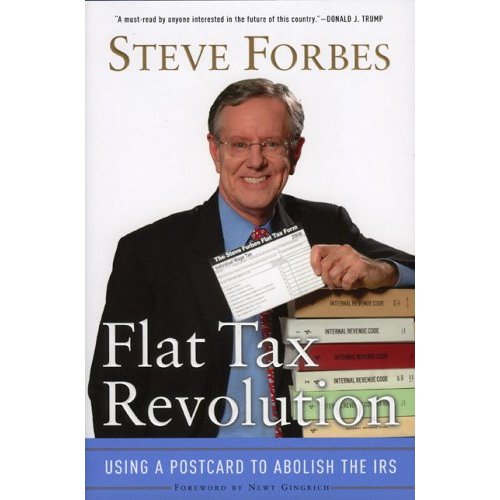
STEVE FORBES: FLAT-TAX REVOLUTION. USING A POSTCARD TO ABOLISH THE IRS


Forbes's masterpiece is a significant work with a lot of helpfully served information. I think everyone who's worried about the future of tax codes should simply read this book.

Flat Tax represents an idea of restoring liberty upon equality. The people who prefer progressive taxes actually prove themselves to be dedicated to the main idea pinned down in Communist Manifesto written by Marx and Engles. They entitled progressive taxation as the basic idea of communist society. There's a never-ending list of "yes" for the adoption of a single, competitive and fair flat tax. The main reasons are growth and simplicity. Economically, the argument of simplicity works perfectly since the margin of administrative costs falls down respectively. In fact, taxes are the main determinant of variability in productive behavior. Higher taxes mean less capital inflows which could be translated into high drop-out rate of new jobs. In fact, policymakers in socialist countries such as Sweden, France, Germany, Slovenia and Italy strongly underpin their uprising for "poor". Bullshit. Do you know that current economic growth in China pulls a million people from poverty a month? Do you know that Slovakia, after adopting the flat tax in 2004, almost trippled its GDP compared to its situation in 1993 when the country launched institutional restructuring towards market economy and property right protection. Do you know that Estonia after adopting a single marginal flat tax rate has been constantly considered "economically completely free" country? Estonia's remarkable achievement of transition was its shifting towards free market economy. Once the "sick edge of Baltics" is now, according to State Department, one of the most competitive countries in European Union in terms of efficiency and performance. Do you know that Hong Kong has been serially treated as No.1 place of economic freedom? The main ingredient of this success was definitely its flat tax system that boosted productive behavior and invited investors from all around the world to invest in Hong Kong. Another reason for simple and effective flat tax is the security of our financial resources. Privatizing social security and health care is just one chapter of this competitive potential. State-subsidized welfare programs of health care and social security are nothing else but a "big joke" that cheats millions of taxpayers who don't receive a credible commitment that their money contributed to the "national health care scheme" will be spent rationally and effectively. Shifting towards private accounts for social security would definitely turn out in an increase of wealth since yields of market investment funds raise impressively. This would result in a free choice of selecting where to put your money in order to be returned in higher value respectively. And finally, tax returns would be filled out on a simple postcard-sized paper. This would mean that you will no longer have to rent tax advisers and tax specialists. The only you'll have to do is to fill out a simple form in a matter of minutes. As simple as that!

If you want to hear more about flat tax than read Forbes's Masterpiece. Click here or here.

DEMS AND BLACKS

Who should Blacks vote when it comes to election deadline.
Democrats or Republicans?

Read Thomas Sowell's column from the latest edition of Townhall
here and find the answer.

But here're some of definitely the most undeniable facts:

1. Most blacks are working people and taxpayers
who do not benefit from welfare programs of from affirmative actions.

2. Blacks are more likely to gain from vouchers pulling them out of the trash called
"public schools". Vouchers would provide them a decent education in a decent place.

3. Gun control makes no sense. In the most criminal neighborhoods, criminal have access to nearly every piece of the most dangerous weapon.
Gun control would pull the potential victims in a very negative position by preventing them from being unable to defend themselves and stand against criminals.
Incidentally, most uses of guns in self-defense do not even involve pulling the trigger.
Once you pull a gun on someone who is threatening to assault you, he is likely to have a very sudden change of plans and head elsewhere.
In communities where most people are known to have guns in their homes, burglaries are rare and violent crime rates are low.
Guns deter as well as defend.The laws of gun control do not actually control guns but protect the criminals respectively.

4. Perhaps even more bizzare ideas is hidden in the thing called "social engineering programs" namely used in Scandinavia (Sweden) and other empires of socialism, including Slovenia. The programs are claiming to be about "drug prevention" or "decision-making" or some other innocuous-sounding name. The idea is that each child should make up his own morality. A more stupid or more dangerous idea could not have taken root anywhere but in a school of education.

5. Self-Defence is a human right and let it be treated that way.

6. Let me cite the words once said by a man "wisdom-of-the-mind" Ronald Reagan: "Government is not the solution to the problem, government is the problem". Finally, Democrats are not the solution to the problem, they are the core of the problem itself.

Monday, July 17, 2006

INFORMATION TECHNOLOGY AND GROWTH

The rapid diffusion of information technology (IT) is a direct consequence of the swift decline in the price of computer-related equipment, which has led to a vast and continuing substitution of IT equipment for other forms of capital and labor. This substitution generates substantial returns for the economic agents who undertake IT investments and restructure their activities in order to increase the role of IT. There is little evidence, however, that substitution is accompanied by technical change as this term is used by economists. While this appears highly paradoxical to technologists who think of substitution of a more IT-intensive mode of production for a less IT-intensive mode as a change in technology, it is entirely consistent with the economic framework developed by Robert M. Solow (1957).

DR. LJUBO SIRC: THE ESSENTIAL QUESTION IS HOW TO INVIGORATE SPONTANEOUS ENTREPRENEURSHIP"

Rado Pezdir has made an interview with Ljubo Sirc, PhD. Click here and read this outstanding interview where Ljubo Sirc speaks about his academic work in Great Britain. He also speaks how difficult it really was to meet face2face with crazy ideas of socialist economic thought and continually catastrophic supporters of socialism's destructive economic philosophy.

"Of course trade unions claim higher wages, but the only way to get them is to work productively. Instead of doing everything possible to improve our productivity, which would be resulted in higher wages, trade unions insist on a deadline without imposing any credible changes . And there's no growth without changes because growth itself requires flexibility. Rapid growth and productivity result wealthier quantity of production goods. If the quantity is too high, then a portion of production factors needs to be replaced into other production. Thereby we say that the elasticity of demand is too low. The onward consequence is that not everyone can be guaranteed for having the same job in the same area of experty ever after."

Ljubo Sirc, PhD

Wednesday, July 05, 2006

THE MARGARET THATCHER CENTER FOR FREEDOM


The MTCF contains numerous papers concerning the future of Anglo-American relationship in terms of cooperation and leadership in the world dedicated to advancing the vision and ideals of Lady Thatcher.

Click here or the picture above in order to access to the website.

Disclaimer: The Margaret Thatcher Center for Freedom was instituted by Heritage Foundation

Tuesday, July 04, 2006

THE 4th OF JULY - CONGRATULATIONS AMERICANS!

"But when a long train of abuses and usurpations, pursuing invariably the same Object evinces a design to reduce them under absolute Despotism, it is their right, it is their duty, to throw off such Government, and to provide new Guards for their future security."
--The Declaration of Independence


"We hold these truths to be self-evident, that all men are created equal, that they are endowed by their Creator with certain unalienable Rights, that among these are Life, Liberty, and the pursuit of Happiness.—That to secure these rights, Governments are instituted among Men, deriving their just powers from the consent of the governed,—That whenever any Form of Government becomes destructive of these ends, it is the Right of the People to alter or to abolish it, and to institute new Government, laying its foundation on such principles and organizing its powers in such form, as to them shall seem most likely to effect their Safety and Happiness. Prudence, indeed, will dictate that Governments long established should not be changed for light and transient causes; and accordingly all experience hath shown, that mankind are more disposed to suffer, while evils are sufferable, than to right themselves by abolishing the forms to which they are accustomed."

-- The Declaration of Independence


Evening's Apple Pie:

The "Top 7" collection of inseparable bits of wisdom and assorted remarks related to American Founding Fathers

"Each individual of the society has a right to be protected by it in the enjoyment of his life, liberty, and property, according to standing laws. He is obliged, consequently, to contribute his share to the expense of this protection; and to give his personal service, or an equivalent, when necessary. But no part of the property of any individual can, with justice, be taken from him, or applied to public uses, without his own consent, or that of the representative body of the people. In fine, the people of this commonwealth are not controllable by any other laws than those to which their constitutional representative body have given their consent.


John Adams


"I am for doing good to the poor, but I differ in opinion of the means. I think the best way of doing good to the poor, is not making them easy in poverty, but leading or driving them out of it. In my youth I traveled much, and I observed in different countries, that the more public provisions were made for the poor, the less they provided for themselves, and of course became poorer. And, on the contrary, the less was done for them, the more they did for themselves, and became richer.

Benjamin Franklin, On the Price of Corn and Management of the Poor, November 1766


"Experience is the oracle of truth; and where its responses are unequivocal, they ought to be conclusive and sacred."

Alexander Hamilton, Federalist No. 20, December 11, 1787


"Men of energy of character must have enemies; because there are two sides to every question, and taking one with decision, and acting on it with effect, those who take the other will of course be hostile in proportion as they feel that effect.

Thomas Jefferson, December 21, 1817


"As the cool and deliberate sense of the community ought in all governments, and actually will in all free governments ultimately prevail over the views of its rulers; so there are particular moments in public affairs, when the people stimulated by some irregular passion, or some illicit advantage, or misled by the artful misrepresentations of interested men, may call for measures which they themselves will afterwards be the most ready to lament and condemn. In these critical moments, how salutary will be the interference of some temperate and respectable body of citizens, in order to check the misguided career, and to suspend the blow mediated by the people against themselves, until reason, justice and truth, can regain their authority over the public mind?

James Madison, Federalist No. 63, 1788

"This new world hath been the asylum for the persecuted lovers of civil and religious liberty from every part of Europe. Hither have they fled, not from the tender embraces of the mother, but from the cruelty of the monster; and it is so far true of England, that the same tyranny which drove the first emigrants from home, pursues their descendants still. Tyranny, like hell, is not easily conquered; yet we have this consolation with us, that the harder the conflict, the more glorious the triumph."

Thomas Paine, Common Sense, 1776


"The value of liberty was thus enhanced in our estimation by the difficulty of its attainment, and the worth of characters appreciated by the trial of adversity.

George Washington, letter to the people of South Carolina, Circa 1790

Monday, July 03, 2006

THE GLOBALIST

The Globalist

STAND UP FOR THE CHAMPIONS: A GLOBALIST MANIFESTO FOR PUBLIC POLICY

A global positive feedback towards prosperous paths of liberlization, privatization and globalisation has produced incredibly successful economic benefit. Liberlization has had its shortcomings, but there's a new emergence of extremely dangerous substantial threats to future progress, growth and prosperity, including an antiglobalization backlash. A famous French philosopher J.Revel has written that in essence, antiglobalism equals exactly the same amount of familiar hostility as antiamericanism. Both entities are merely the same. Continuing progress depends on strenght, requiring an ability to construct clear vision that is offered by positive feedbacks of globalization, privatization and liberalization. Aside from global liberalization, continuingly growing progress demands the establishment of institutions which can help realize the vision mentioned above. Reversing globalization would harm the worlds poorest inhabitants.

Charles W. Calomiris from American Enterprise Institute in his latest book A Globalist Manifesto for Public Policy offers brief but astonishing analysis about how the empirical examination of marvellous trends of globalization substantially contributes to substantial economic benefits that build a bridge of enhencement to prosperity, free society and unparralled economic growth.


Charles W. Calomiris is the Arthur F. Burns Scholar in Economics at American Enterprise Institute

1.000

Sunday, July 02, 2006

JUST A SMALL NOTICE

After having received a few signals of warning about the impossibility of sending comments on postings which are being published on my Blog (http://rspruk.blogspot.com), I hereby inform you all, that those moderations have been changed and the restrictions on posting comments have been removed respectively. In sum, now everyone no matter of his/her status can post comments on postings published.

Saturday, July 01, 2006

MILTON FRIEDMAN: INFLATION AND UNEMPLOYMENT

Click the picture below and read Nobel Memorial Lecture by Milton Friedman, dated on December 13, 1976


"Government policy about inflation and unemployment has been at the center
of political controversy. Ideological war has raged over these matters. Yet the
drastic change that has occurred in economic theory has not been a result of
ideological warfare. It has not resulted from divergent political beliefs or aims
It has responded almost entirely to the force of events: brute experience
proved far more potent than the strongest of political or ideological preferences..."

--Milton Friedman

Thursday, June 29, 2006

MARGARET THATCHER: EXCERPTS FROM "SALUTE TO RONALD REAGAN"


"I note President Reagan, from one of your books, that in 1987 you heard one presidential candidate say that what this country needed was a president for the '90s. You were set to run again, because you thought he said a president in his 90s and you were (inaudible)."


"Sir, you strode into our midst at a time when America needed you most. This great country had been through a period of national malaise bereft of any sense of moral direction. Through it all, throughout eight of the fastest moving years in memory, you were unflappable and unyielding."

"You brushed off the jibes and jabs of your jealous critics. With that Irish twinkle and that easy homespun style, which never changed, you brought a new assurance to America. You were not only America's President -- important as that is -- you were a great leader. In a time of average men, you stood taller than anyone else."


"With a toughness unseen for a long time, you stood face-to-face with the evil empire. And, with an unexpected diplomacy which confused your foes -- and even some of your friends -- you reached out to that empire, perhaps no longer evil, but still formidable. You met its leaders on their turf, but on your terms."

"In a time of politicians, you proved yourself a statesman. And that leadership, that faith in freedom and enterprise brought about a renewal of this great country. America was back and the free world became a safer place."

"It was not only that you were the Great Communicator -- and you were the greatest -- but that you had a message to communicate."

"The message that had inspired the founding fathers, the message that has guided this nation from its birth -- the essence of good government is to blend the wisdom of the ages with the circumstances of contemporary times -- that is what you did. Not since Lincoln, or Winston Churchill in Britain, has there been a President who has so understood the power of words to uplift and to inspire."

"You reached beyond partisanship to principles, beyond our own selves to our very souls. You reached for and touched, as Lincoln had said so long before you, the better angels of our nature. Leadership is more than budgets and balance sheets. More than the policy of public measures, it is a matter of moral purpose. And that moral realm is reached by that insight and rhetoric of which only the truly great are capable."

"In 1969, as Governor of California, you spoke at Eisenhower College. It was a terrible time of student rebellion, of violence against property, violence against fellow students and violence against others on the campus. "How and when did all this begin?", you asked. "It began," you said, "the first time someone old enough to know better declared it was no crime to break the law in the name of social protest. It began with those, who in the name of change or progress, decided they could strap all the time- tested wisdom man has accumulated in his climb from the swamp to the stars." And I particularly like the next bit. "


"And my second choice arises because we are coming to the 50th anniversary of the D-Day Normandy landings -- the Longest Day, the day we dare not lose the battle. Let us recall what you said on the 40th anniversary on those beaches, for no one else could say it better.
You said, "Those men of Normandy had faith that what they were doing was right, faith that they fought for all humanity, faith that a just God would grant them mercy on this beachhead or on the next. The Americans who fought here that morning," you continued, "knew word of the invasion was spreading through the darkness back home. They felt in their hearts that in Georgia they were filling the churches at 4:00 a.m. in the morning. In Kansas they were kneeling on their porches and praying, and in Philadelphia they were ringing the Liberty Bell. And they knew that God was an ally in this great cause. That night General Ridgeway was listening in the darkness for the promise God made to Joshua; 'I will not fail thee, nor forsake thee'." And you said "Let us continue to stand for the ideals for which they lived and died. We will always remember. We will always be proud."


"Ron, I think that was your greatest speech. "

"Like Winston Churchill, you made words fight like soldiers and lifted the spirit of the nation
And my third one, also a favorite, which was seen the world over, was the terrible Challenger space shuttle disaster. You knew immediately, with that unfailing instinct, that the tragedy needed a national voice to share the mourning, to comfort and yet to say, "The quest must go on." You were on television within hours. And I remember so well you spoke especially to the school children who had been watching. You said "I know it is hard to understand, but sometimes painful things like this happen. It's all part of the process of exploration and discovery. The future doesn't belong to the faint-hearted. It belongs to the brave. The Challenger crew is pulling us into the future. And we'll continue to follow them." And, of course, America did, as we saw today. "


"You always had the right words, and we honor you for it. "


"There were so many other speeches, some prophetic, some humorous, but all with a vision, all which inspired. We could identify with each and every one. More than anyone else, you knew peoples' desire to be attached to some cause greater than themselves. "

"So, instead of inundating the American people with the torrent of projections and percentages, you spoke of the voluntary spirit of community and charity. "

"When others spoke of the fear of war, you spoke of the need for warriors and peace through strength. When others bewailed the failure of big government to provide for the collective good, you spoke of self-reliance, of personal responsibility, of individual pride and integrity. When others demanded compromise -- when other demanded compromise, you, Ronald Reagan, preached conviction."

FINNISH EU LEADERSHIP - A SHAMEFUL INTRODUCTION

Finland already has power to hike its own alchohol taxes but ever since there are about to takeover the position of EU Leadership, they want higher alchohol taxes in every EU nation to prevent Finns from making purchases where taxes are less oppressive. Curbing alchoholism is not a matter of the government but rather the matter of every individual who is accountable for what he does, so why shouldn't Finnish policymakers expell their miserable suggestions and finally let everyone on this statist European continent of socialism, to be able to realize one of his/her very basic and inalienable right - FREE CHOICE!

Read about the topic discussed above here.

THERE'S NOTHING WRONG WITH A TRADE DEFICIT

Read Alan Reynolds's effective explanation which correctly points out that trade deficits are a sign of economic strength, since it means that a nation gas a growing economy and that foreigners find it a good place to invest.

"The Economist's survey of world forecasters estimates the current account deficit will reach 7.3 percent of GDP in Spain this year and 5.6 percent of GDP in Australia. I think the U.S. current account deficit will be about 6.5 percent, the flip side of which means that 6.5 percent of GDP measures the difference between foreign investment rushing into the United States minus the amount of U.S. investment flowing abroad. We have a large capital surplus, otherwise known as a current account deficit.
What do countries with large capital account surpluses have in common? Economic growth over the past year was 3.1 percent in Australia, 3.5 percent in Spain and 3.6 percent in the United States. The expected current account deficit is smaller in the United Kingdom (2.7 percent), yet British economic growth is also slower (2.2 percent). India's current account deficit is running about 2.5 percent of GDP. By contrast, Germany has a perpetual current account surplus and a pathetic economic growth rate that has long been stuck close to 1 percent..."


Read more on Market Center Blog at CENTER FOR FREEDOM AND PROSPERITY

Wednesday, June 28, 2006

MERCER'S SURVEY: THE WORLD'S MOST EXPENSIVE CITIES 2006

Click here and view the latest Mercer's Survey which covers the research of where is the most expensive place in the world.

Here're some of the most fascinating results:

1. Moscow has taken the lead of world's most expensive city.

2. London has moved downward and is not anymore recognized as the world's most expensive city.

3. According to EIU Survery, ten the most expensive cities in the World are the following ones: (1) Oslo, (2) Tokyo, (3) Reykjavik, (4) Osaka, (5) Paris, (6) Copenhagen, (7) London, (8) Zurich, (9) Geneva, (10) Helsinki

4. Click here and check the richest cities in the world (UBS Survery)

5. Click here and see the top 10 European Business Cities

6. Click here and view the most expensive shopping streets in Europe and in Americas

7. Click here and see the 50 most literate cities in the U.S. The results are quite surprising

8. Click here and check-up the latest "up-to-date" reports concerning the situations of health care, education, business, economics, finance, sport, transport and of course TOURISM!

Monday, June 26, 2006

THUMBS UP!

Read "The Road from Serfdom" where Friedrich August von Hayek is being interviewed by Thomas W. Hazlett

Sunday, June 18, 2006

DE GUSTIBUS NON EST DISPUTANDUM: WHO ARE THE ENEMIES OF OPEN MARKET SOCIETY

"What hadn't been realized in the literature until now is that merely to describe how severely something has been tested in the past itself embodies inductive assumptions, even as a statement about the past."
ROBERT NOZICK

After having overcome relative transitional progress it seems invariable that the numbers of those who fearfully reject the idea of open society and send fanatical shocks to those who advocate the very fruitful idea of open society. The roots of opposition to open society lies in the most anti-American country nowadays, namely France and it spreads like a disease through the signals of those who Karl Popper named them “the enemies of open society”.

Open Society is about prosperity and progress. Its idea is the idea of happiness being achieved through openness and productive behavior, rewarding risk, work and entrepreneurship as the main point of productive behavior respectively. The most giant source of opposition to open society is so called “wordsmith” intellectualism and it is mainly outsourced by those who pretend to be highly important persons in every-day life. Those wordsmiths include poets, novelists, literary critics, newspaper and magazine journalists, and many professors.

In fact those wordsmiths have wages above average. They fare well in capitalist society. In fact, the opposition to capitalist society is a social significance. Intellectual wordsmiths sends wave of how to behave and how to express ourselves. Their proposals are mostly counter-productive. Following the reasonable sentence each individual is guided through the invisible hand, guiding him through the market in order to help him pursuing his or her interest enabling prosperity and long-term happiness. However, intellectuals and other enemies of open society are afraid of progress and its increase. By and large, each wordsmith intellectual is afraid of success of the other because the value of anti-capitalist intellectual would have been laid-down. That’s how propelling towards anti-capitalism and expressing extremely activist thoughts against it factually depends on other forces pushing the enemies of open society on the edge of despair where anti-capitalistic views are the only tool left in order to boost the promotion of fearful hostility towards those who are more successful and are being pointed out as exploiting people (Americans, Capitalists, Jews,…).

As normal and hard-working people are heading towards progress, wordsmith intellectuals use the only lethal weapon left in order to keep trying to put them down. This very commonly used weapon is so called “neoliberalism” used by the Soviet satellites. Progress is what you gain from hard-work, risk, self-initiative and entrepreneurial actions, penetrating into the information asymmetry and choosing the best maybe for today’s less but inevitably for tomorrow’s more. However, “wordsmith” enemies of open society dislike “productive initiative” and their way to stop it is to try to cause disorder of information. The latter is entailed within the wordsmith argument of “social state”, “social ethics, “social whatever”… But as FA Hayek correctly emphasized facing arguments and instantly using the word social means to avoid personal responsibility and transfigure it onto something what is actually unknown to everybody. Intellectuals now expect to be the most highly valued people in a society, those with the most prestige and power, those with the greatest rewards. Intellectuals feel entitled to this. Agreeably, intellectuals have been expressing enviousness instantly to those who achieved the truest value of prosperity which seems unreachable to wordsmith intellectuals. Instead, intellectuals rather humble those who advocate free choice and use its function in order to prosper tomorrow and become rich by inserting the human capital where it yields the most profitable returns. Wordsmith intellectuals however don’t seem to be in favor of this. Successful capitalists, inventors and businessmen are pointed out as the main enemies of welfare, as the source of exploitation.

The reason for this very unfavorable hostility is that wordsmiths are simply captured “somewhere in the middle of nowhere”. They don’t understand the trade and don’t know how to explain the measure of relative value together with marginal utility which makes them impossible to understand what Hayek called “an expanded order”.

Wordsmith intellectuals, as the main advocates of “explicit socialism”, are captured within the essence of wrong and harmful definition of individual. Their definition of the latter is to be highly active and completely dedicated to the idea of cherishing his choice and eliminating his shiningly flattering career in order to contribute as much power as possible to community.

In the mentality of socialists and collectivists each prosperous individual has been treated negatively, as an enemy and exploiter, just because his race for profit has enabled welfare to thousand and let them into the fortune of middle class income earners. Wordsmith intellectuals build their defense by penetrating where it’s possible to send waves of anti-capitalism and anti-Americanism because their defective way of thinking seeks channels of propaganda and thus “successfully” implements the lessons of Lenin, their most probable source of philosophical inspiration. It is not surprising that in many Western and few Eastern countries media are keep frightening people about progress and liberal economic reforms (i.e. flat tax). Those sheltered signals are the product of pure anti-capitalist mentality and leftist propaganda whose weapon against Reason, courage and challenge is media and especially daily newspapers where we can see what kind of miserable “shits” are possible to be written by those who are completely unaware of some basic principles of Economics.

Who knows, perhaps one the most masterful macroeconomists, Gregory Mankiw could start teaching them some basic definitions and laws of Economics.

Another possibly the most probable, much more elementary source of anti-Capitalism and extreme hostility towards the creature of competitive, successful and encouraged individuals is the school system. There, wordsmith intellectuals have succeeded on nearly every front and send anti-capitalistically inspired youth on the market where their “social significance” is recognized in a complete unawareness of productive behavior which could boost their unused grain of power and help them becoming the leaders of tomorrow. The (future) wordsmith intellectuals are successful within the formal, official social system of the schools, wherein the relevant rewards are distributed by the central authority of the teacher. The schools contain another informal social system within classrooms, hallways, and schoolyards, wherein rewards are distributed not by central direction but spontaneously at the pleasure and whim of schoolmates. Here the intellectuals do less well.

It is not surprising, therefore, that distribution of goods and rewards via a centrally organized distributional mechanism later strikes intellectuals as more appropriate than the "anarchy and chaos" of the marketplace. For distribution in a centrally planned socialist society stands to distribution in a capitalist society as distribution by the teacher stands to distribution by the schoolyard and hallway.

Beside promoting income equality and telling capitalists, economists, businessmen and free marketers exploiters makes wordsmiths a firm grounding of ideological fire, holding strongly against the efforts of economic progress and defining market as chaos.

Public schools are in general the opposition to private property itself. Wordsmith intellectuals seem to be the most fanatical defenders of anti-Americanism, hiding behind the curtain of “human rights”. Neosocialism’s defective way of thinking has poured into nearly every channeled area of life. The ideas sound fairly well in practice and extend from feminism, environmental protection and the defense of human rights. But when you uncover the shield you discover the unthinkable – a dirty mud of hostility towards everything what is more successful and continues to prosper accordingly.

The world of wordsmith intellectuals is actually a fairytale world of hopelessness, uncompetitiveness and fearfully hostile anti-capitalistic mentality wherein “literary critics” and sometimes even amusingly funny “novelists” produce their very special forcible thoughts of development puzzled into a phenomena called “anti-Capitalism”.

“There are no such things as limits to growth, because there are no limits on the human capacity for intelligence, imagination and wonder.”
RONALD REAGAN


The opposition to free market society, competitive advantage, productive behavior, encouraged challenge of creating positively unthinkable achievements, competitive entrepreneurship, risk taking, progress and going for growth are only the fractions being a great target for wordsmith intellectuals in order to shoot them and penalize them for being successful, prosperous and challengingly encouraged to go forward. Helpfully recommended is to not listen to them and ask what you can do for you for today’s less in order to achieve comprehensive tomorrow’s more.

Disclaimer: Together with libertarec.blogspot.com, Capitalism & Freedom is a newly-joint member of Freemasonic-Zionistic-Libertarian conspiracy for destroying Alpine paradise of public economic well-being for pensioners and public privileges of wordsmith intellectuals penetrated into the channels of public rent-seeking.


Literature

Annelise Anderson, Martin Anderson and Ronald Reagan: Reagan in His Own Hand. The Writings of Ronald Reagan that Reveal His Revolutionary Vision for America, Free Press, 2001
http://www.amazon.com/gp/product/074320123X/104-9966621-4914341?v=glance&n=283155

Milton Friedman, Capitalism and Freedom, Chicago University Press, 1972
http://www.press.uchicago.edu/cgi-bin/hfs.cgi/00/15395.ctl

Friedrich August von Hayek, Fatal Conceit: Errors of Socialism, Chicago University Press, 1988
http://www.amazon.com/gp/product/0226320669/104-9966621-4914341?v=glance&n=283155

Ludwig von Mises, Anti-Capitalistic Mentality, Libertarian Press, 1972
http://libertarec.blogspot.com/anticap.pdf

Gregory Mankiw, Teaching Principles of Economics, Eastern Economic Journal, 1998

Robert Nozick, Why Do Intelectuals Oppose Capitalism, CATO Policy Report, 1998
http://www.cato.org/pubs/policy_report/cpr-20n1-1.html

Alexander Marriot, The Limitations of Marxist Approach to Writing History, Capitalism Magazine, 2005
http://www.capmag.com/article.asp?ID=4512

Sean Hannity, Deliver us from Evil. Defeating Terrorism, Despotism…, Reagan Books, 2004
http://www.amazon.com/gp/product/0060582510/104-9966621-4914341?v=glance&n=283155

Tuesday, June 13, 2006

CAPITALISM - MAKE A WISH IN EVERY PROSPEROUS FOUNTAIN!

"There is no such thing as society."
MARGARET H. THATHCER


"Then the dean understood what had puzzled him in Roark's manner.
"You know," he said, "you would sound much more convincing if you spoke as if you cared whether I agreed with you or not."
"That's true," said Roark. "I don't care whether you agree with me or not." He said it so simply that it did not sound offensive, it sounded like the statement of a fact which he noticed, puzzled, for the first time.
"You don't care what others think - which might be understandable. But you don't care even to make them think as you do?"
"No."
"But that's... that's monstrous."
"Is it? Probably, I couldn't say."
AYN RAND, The Fountainhead

INDIA: AN OPPORTUNITY FOR REAL-ESTATE INVESTMENT AFTER LIBERALIZING THE INVESTMENT RULES

Over the past decade, India has valuted from an also-ran to a leader in global economy. It is becoming an attractive magnet to foreign investment. Its presence in India remarkably outshines the global average. The increase in foreign investment, more competitive joint ventures between Indian and foreign companies and a gigantic growth of Indian domestic economy have create an uprising employment opportunities on Indian market for Indian young, proferssional, highly skilled and middle-classed workforce. With more disposable income workers are spending more on consumer goods and services and especially BUYING HOMES!
Click here in order to connect to one of Ernst&Youngs' latest reports on Indian "real estate" FDI and the liberalization of the investment rules. The file is downloadable!

Tuesday, June 06, 2006

CONGRATULATIONS - CAPITALISM DAY - 6th OF JUNE - LETS' CELEBRATE LAISSEZ FAIRE


"Education is the best provision for the journey to old age."
ARISTOTLE


"The improvement of understanding is for two ends: first, our own increase of knowledge; secondly, to enable us to deliver that knowledge to others."
JOHN LOCKE


"It is the maxim of every prudent master of a family, never to attempt to make at home what it will cost him more to make than to buy...What is prudence in the conduct of every private family, can scarce be folly in that of a great kingdom. If a foreign country can supply us with a commodity cheaper than we ourselves can make it, better buy it of them with some part of the produce of our own industry, employed in a way in which we have some advantage."
ADAM SMITH


"The tree of liberty must be refreshed from time to time with the blood of patriots and tyrants. It is its natural manure."
THOMAS JEFFERSON


"They will come to learn in the end, at their own expense, that it is better to endure competition for rich customers than to be invested with monopoly over impoverished customers. The state is the great fictitious entity by which everyone seeks to live at the expense of everyone else."
FREDERIC BASTIAT


"Individualism resulted in the fall of autocratic government, the establishment of democracy, the evolution of capitalism, technical improvements, and an unprecedented rise in standards of living. It substituted enlightenment for old superstitions, scientific methods of research for inveterate prejudices."
LUDWIG von MISES


"The moral justification of capitalism does not lie in the altruist claim that it represents the best way to achieve the “common good”. It is true that capitalism does—if that catch-phrase has any meaning—but this is merely a secondary consequence. The moral justification of capitalism lies in the fact that it is the only system consonant with mans rational nature, that it protects mans survival qua man, and that its ruling principle is: justice."
AYN RAND