Monday, October 30, 2006
SAXO BANK GOES INTO THE FLOW OF FREE TRADING
Recently announced, Danish investment bank Saxo will abolish the minimum ticket fee and percentage commission on Danish stocks. Saxo will therefore become the very first Scandinavian bank to approach to zero-commission online share trading. Improving the financial conditions for shareholders and online traders is definitely one of the key features to gain success along global benefits of free online trading, increased competition and better efficiency among customers in online trading. Global market as a whole is generally headed toward increasingly smaller commissions. According to Christopher Noon from Forbes, Saxo's zero-commission trading extends offer to retail clients as well as new clients with a minimum account balance of 50,000 Danish Krone ($8,393). These clients can trade online with zero-commission up to 50 times a month on the Danish stock market. Saxo's Vice Chief Executive is not expecting to take away business from traditional online traders such as E*Trade, IFX Markets, Charles Schwab and StockTrade. According to his words, only 10% to 20% of e-trade business actually comes from equity trading. Saxo's furtherized ambitious agenda also includes plans to access of the its initiative before exporting the idea across borders.


Friday, October 27, 2006
Monday, October 23, 2006
SETTING THE STAGE TO SOAR FUTURE ECONOMIC GROWTH
It seems that U.S. Congress is captured by an unwillingness when it comes to shift from social security programs to ownership-based retirement programs. U.S. Congress actually made a huge failure due to permanently maintain tax reforms that would eliminate the death tax and cut marginal tax rates on capital gains and dividends. In the U.S., the economic growth has been higher for most of the decades than it was overseas. But also editorial pages have been enriched with the words from Milton Friedman and other Chicago guys. They firmly set the intelectual foundation for an economic policy based on low taxation, market competition and individual ownership. However, today you won't find those words written in English. Instead they are printed in Estonian, Hindi and Spanish as well as in other languages where policy-makers decided to shift the wheel of economic policy towards the implementation of free-market ideas. They have been, of course, successfully implemented. It was amazing to see how the idea of Private Retirment Accounts (PRA's) exploded in South America. Chilean labor minister Jose Pinera boldly ran the Chicago vision back in 1981 and the results of this encouragement are still seen in Santiago today. Chile's current national saving rate accounts 21 percent of the GDP. Following the Chilean example, at least 30 other nations followed that way, having replaced benefit pension systems with individual ownership and personal control, including countries such as Denmark and Sweden. Former communist nations in Eastern Europe also enacted pro-growth and free-market economic reforms, wathcing their economies setting the path for future economic growth. Simple, dynamic and low-cost flat tax codes encourage people to work more as well as to expand economic activity more rapidly. Recently, Estonia has reached the edge of economic growth soaring over an amazing 10 percent. In the past six and seven years, the rates of economic growth in Baltic countries, including Latvia and Lithuania, averaged 8 percents consistently. Seeing the situation today, more than 9 countries have adopted the flat tax code, including Russia and Romania. Conversely, the U.S. Congress consumes its days. Instead of debating how to cut public consumption rate and improve macroeconomic situation, Congressmen are rather busy with intensive debates on how to impose taxes on energy profits. While America is still the greatest pillar of newly-born ideas, it is not the leader in tax competition anymore. The U.S. federal tax code is grasply written on 66 498 pages, adding $265 billion compliance costs. Currently, the U.S. Government is facing a long-term problem of how to cut unfunded liabilities in retirement systems such as Social Security and Medicare. Those programs amount to $80 trillion. Therefore, work force is facing a shrinking benefits and higher tax rates while Congress still remains unwilling to impose serious reforms to cut those benefits and provide a decent and sustainable way of living to thousands of Americans in the future. Giving workers the right to choose ownership-contribution retirement system would helpfully replace current massive debt, giving individuals real ownership and control would ensure and secure better financial future for each member of the big hub, namely "taxpayers". Continually prolonged retirement systems based upon massive outlays for Social Security and Medicate programs would, on the long term, result in higher tax rates on income and capital gains, higher public debt while economic growth would start to push the economy towards falling off the cliff. The consequences of this way of spending and economic policy-making would be painful for everyone. Rising taxes on labor and capital formation would cause capital flight, economic contraction and high unemployment. As an output of "socialized results of production" there would be no means to boost productivity and create more value-added goods and services in order to create a society based on soaring productivity through hard-work and anticipated innovative behavior. Other nations have prospered from economic policy based on economic freedom. Global financial markets are about to judge the efficiency of economic policy, not flashing cameras around the enemies of progress and development. If policy-makers in countries such as the U.S., Slovenia, Italy, Germany, France and Spain will not undertake serious structural reforms capital and investment will quickly fly to other nations where the ideas of Chicago economists work and where economic freedom coupled with low rates on capital and income taxation soundly works as future prosperity peaks and opportunities flourish.
Thursday, October 19, 2006
SINGAPORE - THE FINANCIAL OASIS
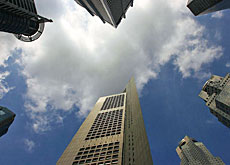 Singapore has made significant economic progress based upon favorable conditions for incoming financial institutions that set-up their assets in small Asian city state such as Singapore. In fact, the economic and financial policy coupled with low corporate tax rates and comparatively modest fiscal burden has created very stable financial environment for incoming capital flows and foreign investors as well. However, Singapore went ahead of other global competitors. Its recent measures were done in order to revitalize the financial marketplace. Policy-makers in a small and highly competitive Asian city decided to furtherly adapt banking secrecy laws, much of its tax and trust policy in a recent drive to reinvest itself. Nowdays, investors in banking industry usually take a closer look at country's secrecy laws, taxation on interest bearing and capital gains and taxation in terms of residency and trust policy. But this is generally speaking not the entire framework of sets of decisions. Investors also pay attention to other general banking measures such as set-ups and set-up speed of banking operation and of course regulation as such. One of the very first measures was to boost banking confidentiality laws by imposing a sentence of $78,000 USD for disclosing information. Singapore has also amended its trust laws to allow incoming foreigners to move away from European state interference which dicatates how inheritance is being carved up. Singapore also completely slashed taxes on profits from foreign investment earned abroad and finally reduced corporate tax burden to attract more dynamic businesses. Singapore has therefore followed the example of many Swiss cantons which also adapted similar measure to foster competitive markets. Unlike in European countries, tax evasion is not a criminal act unless proof of sharp practice is found. Singapore managed to foster more growth by bringing more foreign investors into a small cherry-flavoured Asian tiger. These parts of measures have been very favourable and along with other attractive features, those parts are about to fit the competitiveness of Asian financial markets. Unlike in European countries, in fostering growth and developmental progress, Singapore relied on global financial integration by taking various examples in financial capitals such as London, Tokyo, Sydney, Hong Kong and Zurich. The combinations of measures in each of these examples will result in a higher and more rapid growth of Singapore's and Asian financial markets because businesses itself will be able to rely on sustainable options of crediting and other alternatives to continue an amazing move-up of Singapore's growth of entrepreneurial activity particulary in areas which require strong support from the financial industry. But this is not the end of the story at all. One of the Singapore's main strengths is highly sophisticated infrastructure modelled specifically on creating the ambience in order to invigorate and recreate this small and hopefully Asian peer. One of the foremost infrastructural achievements of Singapore has been converting salt water marina into a fresh water lake. One regulation did not transfer ti Singapore - European saving-tax directive imposed on Switzerland by the European Union. This particulary tax law is levied on Swiss accounts of foreign nationals on behalf of their resident countries to counter tax evasion. However it would be a little bit too soon to expect rapid capital flight from Switzerland to Singapore, emptying from Swiss accounts into Singapore's. Turning the issue to Switzerland, there're definitely some investors who have problems with withholding tax. Will this lead to a major capital flow? Perhaps only a little bit. To make this happen, there should be a big thing that moves the needle. Switzerland will definitely not capture future growth market to the extent that once used to. Swiss banks are still setting-up in Switzerland so the government still benefits through greater revenues as a result of low taxation of corporate income and capital gains.
*The indicators describe three dimensions of investor protection: transparency of transactions (Extent of Disclosure Index), liability for self-dealing (Extent of Director Liability Index), shareholders’ ability to sue officers and directors for misconduct (Ease of Shareholder Suits Index) and Strength of Investor Protection Index. The indexes vary between 0 and 10, with higher values indicating greater disclosure, greater liability of directors, greater powers of shareholders to challenge the transaction, and better investor protection.
Source: World Bank, Doing Business 2006
Wednesday, October 18, 2006
DYNAMIC CAPITALISM
Edmund PHELPS, this year's Nobel Laureate has publish perfectly pin-pointed opinion on the superiority of modern dynamic "laissez faire" capitalism over the so-called social market economy which has primarily taken origins from archaic German and French corporativist models. Institutional protection of interest groups and rent-seekers is now paying the price. Economic growth rates are sluggish, job-creation rarely finds itself productive while international competitiveness of those welfare-based economies (Germany, France, Italy, Slovenia) is falling off the cliff. I recommend you to read the opinion of Edmund Phelps.
"The issues swirling around capitalism today concern the consequences of its dynamism. The main benefit of an innovative economy is commonly said to be a higher level of productivity--and thus higher hourly wages and a higher quality of life. There is a huge element of truth in this belief, no matter how many tens of qualifications might be in order."
- Edmund Phelps
"The issues swirling around capitalism today concern the consequences of its dynamism. The main benefit of an innovative economy is commonly said to be a higher level of productivity--and thus higher hourly wages and a higher quality of life. There is a huge element of truth in this belief, no matter how many tens of qualifications might be in order."
- Edmund Phelps
Friday, October 13, 2006
HONG KONG'S LAISSEZ FAIRE POLICY - TOO GOOD TO LAST?
The story of Hong Kong had been the tale of roaring tiger as a shining example of economic freedom. At the end of World War II, Hong Kong was a dirt-poor island with a per-capita income about one-quarter that of Britain's. When laissez-faire economic policy of positive non-interventionism was adopted, Hong Kong’s territory started to wheel the new era of prosperity and business freedom. Hong Kong began to boom. That was a striking demonstration of the productivity of freedom, of what people can do when they are left free to pursue their own interests. In fact, Hong Kong's remarkable achievement, seen in a rapidly growing economy, benefited its neighboring countries as well. It boosted them to move away from central-planning and move towards the reliance on private enterprise and free-market. As a result, both, Hong Kong and China benefited from rapid economic growth. But Hong Kong's current leader Donald Tsang has recently declared the death of the policy on which the prosperity of small and up-beating tiger had been built.
Milton Friedman, the 1976 Nobel laureate in Economics and the most influential economist of the 20th century bemoans the latest Hong Kong's political shift toward governmental interventionism and statist approach that is forgetting the lessons of the policy that lead Hong Kong toward the miracle of free market. You can read it here.
Milton Friedman, the 1976 Nobel laureate in Economics and the most influential economist of the 20th century bemoans the latest Hong Kong's political shift toward governmental interventionism and statist approach that is forgetting the lessons of the policy that lead Hong Kong toward the miracle of free market. You can read it here.
Monday, October 09, 2006
MASTERING LIBERTARIAN WISDOM
Tomaz has published a great post that gives youthful population very helpful advice about the way of how the youth should look forward to the future. Don't miss that and read the post as quickly as you can.
"Slovenia is a land of contradictions, an Alpine paradise for pensioners with extremely hostile environment to the youth. They are enchained to be forced to pay high progressive taxes that don't take assets into account as well as they're compelled to high prices of real estate. They will sweat longer than current pensioners ever did, they will pay higher social security contributions and at the end they will receive lower pensions. Those who're thrown into the wheel of life without backup basis are only able to create wealth and welfare on their own account respectively. Closer they reach the point of their objectives, more they are pushed to the ground with progressive taxes. The outcome of "socially egalitarian" order is that people spend more time on the workplace and rarely decide to start taking care of themselves as well as they rarely decide to start creating their own families ... And remember, if you're a liberally minded individual living in Slovenia, don't get despaired. Instead, keep on finding the way of how to be liberal within the current system.
"Slovenia is a land of contradictions, an Alpine paradise for pensioners with extremely hostile environment to the youth. They are enchained to be forced to pay high progressive taxes that don't take assets into account as well as they're compelled to high prices of real estate. They will sweat longer than current pensioners ever did, they will pay higher social security contributions and at the end they will receive lower pensions. Those who're thrown into the wheel of life without backup basis are only able to create wealth and welfare on their own account respectively. Closer they reach the point of their objectives, more they are pushed to the ground with progressive taxes. The outcome of "socially egalitarian" order is that people spend more time on the workplace and rarely decide to start taking care of themselves as well as they rarely decide to start creating their own families ... And remember, if you're a liberally minded individual living in Slovenia, don't get despaired. Instead, keep on finding the way of how to be liberal within the current system.
Friday, October 06, 2006
ITALY'S TAX HIKE
It seems Italy's going to plunge into another serious economic downturn by increasing income tax rates. The country is captured by a fairly unstable macroeconomic situation. Public debt (measured as a percentage of GDP) is the highest in the Union. Italian leftist policymakers chose to cut country's 4,2% budget deficit by increasing tax rates instead of cutting spending habits. Although the budget reduces payroll taxes by EUR6bn in 2007 and EUR9bn in 2008, income taxes are raised immediately by EUR33.4bn, mostly through an increase in the top rate of tax from 41% to 43%, and lowering the floor for the top rate from EUR100,000 to EUR75,000. Lower bands are adjusted to favour the less well-off. This amounts to a savage attack on the middle classes, and is presumably exactly the opposite of what needs to be done if Italians' notorious under-declaration of tax is to be brought under control. Prodi announced measures to punish professionals who don't declare all their income; but successive governments have totally failed in this endeavour and there's no reason to think that the new one will be any more successful. It is completely impossible to create economic growth by increasing taxes and uncutting government spending. Italian general economic picture is everything else but favorable. IMD ranked Italy's Competitveness even below its neighbour Slovenia. Foreign investors face enormous restrictions on operations and ownership as well. Economic freedom of Italy is miserable. Together with France, the country's economic freedom has been kicked-off far below the level of the most competitive economies. Fiscal deficit is huge. Labor market amount indispensable rigidies that produce difficult practices of hiring and firing workers. It takes more than 500 hundred days to enforce contracts while venture capital funds are rarely availible. New tax increases proposed by Prodi's government will make this problematic situation even worse off.
Monday, October 02, 2006
Wednesday, September 27, 2006
WORLD ECONOMIC FORUM: GLOBAL COMPETITIVENESS INDEX 2006

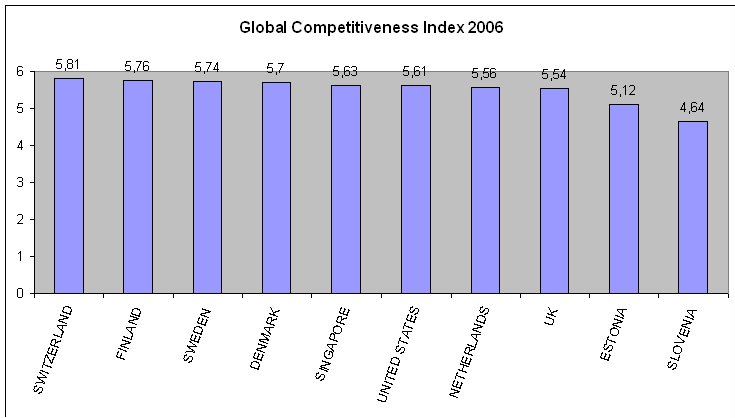
This year's Global Competitiveness Index surprised many economists, managers, researchers, scholars and other people as well. Two years ago nobody could think of Swiss economic tiger on top of the Global Competitiveness Index issued by World Economic Forum.
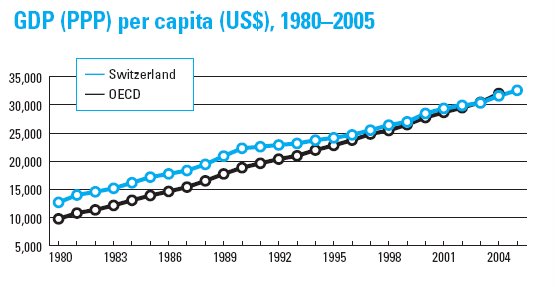
Switzerland is truly the embodiment of the success story. The country has preserved its political neutrality for a long time. Aided by peace and neutrality Switzerland had almost no problems in facing challenges in the global economy. The country's institutional order is very sufficient in terms of protecting everyone's wealth and income when he enters the market. Milton Friedman, Gary Becker and Douglass North have defined solid protection of private property rights as a key element of the economic freedom. Heritage Foundation's Index of Economic Freedom firmly placed Switzerland among the freest economies in the world. Long years of stable politics and stable currency, relatively low taxes, secure financial system and many incentives for incoming investors have made Switzerland an attractive investment destination especially for small manufacturing firms. Larger businesses are internationally highly competitive while agricultural businesses are small and economic policy has insisted on largely protecting them from foriegn competition.
Despite of brilliant innovation performance, Swiss consensus-driven business and political system retard further economic growth. Similar distorsions could be seen in Germany, Italy, Austria and Slovenia. Several years ago, Switzerland has announced its intention to pursue free trade agreement with the United States. We hope that this comes true. Switzerland favors a moderate trade policy, far from being a protectionalist economy. Only restrictive agricultural trade policy is varying aside from this. Nearly all agricultural products are subject to strict import duties and variable quotas. Protectionist agricultural trade policy lowers the level of Swiss economic globalization. Relatively low taxes are an important aspect of producing incentives to acelerate more productive behavior and efforts in order to work, save and invest. Current top cantonal income tax rates is 35% while top cantonal corporate tax rate is equal to 23%.
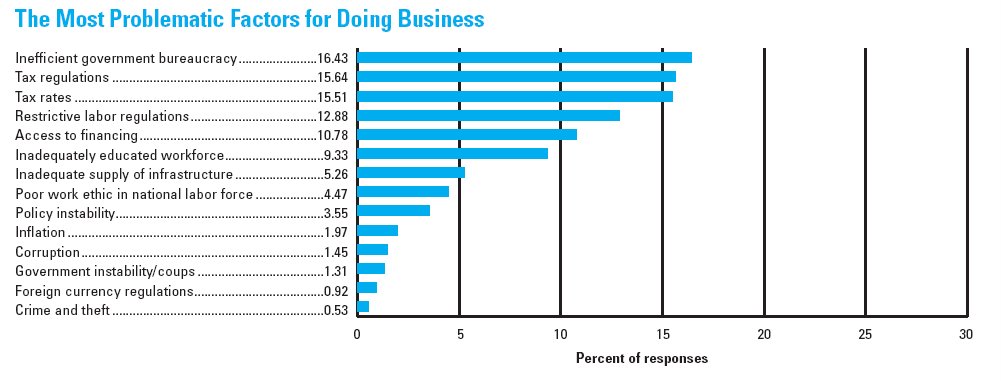
A little bit worrying is unusually high public expediture rate (36% of the GDP) setup by the government. Bernanke, Mishkin, Laubach and Posen (1999) report that Switzerland adopted inflation targeting in December 1974. The desire of the monetary policy was to coordinate the inflation expectations of the public with policy objectives of the central banks. Monetary targeting has been quite flexible in practice. Switzerland announced a point target which arguably doesn't give the public the false impression that money is controllable over a narrow range. At the beginning og 1975 Switzerland was about to enter the worst recession in postwar history. The oil shock had triggered a downturn that must already have been under way. Although the Swiss franc helped to absorb the inflationary impact of the shock, that impact posed a serious threat to the Swiss export sector, which constituted about a third of GNP at the time. During 1975 exports of merchandise fell by 8% in real terms. Moreover, though subdued growth in real wages supported the Bank's fight against acelerated inflation, it also contributed to a sharp decline in real consumption which was worsened by a significant outflow of foreign workers. The money-targeting initiative did nothing to ease the high costs of Switzerland's disinflatio, nor did the Bank suggest that the targeting would provide a coordinating function for wage- and price-setters that would lower that cost. The adoption of a target was intended to cap inflation expectations by indicating a policy commitment and nothing else. Today Switzerland's annual rate of inflation from 1995-2004 is 0,77 percent.
Institutionally, Switzerland may be one of the best protectors of private property rights due to secure contratual agreements and high quality judiciary. According to World Bank, it takes 22 procedures, 215 days to enforce contracts on the whole. The cost of enforcing contracts is 11 percent of the debt which ranks Switzerland on the 9th place according to the flexibility of enforcing contracts. Switzerland is very open to foreign investment with some restrictions on ownership participation in certain sectors as well. Banking system is secure and offers a wide variety of financial products. Approving credits and loans is allocated on market terms. Aside from extensive regulation practices, informal business sector participation rate is among the lowest in the world according to Transparency International.
Components that led Switzerland to the top of Global Competitiveness Index were performed successfully. Infrastructure is one of the most sophisticated in the world. It presents one of the foremost requirements for good conditions in order to pursue economic growth and long-term economic development. Macroeconomic picture is a little bit off the anchor but macroeconomic forecasts for the future predict improvement in that way. Higher Education and training institutions offer excellent education opportunities while the cooperation between universities and economy returns profitably and produces excellent output in terms of knowledgeable achivements. Market efficiency and efficiency enhancers successfully derive the problem of business sophistication, as well as of technological readiness.
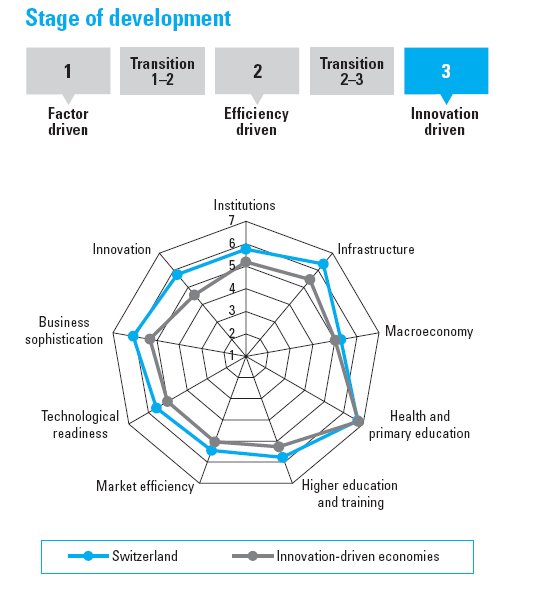
Other countries showed randomly mixed performance. Traditionally competitive Nordic economies scored very well. Sweden and Finland topped right behind Switzerland. The main drivers of Nordic formula for success are a very sound financial system, strong protection of private property rights, quickly enforced contracts, high R&D expeditures, excellent education system, technological readiness and above-averaged rate of market efficiency and other efficiency enhancers.
Read more:
WEF, Global Competitiveness Index 2006,
Forbes, Global Competitiveness Rankings,
Forbes, The World's Most Competitive Countries 2006,
International Investing Guide
Friday, September 22, 2006
SWEDEN: MAKING ROOM FOR IMPROVEMENT IN ECONOMIC PERFORMANCE

The victory by Sweden's Conservative coalition in the September 17 general election was its first since 1991, and as the outcome became clear on a crisp fall night, it triggered ecstatic celebrations. Young people even stripped off their clothes and cavorted in the fountain at Sergels Torg, the gritty center of Stockholm.
Radical economic reforms are inevitable for Sweden. Free-market policies based on the continually-adjusted improvement for pro-business incentives will likely be the main platform for chargining up already strong economic growth (4,2% of GDP). Business sector needs to be free of rigid regulation in order to be more flexible in terms of faster hiring and firing of productive workers. If new promises are kept then small and medium-sized enterprises will be in for a better and freer ride in the future. Long-term prospects of economic growth should also get boost but it's quite impossible to say how much.
One of the most paramount concerns of current Swedish economic picture is very high unemployment. Officially its rate is equal to 5% but other resources are saything that actual Swedish unemployment is about 7,5% of the capable working force. Other sources are counting Swedish unemployment above 10%. By cutting taxes, employers pay wages to employees and trimming high incomes employers face difficulties in hiring the most productive participants in the labor market since employers are facing heavy burden with gradually imposed income tax rates on those labor force whose contribution to progress and change in dynamic environment is essential to dynamic business and growing economy as well.
Sweden should immediately cut some of very irrelevant elements of welfare state. Taxes on luxury should be immediately dismissed in order to encourge dynamic and productive entrepreneurship that will evaluate agendas for strong global growth. Swedish tax system is definitely one of the foremost disincentives to save, work and invest. Current Swedish system is geared toward stopping wealth instead of stopping poverty. In the 20th century Sweden succeeded in terms of strong economic growth and remarkable level of economic freedom. This enabled strong growth upon creating wealth. After Sweden was getting richer, it was more capable for spreading strong welfare-spending habits. On the opposite, marignal tax rates grew as well. Punitive taxes are now a serious threat to country's overall competitiveness. Sweden enjoys many benefits from sections such as excellent education system. If Mr.Reinfeldt's promises are kept country should progress faster towards massive privatization of state hospitals to private companies. It's essential to improve the efficiency of health-care system. Large public spending habits in health care invariably result in less efficiency compared to invested resources. Welfare state means a warfare state. Private welfare is what creates prosperity and wealth. In order to have welfare policy-makers need to adopt pro-growth and pro-business reforms outputting in people who are able to save, work, invest and take part actively in entrepreneurship and business.
Mr. Reinfeldt should avoid gradualist approach to economic policies and immediately remove government intervention completely. Costs of adopting free-market reforms are not lower than costs of gradual advancement in careful and slow-moving imposition of economic policies aiming to increase stimulative incentives to let free entrepreneurship grow.
In fact, the Scandinavian or Nordic countries are admired across Europe for their ability to combine respectable economic growth with generous welfare programs. A fine-tuning of the model will likely make their approach even more appealing.
The best way to fund tax cuts is to launch hefty, fast and efficient privatization program, floating government stakes in a portfolio of companies including Nordea, a major bank; TeliaSonera, the largest phone company; OMX, the stock exchange operator; and SAS, the airline. The value of these shares is about $30 billion. All of these issues rose briskly on Sept. 18, with the broad Stockholm market up nearly 1%.
It is true that Social Democrats left Swedish budget in surplus but economic performance and overall competitiveness declined. But their policies toward low employment growth and massive outlays for public sector produced disincentives in gearing productive pariticipation. According to Fraser Institute's "Economic Freedom of the World" Sweden, beside Slovenia, has the most extensive public sector spending compared to the portion of GDP contributed to financing public sector. The Swedish krona has already strengthened to $7.24 to the dollar on the morning after the election as investors anticipate higher growth and spending.
Sweden can gain many benefits from flat-rated tax system. Swedish decision-makers should accelerate stopping and cutting public consumption, the growth of which must not exceed the growth of GDP. Lower taxes will encourage people to work on more productive things than seeking loopholes. Investments and entrpreneurial project are not the matter of taxation. They are the object of growth and productivity.
Low taxes, minimal regulation and more flexible labor market are a key to creating wealth and long-term prosperity. Sweden has a great chance to show others how this simple formula works in practice.
Friday, September 15, 2006
INDIA: MORE MARKET, LESS GOVERNMENT
 Today's India is one of the most rapidly growing economies in the world, right after China. FDI rules for investors are becoming more and more liberal while real estate investment is booming as well. A stronger financial system would ensure India faster economic growth and higher revenues without high tax rates. Tight government control over almost every part of the financial system is undermining Indian economic growth. To sustain rapid growth of GDP and spread its benefits India needs a financial system that is comprehensively market-oriented. The shortcomings of Indian financial system fall largely on three major areas:
1. Formal institutions attract only half of Indian household savings.
2. These institutions allocate more than half of the capital they do attract to economy's least productive sectors such as state-owned enterprises, agriculture and unorganized sectors. The most productive corporations in India receive only 43 percent of all commercial credit.
3. Since the financial system is weak in both aspects - mobilizing savings and allocating capital - borrowers in India pay more and depositors receive less than in comparable economies.
This huge failures place heavy burden on India's economy; just fixing them would give it an immense boost. Research by McKinsey Global Institute predicted that a coherent program of reforms for the financial system and its institutional framework would add 47 billion to India's GDP growth. This would increase current economic growth from 7 percent to 9,4 percent. This would place India upon current Chinese economic boom. The resulted growth of GDP would be slightly below shy be 30 percent above current projections by 2014. This would lift unexpected number of people out of poverty. Financial reforms are one of the key transformation areas in the process of Indian convergence. Without dynamic and purely market-driven financial institutions India will hardly rely on competitive and innovative entrepreneurship since investors and entrepreneurs would not be able to find proper financial support to their projects. Governmental control and regulation over financial system remains unusually high. Many forecasted reforms suddenly ran out of steam. Change and progress will require strong rethinking of goverment's role in financial markets.
However, without serious reforms of the financial system India will never be able to complete the transition from a poor economy, dominated by agriculture, to a prosperous economic oasis dominated by services and manufacturing. Financial reforms offer a lot of opportunities. In a larger sense, financial reforms are greatly-fueled challenge to put contemporary academic research results and professional recommendations soundly into practice.
PUBLIC SCHOOLS? MAKE THEM PRIVATE, COMPETITION NOW!
It is amazing what competition does for consumers. Those entire businesses scramble to offer us good products at low prices. The power to say "no" to one business and "yes" to another one is awesome.
Unfortunately we can't apply the idea competition to current public schools.
Teacher Unions and bureaucrats are against it. They want to dictate where our kids go to school. The idea of public school as a system of social justice where everyone is harmonized in utopia and where equal opportunities are transferred to every child is actually a big lie that leaves heavy emotional consequences on people's feelings. We're all consumers. We all demand after certain products. If we flow into two stores where retailers offer us Nokia and Ericsson cell phones we analyze the information and let retailers compete and struggle for our attention. The one who offers sound products after low prices the one will win. We're the one who decide which cell-phone we will buy. So do we also demand after good and efficient education for our children? But according to current fiasco of public education we're not so free to choose. If we're not satisfied with courses, lectures and topics our children receive we don't have a choice to send out children into alternative school where we could get better education and better improvement of knowledge our children gain.
However teacher unions and bureaucrats dislike competition in education. Then they are having a monopoly. Subsequently they offer shoddy products at very high prices and the costs are booming as well. It's disgraceful to talk about cost-free education because there's no such thing as free lunch as well as there's no such thing as cost-free education. Taxpayers are paying a big fraction of their incomes to finance government-supported schools. They finance governmental service. They don't finance their children. After each € that is cash-out of their income and transferred to education budget, parents must divide paid euros into thousands of fractions and then they're able to see how little their child gets from their fractional income transfer to the government. There's no such thing as universally cost-free education. You have to pay it either through taxes or directly to educational institution. In fact we all want our money contributed to education to be spent efficiently. And what do we get for this? Public schools with dismal and relatively poor performance is what makes our children uncompetitive with the most productive individuals in countries such as South Korea where the rate of educational enrollment on all levels is the highest in the world and where 65% of all schools are placed in private sector.
Public schools are government monopolies. They are virtual monopolies of the state. They are run pretty much like Cuban or North Korean schools. Public system education operates like planned economy in which everyone's role is spelled out in advance and there are few incentives for innovation and productivity. It is surprise to see how our school system doesn't improve despite an enormous amount of taxpayers' money that is spent in public education. When a government monopoly limits competition, we can't know what ideas would bloom if competition were allowed.
Friedrich August von Hayek, Nobel-Prize winning economist wrote: "Competition is valuable only because and so far as its results are unpredictable and on the whole different from those which everyone has, or could have, deliberately aimed at."
This means that no human being can imagine what improvements a competitive market will bring.
I'll try anyway. I bet we'd see cheap and efficient virtual schools where you learn at home on your computer, music schools and sports schools and who knows what?
Every economics textbook tells you that monopolies are bad because they charge high prices and offer shoddy products. It is government who gives monopolies so why do we entrust something as valuable as children to government monopolies. If parents were not taxed to pay for lousy government schools, more might teach their kids at home.
A vast majority of teachers teaching in public schools have never worked in private sector so many of them don't know how to learn kids the hottest productive and global issues and topics in order to equip children for business, growth, challenge and progress. The outcomes of public schools are functionally illiterate children. That's because bureaucrats delegate how schools must teach children. And they teach them unproductively. They teach them by force and nearly everybody finds schools disgusting. Instead of pouring more money into the failed government monopoly let us free parents to control their own education money. Competition is that small but mighty seed of progress. It is a powerful wheel which bureaucrats can't resist on the long-run. Competition is the solution to save our school from governmentally and bureaucratically wasteful tyranny.
There's no need to prolong public schools. The simplest and most efficient plan is to privatize them completely and let them grow in order to impose some heavily needed innovations and productive reforms. Public education is a failure that needs to be removed by being radically privatized. Planned economy and monopolies have caused a lot of harm, burden and waste. Let's not allow the same to be done with children.
Unfortunately we can't apply the idea competition to current public schools.
Teacher Unions and bureaucrats are against it. They want to dictate where our kids go to school. The idea of public school as a system of social justice where everyone is harmonized in utopia and where equal opportunities are transferred to every child is actually a big lie that leaves heavy emotional consequences on people's feelings. We're all consumers. We all demand after certain products. If we flow into two stores where retailers offer us Nokia and Ericsson cell phones we analyze the information and let retailers compete and struggle for our attention. The one who offers sound products after low prices the one will win. We're the one who decide which cell-phone we will buy. So do we also demand after good and efficient education for our children? But according to current fiasco of public education we're not so free to choose. If we're not satisfied with courses, lectures and topics our children receive we don't have a choice to send out children into alternative school where we could get better education and better improvement of knowledge our children gain.
However teacher unions and bureaucrats dislike competition in education. Then they are having a monopoly. Subsequently they offer shoddy products at very high prices and the costs are booming as well. It's disgraceful to talk about cost-free education because there's no such thing as free lunch as well as there's no such thing as cost-free education. Taxpayers are paying a big fraction of their incomes to finance government-supported schools. They finance governmental service. They don't finance their children. After each € that is cash-out of their income and transferred to education budget, parents must divide paid euros into thousands of fractions and then they're able to see how little their child gets from their fractional income transfer to the government. There's no such thing as universally cost-free education. You have to pay it either through taxes or directly to educational institution. In fact we all want our money contributed to education to be spent efficiently. And what do we get for this? Public schools with dismal and relatively poor performance is what makes our children uncompetitive with the most productive individuals in countries such as South Korea where the rate of educational enrollment on all levels is the highest in the world and where 65% of all schools are placed in private sector.
Public schools are government monopolies. They are virtual monopolies of the state. They are run pretty much like Cuban or North Korean schools. Public system education operates like planned economy in which everyone's role is spelled out in advance and there are few incentives for innovation and productivity. It is surprise to see how our school system doesn't improve despite an enormous amount of taxpayers' money that is spent in public education. When a government monopoly limits competition, we can't know what ideas would bloom if competition were allowed.
Friedrich August von Hayek, Nobel-Prize winning economist wrote: "Competition is valuable only because and so far as its results are unpredictable and on the whole different from those which everyone has, or could have, deliberately aimed at."
This means that no human being can imagine what improvements a competitive market will bring.
I'll try anyway. I bet we'd see cheap and efficient virtual schools where you learn at home on your computer, music schools and sports schools and who knows what?
Every economics textbook tells you that monopolies are bad because they charge high prices and offer shoddy products. It is government who gives monopolies so why do we entrust something as valuable as children to government monopolies. If parents were not taxed to pay for lousy government schools, more might teach their kids at home.
A vast majority of teachers teaching in public schools have never worked in private sector so many of them don't know how to learn kids the hottest productive and global issues and topics in order to equip children for business, growth, challenge and progress. The outcomes of public schools are functionally illiterate children. That's because bureaucrats delegate how schools must teach children. And they teach them unproductively. They teach them by force and nearly everybody finds schools disgusting. Instead of pouring more money into the failed government monopoly let us free parents to control their own education money. Competition is that small but mighty seed of progress. It is a powerful wheel which bureaucrats can't resist on the long-run. Competition is the solution to save our school from governmentally and bureaucratically wasteful tyranny.
There's no need to prolong public schools. The simplest and most efficient plan is to privatize them completely and let them grow in order to impose some heavily needed innovations and productive reforms. Public education is a failure that needs to be removed by being radically privatized. Planned economy and monopolies have caused a lot of harm, burden and waste. Let's not allow the same to be done with children.
Thursday, September 14, 2006
ESTONIA - THE MIRACLE OF FREE MARKET
Click here and see how Estonian economy is skyrocketing.
Estonian GDP growth has risen increasingly fueled with strong domestic consumption and strong growth in export sector. Growth was increasingly reliant on strong expansion in the construction and service sector. Analysits predict continually rising economic growth extending from 9,4 percent to around 10 percent for this year.
Estonian GDP growth has risen increasingly fueled with strong domestic consumption and strong growth in export sector. Growth was increasingly reliant on strong expansion in the construction and service sector. Analysits predict continually rising economic growth extending from 9,4 percent to around 10 percent for this year.
Tuesday, September 12, 2006
FROM COMMUNISM TO KEYNESIANISM
How effective is deficit spending in reviving economic growth? A recent test case of applying Keynesian-style cyclical cures to resolve structural problems can be seen in Japan. Since the end of its "bubble economy", most of Japan's additional public-sector expenditures were financed by deficits. With government spending exceeding 800 trillion yen it was fives times greater than U.S. public spending in the eighties. Despite massive expeditures combined with expansionary credit policies and zero interest rate Japanese economic growth in the nineties was reached at 1,1,%. Tokyo's outstanding public debt arose from 56% of GDP to an amazing 130%. Many credit rating agencies announced much higher figure. Some similarities between China and Japan inevitably exist. Both countires small and medium enterprises are starved out of capital while industrial behemonts are kept alive. Rising incomes and redcing unemployment in both coutries could induce policy changes so a new class of entrepreneurs can be a new sustainable basis of future growth. Even despite high level of saving in both countries, the allocation of these funds is largely inefficient. Japan and China suffer from a lack of a well-functioning domestic capital markets. An obvious problem with bank-lending is the vulnerability to political pressures. Indeed, the politicization of decisions on capital formation is at the core of the serious financial sector problems in China and Japan. Both countries need domestic stock and bond markets that are wider and deeper. Since capital markets require greater transparency and accountability, massive failures are less likely. Restructuring needs to be aimed in Japan and China as well. Proper and dynamic restructuring certainly requires very deep reform of management practices and government involvement in the economy.
Read Christopher Lingel's column here.
Read Christopher Lingel's column here.
FREE MARKETS ARE THE MAIN DRIVERS OF GROWTH, NOT TECHNOLOGY
Many unsophisticated economists believe that technology is the main engine of economic growth but in larger terms this confuses cause and effect of economic growth itself. Technology is a reflection of growth and growth is a function of free markets.
Donald Boudreaux explains this coherently. Read his column here.
Donald Boudreaux explains this coherently. Read his column here.
Sunday, September 10, 2006
ON THE NATURE OF THE CORPORATE TAX
Rado wrote an excellent column on the truest nature of corporate tax and its irrelevance which makes an oasis of rent-seeking for interest groups and political parties. Rado has done excellent work and I therefore recommend you to read the column:
"Let's stop at corporate tax and ask ourselves why we have it. The answer is very simple - to full the budget so that political parties can later finance their support with subsidies and exhaust the budget as well. If this wouldn't happen then we had an efficient health care, pension system would not be similar to the "pyramid game" while education system would not be as bad as it is today when there is no Slovenian university among top 500 in the world. Let us ask ourselves why businesses make profits? To pay their workers for the participation of productive behavior and to finance their development or do businesses make profits in order to finance the voters output and what interest groups count as an advantage..." (http://www.finance-on.net/?MOD=show&id=162395 - only membership subscription required)
"Let's stop at corporate tax and ask ourselves why we have it. The answer is very simple - to full the budget so that political parties can later finance their support with subsidies and exhaust the budget as well. If this wouldn't happen then we had an efficient health care, pension system would not be similar to the "pyramid game" while education system would not be as bad as it is today when there is no Slovenian university among top 500 in the world. Let us ask ourselves why businesses make profits? To pay their workers for the participation of productive behavior and to finance their development or do businesses make profits in order to finance the voters output and what interest groups count as an advantage..." (http://www.finance-on.net/?MOD=show&id=162395 - only membership subscription required)
Subscribe to:
Posts (Atom)