Mart Laar was 32 years old when he took the wheel of leadership into his own hands by becoming a prime minister of Estonia, a country that had stepped into the beginning of transition with 1 000% inflation, suffering massive economic downturn as a consequence of dozens of years of Communist oppresion.
Laar inherited rapidly grown inflation, 30% unemployment and mostly government-owned businesses which looked like a dirty shamble. Laar's government was the first one to introduce liberal economic reforms and had introduced the following steps to move Estonia out economic disaster:
- The removal of price controls
- Cutting welfare programs
- Cutting regulation
- Rapid and transparent privatization of government-owned businesses
- The introduction of new currency
- Instituting simple and fair flat-rated income tax which has lowered over time and now equals 20%
Results were stunning. The inflation has dropped below 3%, unemployment is now lower than 6% and foreign investment has been pouring in like an avalanche of recovery. Estonia has enjoyed the greatest Economic growth of any of the former Soviet states. State Department has ranked Estonia as the most competitive country of all new member states in the EU.
For his achievements and continuing commitment to personal and economic freedom for Estonia and elsewhere, Laar on May 18 traveled to Chicago to receive the Cato Institute's 2006 Milton Friedman Prize for Advancing Liberty. He is the third recipient of the $500,000 biannual prize, named in honor of brilliant and mastermind American economist Milton Friedman.
Laar served two terms as prime minister. His accomplishments and those of his team of government reformers are particularly remarkable because Laar is not an economist. He is a historian. He read his first Western book on economics--Friedman's Free to Choose--shortly before becoming prime minister. Laar determined to put Friedman's principles of free markets, low and fair taxation, and trust in people into practice.
Steve Stannek has made an interview with the most liberal prime minister in Europe where young and experienced Laar has told how he and his government faced the troubles that were caused as a result of communist oppresion. You read the interview below.
Stanek: I understand the first book on economics you read was Milton Friedman's Free to Choose. How did someone who grew up under Communism come across a book by Milton Friedman?
Laar: First of all, when you grow up in Communism, you know books on economics are not really on economics. They are Communist political propaganda. It is very hard to believe in Karl Marx when you see what is happening around you. Ronald Reagan once said, "What is the difference between a Marxist and an anti-Marxist? A Marxist reads the books of Karl Marx. An anti-Marxist understands them."
The first time I heard the name Milton Friedman, it was in propaganda newsletters that said there is one very bad and very dangerous economist, and his name is Milton Friedman. I was quite sure, when he is so dangerous for the Communists to be telling me this, he must be a good man. Free to Choose was one of the first Western books translated into Estonian at the end of the 1980s. That is how I had the chance to look at these ideas, which, when they were introduced in Estonia, looked quite crazy to many Western people but which to me looked quite logical, I must say.
"
Stanek: We have some debate in the United States about our income tax system and other taxes. If you had a room full of congressmen and senators here, what would you tell them about the flat tax?
Laar: I think nearly all of them know it is a good thing. When you look logically at how the tax works and at the current tax system in the United States, it is very hard to find anyone who is satisfied with it. The problem is, even when the people know the flat tax is a good idea, it looks like the politicians are afraid to do it. This is because they are afraid to lose the wealth; they are afraid to lose the power; they are afraid of the discussion.
It's quite radical reform. There are influential groups in the United States who are against this kind of reform, starting with tax lawyers. This is one group that would be out of a job if you could do your taxes on a postcard. Last year in Estonia, 83 percent of people did their taxes electronically, and it took from five to 20 minutes for each of them. So you don't need tax lawyers or a big tax bureaucracy.
Stanek: Were you surprised at how rapidly Estonia began to improve economically after embracing these ideas?
Laar: I must say we are a little bit surprised, to be very frank, because when we started the reforms, the administration was really very bad. Even as we taught that we would get up and get development, as we started to see development, it was actually more than we expected.
Stanek: Have you been surprised at how many of the other countries in Europe have been embracing the flat tax? I understand eight other countries have a flat tax and others are moving toward it.
Laar: At first everybody was a little cautious to see whether this would work. When it was seen that it worked, they were willing to do it. Our closest neighbors Latvia and Lithuania did it, and then it was some small distance to ask would it work in free countries? And would it be sustainable in the European Union? And when it was seen what was happening [in Estonia, Latvia, and Lithuania], there was the next big wave of tax reform, because it really is a working model. It brings more money to the budget. It supports growth. Its relevance has been proved. It works.
Stanek: What would you say are the greatest benefits Estonia has enjoyed from the transition to a new economy? Are they simply economic, or is it more encompassing, with people feeling better about their lives? Do they feel they have control over themselves and their families that they didn't have before?
Laar: I think to have control over your life and family is a challenge. It will not always make you happy. Nevertheless, it is one of the greatest feelings you can have. Liberty is something that, when it's there, you maybe are not noticing it, but you understand absolutely when you don't have it. We are coming from a society where we did not have it. And this is something which is very important to us. I think the most important thing in our reforms is that we gave the power to the people. We trusted the people. We made them free. That was the goal of the tax reform and our other reforms.
Stanek: Tell me a little about your acceptance of the award. What did you think when you learned you were named to receive the Milton Friedman Prize for Advancing Liberty?
"Liberty is something that, when it's there, you maybe are not noticing it, but you understand absolutely when you don't have it. We are coming from a society where we did not have it. And this is something which is very important to us."
Laar: I was quite positively surprised, because I am not an economist. Getting a prize named after a great economist, a man I admire very much, I am very honored. Of course it is not a prize for me. It is a prize for my countrymen and country, because the government's task is only to make the conditions. The people are the ones who are doing the miracles.
Suggested further readings:
Mart Laar: What have we learned in Estonia about Freedom and Growth
Heidi Brown: The Baltics: Pampering Foreign Investors, Forbes
Madsen Pirie: Estonia's Success
Mart Laar: Walking on Water: How to do it, Brussels Journal
Mart Laar: Just do it!
Saturday, July 29, 2006


Saturday, July 22, 2006
TAX POLICY FOR PROSPERITY: WHY IS THE FLAT TAX GOOD FOR SLOVENIA?
Flat tax represents a simplification of the tax liabilities. In many countries there are different rates of tax for different levels of income, and sometimes the rates vary depending on how the income was earned. Usually there is a list of allowable exemptions from tax, and deductions from tax, as well as tax allowances. Flat tax changes all that by introducing a constant tax rate for all income above the threshold starting level. It abolishes most of the exemptions, deductions and allowances. It represents a different attitude to taxation, and sweeps away the clutter of the years, like spring-cleaning a house from the debris which piled up over the winter.
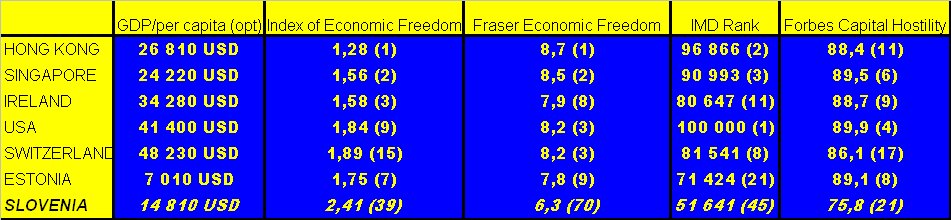
Streaming to the future, flat tax is inevitable for Slovenia if this country once wants to be the most competitive "Central European Tiger" with impressive economic growth, rapid job creation and highly protective system of private property. To maximize its economic growth, create jobs, raise incomes, and provide the government with sufficient revenue to finance the essential limited tasks of government Slovenia must sooner or later move forward towards simplified and non-discriminatory system of flat tax. Several examples in Eastern Europe have shown that the system of flat tax works perfectly well, since there are no double taxation laws, dividends taxations and where citizens of certain country are not forced to spend their entire time on filling out tax return for months. Instead, they would fill-out the tax return on a small postcard-sized form in matter of minutes.
Today Slovenia faces an immensely exposed challenge. One of its long-term objectives must be to devise a tax system that will help boost economic growth and total factor productivity so the Slovenians will easily overcome their inherited crippling legacy of socialist mismanagement which has moved Slovenia away from prosperity and benefits of free market economy. However, the new tax system must be made attractive to foreign investors. This is being extremely important because of integral globalization which awards nations with low tax-rates and non-discriminatory environment for foreign investment. Essentially, foreign investment is one of the foremost drivers of economic growth. Yet, the tax system in Slovenia needs flat tax. It must raise its revenue to finance the needs of hopefully limited government with rare spending habits. The flat tax is a good solution for Slovenia to become prosperous, competitive and successful small tiger in the heart of Europe.
Nearly every economic theorist and expert for public finance prefers flat tax. It holds low tax rates where people have a strong incentive to work and a little reason to hide their money from the government. After getting rid of many specific forms of taxation, flat tax does not impose bias against saving and investment. It also completely eliminates all forms of different tax treatment, preferences and penalties so that consumers' decisions are based on economic merit rather than on tax consideration. In case of certain fundamental or incremental tax reform, Slovenian leaders will face a never-ending number of obstacles towards implementing the flat tax. Unfortunately, international bureaucracies are very likely to be a part of that problem. The EU and OECD, for instance, strongly represent interests of high-tax nations, such as Germany and France. Those and many others area of extreme and discriminatory taxations have already been very upset that some Eastern European nations are moving ahead and implement the flat tax. The bureaucrats apparently don’t understand that higher tax rates simultaneously discourage work, saving, and investment and encourage tax evasion and tax avoidance.
The IMF may be even more dangerous than the OECD and EU since it uses its large budget to bribe nations to follow its advice. Slovenian leaders should reject the bad advises of international bureaucracies immediately. There's no other choice if Slovenia really wants to become a bite-roaring economic tiger or "Singapore of Central Europe". If tax rates will remain too high, people will keep hiding the money away from the government. Even worse, foreign investors will rather choose another country to build production factories and create jobs. Indeed, this is why it is so important to be radical and reject harmfully bad advises of international bureaucrats from EU and OECD against tax competition.
If Slovenia doesn't lower tax rates and reform its rigid tax system, it will have very little chance of successfully competing with other nations in the region that have made these changes. Foreign investors will have plenty of options left to choose where to build high-tech production parks. They will rather choose Slovakia with 19% corporate tax, Romania with 15% corporate tax rate. Why should Nokia build a factory in Slovenia, when it can benefit from Hungary's 16% flat rate on corporate income. Simply told, Slovenia must compete or perish.
It must become a leading innovation free market nation and create competitive, free and friendly investors' business environment like no other nation before. Continually, it must improve its score on regulation, banking system, pension reform, labor market flexibility and private property rights in order to climb to the top. And if the IMF (or even the World Bank) argues that tax reform and tax rate reductions will deprive the government of too much revenue, Slovenia's leaders should point to what has happened in other nations. In Russia, for instance, income tax revenues have nearly doubled since President Putin shifted from a 30 percent “progressive” tax to a 13 percent flat tax. Estonia rejected IMF's advice to implement strongly progressive tax system back in 1994 and had moved towards the flat tax. The results of implementing it were of course impressive. Other Eastern European nations have seen similar results because of faster growth and less evasion. More than 40 years ago, American president John Fitzgerald Kennedy implemented congratulating reductions in tax rates. His opponents made the same arguments as the ones we hear from international bureaucratic monsters such as EU and OECD today. But President Kennedy had a vision and preserved. He told critics that:
"Our true choice is not between tax reduction, on the one hand, and the avoidance of large Federal deficits on the other. It is increasingly clear that no matter what party is in power, so long as our national security needs keep rising, an economy hampered by restrictive tax rates will never produce enough revenues to balance our budget just as it will never produce enough jobs or enough profits… In short, it is a paradoxical truth that tax rates are too high today and tax revenues are too low and the soundest way to raise the revenues in the long run is to cut the rates now."
Slovenia should follow this highly sensible advice. American economy boomed after Kennedy's tax cuts in the 1960s and it sky-rocketed again when Ronald Reagan cut corporate and personal income tax rates in the 1980s. Slovenia should do the same. If enacted, let Slovenia cut its extremely high tax rates and let it reform the tax system. I hope that Slovenian policymakers will not listen to bureaucratic monsters who represent crippling, backward and damaging thinking of high-tax welfare states such as France, Germany, Sweden, Italy etc. Slovenian lawmakers should eliminate the evil called progressive taxation and finally implement the flat tax in order to let its economy moving upward with high rates of economic growth, rapid job creation, privatized economy, strong protection of property rights and new way of thinking how to become the most competitive small tiger in the global economy.
Like Estonia, Slovenia should champion private property rights through privatization and pursue tax competition via flat tax.
Taking amazing geographical location, privatization launch, competitive strength and free trade into account, Slovenia has excellent potential for being the tiger of hope, the child of brave and the champion of economic freedom.
Streaming to the future, flat tax is inevitable for Slovenia if this country once wants to be the most competitive "Central European Tiger" with impressive economic growth, rapid job creation and highly protective system of private property. To maximize its economic growth, create jobs, raise incomes, and provide the government with sufficient revenue to finance the essential limited tasks of government Slovenia must sooner or later move forward towards simplified and non-discriminatory system of flat tax. Several examples in Eastern Europe have shown that the system of flat tax works perfectly well, since there are no double taxation laws, dividends taxations and where citizens of certain country are not forced to spend their entire time on filling out tax return for months. Instead, they would fill-out the tax return on a small postcard-sized form in matter of minutes.
Today Slovenia faces an immensely exposed challenge. One of its long-term objectives must be to devise a tax system that will help boost economic growth and total factor productivity so the Slovenians will easily overcome their inherited crippling legacy of socialist mismanagement which has moved Slovenia away from prosperity and benefits of free market economy. However, the new tax system must be made attractive to foreign investors. This is being extremely important because of integral globalization which awards nations with low tax-rates and non-discriminatory environment for foreign investment. Essentially, foreign investment is one of the foremost drivers of economic growth. Yet, the tax system in Slovenia needs flat tax. It must raise its revenue to finance the needs of hopefully limited government with rare spending habits. The flat tax is a good solution for Slovenia to become prosperous, competitive and successful small tiger in the heart of Europe.
Nearly every economic theorist and expert for public finance prefers flat tax. It holds low tax rates where people have a strong incentive to work and a little reason to hide their money from the government. After getting rid of many specific forms of taxation, flat tax does not impose bias against saving and investment. It also completely eliminates all forms of different tax treatment, preferences and penalties so that consumers' decisions are based on economic merit rather than on tax consideration. In case of certain fundamental or incremental tax reform, Slovenian leaders will face a never-ending number of obstacles towards implementing the flat tax. Unfortunately, international bureaucracies are very likely to be a part of that problem. The EU and OECD, for instance, strongly represent interests of high-tax nations, such as Germany and France. Those and many others area of extreme and discriminatory taxations have already been very upset that some Eastern European nations are moving ahead and implement the flat tax. The bureaucrats apparently don’t understand that higher tax rates simultaneously discourage work, saving, and investment and encourage tax evasion and tax avoidance.
The IMF may be even more dangerous than the OECD and EU since it uses its large budget to bribe nations to follow its advice. Slovenian leaders should reject the bad advises of international bureaucracies immediately. There's no other choice if Slovenia really wants to become a bite-roaring economic tiger or "Singapore of Central Europe". If tax rates will remain too high, people will keep hiding the money away from the government. Even worse, foreign investors will rather choose another country to build production factories and create jobs. Indeed, this is why it is so important to be radical and reject harmfully bad advises of international bureaucrats from EU and OECD against tax competition.
If Slovenia doesn't lower tax rates and reform its rigid tax system, it will have very little chance of successfully competing with other nations in the region that have made these changes. Foreign investors will have plenty of options left to choose where to build high-tech production parks. They will rather choose Slovakia with 19% corporate tax, Romania with 15% corporate tax rate. Why should Nokia build a factory in Slovenia, when it can benefit from Hungary's 16% flat rate on corporate income. Simply told, Slovenia must compete or perish.
It must become a leading innovation free market nation and create competitive, free and friendly investors' business environment like no other nation before. Continually, it must improve its score on regulation, banking system, pension reform, labor market flexibility and private property rights in order to climb to the top. And if the IMF (or even the World Bank) argues that tax reform and tax rate reductions will deprive the government of too much revenue, Slovenia's leaders should point to what has happened in other nations. In Russia, for instance, income tax revenues have nearly doubled since President Putin shifted from a 30 percent “progressive” tax to a 13 percent flat tax. Estonia rejected IMF's advice to implement strongly progressive tax system back in 1994 and had moved towards the flat tax. The results of implementing it were of course impressive. Other Eastern European nations have seen similar results because of faster growth and less evasion. More than 40 years ago, American president John Fitzgerald Kennedy implemented congratulating reductions in tax rates. His opponents made the same arguments as the ones we hear from international bureaucratic monsters such as EU and OECD today. But President Kennedy had a vision and preserved. He told critics that:
"Our true choice is not between tax reduction, on the one hand, and the avoidance of large Federal deficits on the other. It is increasingly clear that no matter what party is in power, so long as our national security needs keep rising, an economy hampered by restrictive tax rates will never produce enough revenues to balance our budget just as it will never produce enough jobs or enough profits… In short, it is a paradoxical truth that tax rates are too high today and tax revenues are too low and the soundest way to raise the revenues in the long run is to cut the rates now."
Slovenia should follow this highly sensible advice. American economy boomed after Kennedy's tax cuts in the 1960s and it sky-rocketed again when Ronald Reagan cut corporate and personal income tax rates in the 1980s. Slovenia should do the same. If enacted, let Slovenia cut its extremely high tax rates and let it reform the tax system. I hope that Slovenian policymakers will not listen to bureaucratic monsters who represent crippling, backward and damaging thinking of high-tax welfare states such as France, Germany, Sweden, Italy etc. Slovenian lawmakers should eliminate the evil called progressive taxation and finally implement the flat tax in order to let its economy moving upward with high rates of economic growth, rapid job creation, privatized economy, strong protection of property rights and new way of thinking how to become the most competitive small tiger in the global economy.
Like Estonia, Slovenia should champion private property rights through privatization and pursue tax competition via flat tax.
Taking amazing geographical location, privatization launch, competitive strength and free trade into account, Slovenia has excellent potential for being the tiger of hope, the child of brave and the champion of economic freedom.
Friday, July 21, 2006
YEGOR GAIDAR AND THE INSTITUTE FOR ECONOMY IN TRANSITION
Yegor Gaidar and the Institute for Economy in Transition under his leadership. The institute is dedicated to analyzing particular economies in transition with specific emphasis on Russian Economy. The institute perceives highly performed level of on-running activities and thus contributes a great portion of knowledge towards the transformation of formerly socialist-communist economies into market-driven economies upon its premises - entrepreneurship, competition, the rule of law and risk-taking.
Recommended readings:
Alvin Rabushka: Russian Economy Archive
Recommended readings:
Alvin Rabushka: Russian Economy Archive
Thursday, July 20, 2006
STEVE FORBES: FLAT-TAX REVOLUTION. USING A POSTCARD TO ABOLISH THE IRS
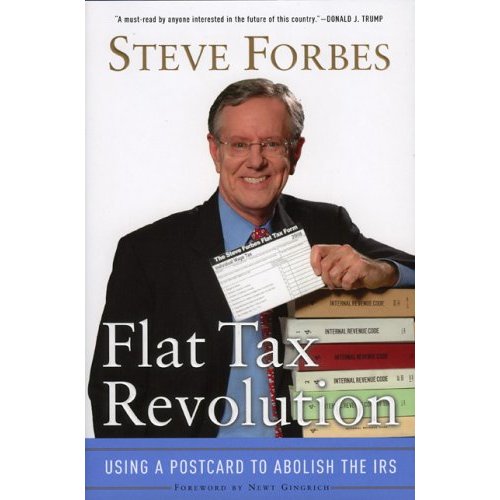
Forbes's masterpiece is a significant work with a lot of helpfully served information. I think everyone who's worried about the future of tax codes should simply read this book.
Flat Tax represents an idea of restoring liberty upon equality. The people who prefer progressive taxes actually prove themselves to be dedicated to the main idea pinned down in Communist Manifesto written by Marx and Engles. They entitled progressive taxation as the basic idea of communist society. There's a never-ending list of "yes" for the adoption of a single, competitive and fair flat tax. The main reasons are growth and simplicity. Economically, the argument of simplicity works perfectly since the margin of administrative costs falls down respectively. In fact, taxes are the main determinant of variability in productive behavior. Higher taxes mean less capital inflows which could be translated into high drop-out rate of new jobs. In fact, policymakers in socialist countries such as Sweden, France, Germany, Slovenia and Italy strongly underpin their uprising for "poor". Bullshit. Do you know that current economic growth in China pulls a million people from poverty a month? Do you know that Slovakia, after adopting the flat tax in 2004, almost trippled its GDP compared to its situation in 1993 when the country launched institutional restructuring towards market economy and property right protection. Do you know that Estonia after adopting a single marginal flat tax rate has been constantly considered "economically completely free" country? Estonia's remarkable achievement of transition was its shifting towards free market economy. Once the "sick edge of Baltics" is now, according to State Department, one of the most competitive countries in European Union in terms of efficiency and performance. Do you know that Hong Kong has been serially treated as No.1 place of economic freedom? The main ingredient of this success was definitely its flat tax system that boosted productive behavior and invited investors from all around the world to invest in Hong Kong. Another reason for simple and effective flat tax is the security of our financial resources. Privatizing social security and health care is just one chapter of this competitive potential. State-subsidized welfare programs of health care and social security are nothing else but a "big joke" that cheats millions of taxpayers who don't receive a credible commitment that their money contributed to the "national health care scheme" will be spent rationally and effectively. Shifting towards private accounts for social security would definitely turn out in an increase of wealth since yields of market investment funds raise impressively. This would result in a free choice of selecting where to put your money in order to be returned in higher value respectively. And finally, tax returns would be filled out on a simple postcard-sized paper. This would mean that you will no longer have to rent tax advisers and tax specialists. The only you'll have to do is to fill out a simple form in a matter of minutes. As simple as that!
If you want to hear more about flat tax than read Forbes's Masterpiece. Click here or here.
DEMS AND BLACKS
Who should Blacks vote when it comes to election deadline.
Democrats or Republicans?
Read Thomas Sowell's column from the latest edition of Townhall
here and find the answer.
But here're some of definitely the most undeniable facts:
1. Most blacks are working people and taxpayers
who do not benefit from welfare programs of from affirmative actions.
2. Blacks are more likely to gain from vouchers pulling them out of the trash called
"public schools". Vouchers would provide them a decent education in a decent place.
3. Gun control makes no sense. In the most criminal neighborhoods, criminal have access to nearly every piece of the most dangerous weapon.
Gun control would pull the potential victims in a very negative position by preventing them from being unable to defend themselves and stand against criminals.
Incidentally, most uses of guns in self-defense do not even involve pulling the trigger.
Once you pull a gun on someone who is threatening to assault you, he is likely to have a very sudden change of plans and head elsewhere.
In communities where most people are known to have guns in their homes, burglaries are rare and violent crime rates are low.
Guns deter as well as defend.The laws of gun control do not actually control guns but protect the criminals respectively.
4. Perhaps even more bizzare ideas is hidden in the thing called "social engineering programs" namely used in Scandinavia (Sweden) and other empires of socialism, including Slovenia. The programs are claiming to be about "drug prevention" or "decision-making" or some other innocuous-sounding name. The idea is that each child should make up his own morality. A more stupid or more dangerous idea could not have taken root anywhere but in a school of education.
5. Self-Defence is a human right and let it be treated that way.
6. Let me cite the words once said by a man "wisdom-of-the-mind" Ronald Reagan: "Government is not the solution to the problem, government is the problem". Finally, Democrats are not the solution to the problem, they are the core of the problem itself.
Democrats or Republicans?
Read Thomas Sowell's column from the latest edition of Townhall
here and find the answer.
But here're some of definitely the most undeniable facts:
1. Most blacks are working people and taxpayers
who do not benefit from welfare programs of from affirmative actions.
2. Blacks are more likely to gain from vouchers pulling them out of the trash called
"public schools". Vouchers would provide them a decent education in a decent place.
3. Gun control makes no sense. In the most criminal neighborhoods, criminal have access to nearly every piece of the most dangerous weapon.
Gun control would pull the potential victims in a very negative position by preventing them from being unable to defend themselves and stand against criminals.
Incidentally, most uses of guns in self-defense do not even involve pulling the trigger.
Once you pull a gun on someone who is threatening to assault you, he is likely to have a very sudden change of plans and head elsewhere.
In communities where most people are known to have guns in their homes, burglaries are rare and violent crime rates are low.
Guns deter as well as defend.The laws of gun control do not actually control guns but protect the criminals respectively.
4. Perhaps even more bizzare ideas is hidden in the thing called "social engineering programs" namely used in Scandinavia (Sweden) and other empires of socialism, including Slovenia. The programs are claiming to be about "drug prevention" or "decision-making" or some other innocuous-sounding name. The idea is that each child should make up his own morality. A more stupid or more dangerous idea could not have taken root anywhere but in a school of education.
5. Self-Defence is a human right and let it be treated that way.
6. Let me cite the words once said by a man "wisdom-of-the-mind" Ronald Reagan: "Government is not the solution to the problem, government is the problem". Finally, Democrats are not the solution to the problem, they are the core of the problem itself.
Wednesday, July 19, 2006
Monday, July 17, 2006
INFORMATION TECHNOLOGY AND GROWTH
The rapid diffusion of information technology (IT) is a direct consequence of the swift decline in the price of computer-related equipment, which has led to a vast and continuing substitution of IT equipment for other forms of capital and labor. This substitution generates substantial returns for the economic agents who undertake IT investments and restructure their activities in order to increase the role of IT. There is little evidence, however, that substitution is accompanied by technical change as this term is used by economists. While this appears highly paradoxical to technologists who think of substitution of a more IT-intensive mode of production for a less IT-intensive mode as a change in technology, it is entirely consistent with the economic framework developed by Robert M. Solow (1957).


DR. LJUBO SIRC: THE ESSENTIAL QUESTION IS HOW TO INVIGORATE SPONTANEOUS ENTREPRENEURSHIP"
Rado Pezdir has made an interview with Ljubo Sirc, PhD. Click here and read this outstanding interview where Ljubo Sirc speaks about his academic work in Great Britain. He also speaks how difficult it really was to meet face2face with crazy ideas of socialist economic thought and continually catastrophic supporters of socialism's destructive economic philosophy.
"Of course trade unions claim higher wages, but the only way to get them is to work productively. Instead of doing everything possible to improve our productivity, which would be resulted in higher wages, trade unions insist on a deadline without imposing any credible changes . And there's no growth without changes because growth itself requires flexibility. Rapid growth and productivity result wealthier quantity of production goods. If the quantity is too high, then a portion of production factors needs to be replaced into other production. Thereby we say that the elasticity of demand is too low. The onward consequence is that not everyone can be guaranteed for having the same job in the same area of experty ever after."
Ljubo Sirc, PhD
"Of course trade unions claim higher wages, but the only way to get them is to work productively. Instead of doing everything possible to improve our productivity, which would be resulted in higher wages, trade unions insist on a deadline without imposing any credible changes . And there's no growth without changes because growth itself requires flexibility. Rapid growth and productivity result wealthier quantity of production goods. If the quantity is too high, then a portion of production factors needs to be replaced into other production. Thereby we say that the elasticity of demand is too low. The onward consequence is that not everyone can be guaranteed for having the same job in the same area of experty ever after."
Ljubo Sirc, PhD
Wednesday, July 05, 2006
THE MARGARET THATCHER CENTER FOR FREEDOM

The MTCF contains numerous papers concerning the future of Anglo-American relationship in terms of cooperation and leadership in the world dedicated to advancing the vision and ideals of Lady Thatcher.
Click here or the picture above in order to access to the website.
Disclaimer: The Margaret Thatcher Center for Freedom was instituted by Heritage Foundation
Tuesday, July 04, 2006
THE 4th OF JULY - CONGRATULATIONS AMERICANS!
"But when a long train of abuses and usurpations, pursuing invariably the same Object evinces a design to reduce them under absolute Despotism, it is their right, it is their duty, to throw off such Government, and to provide new Guards for their future security."
--The Declaration of Independence
John Adams
"I am for doing good to the poor, but I differ in opinion of the means. I think the best way of doing good to the poor, is not making them easy in poverty, but leading or driving them out of it. In my youth I traveled much, and I observed in different countries, that the more public provisions were made for the poor, the less they provided for themselves, and of course became poorer. And, on the contrary, the less was done for them, the more they did for themselves, and became richer.
Benjamin Franklin, On the Price of Corn and Management of the Poor, November 1766
"Experience is the oracle of truth; and where its responses are unequivocal, they ought to be conclusive and sacred."
Alexander Hamilton, Federalist No. 20, December 11, 1787
"Men of energy of character must have enemies; because there are two sides to every question, and taking one with decision, and acting on it with effect, those who take the other will of course be hostile in proportion as they feel that effect.
Thomas Jefferson, December 21, 1817
"As the cool and deliberate sense of the community ought in all governments, and actually will in all free governments ultimately prevail over the views of its rulers; so there are particular moments in public affairs, when the people stimulated by some irregular passion, or some illicit advantage, or misled by the artful misrepresentations of interested men, may call for measures which they themselves will afterwards be the most ready to lament and condemn. In these critical moments, how salutary will be the interference of some temperate and respectable body of citizens, in order to check the misguided career, and to suspend the blow mediated by the people against themselves, until reason, justice and truth, can regain their authority over the public mind?
James Madison, Federalist No. 63, 1788
"This new world hath been the asylum for the persecuted lovers of civil and religious liberty from every part of Europe. Hither have they fled, not from the tender embraces of the mother, but from the cruelty of the monster; and it is so far true of England, that the same tyranny which drove the first emigrants from home, pursues their descendants still. Tyranny, like hell, is not easily conquered; yet we have this consolation with us, that the harder the conflict, the more glorious the triumph."
Thomas Paine, Common Sense, 1776
"The value of liberty was thus enhanced in our estimation by the difficulty of its attainment, and the worth of characters appreciated by the trial of adversity.
George Washington, letter to the people of South Carolina, Circa 1790
--The Declaration of Independence

"We hold these truths to be self-evident, that all men are created equal, that they are endowed by their Creator with certain unalienable Rights, that among these are Life, Liberty, and the pursuit of Happiness.—That to secure these rights, Governments are instituted among Men, deriving their just powers from the consent of the governed,—That whenever any Form of Government becomes destructive of these ends, it is the Right of the People to alter or to abolish it, and to institute new Government, laying its foundation on such principles and organizing its powers in such form, as to them shall seem most likely to effect their Safety and Happiness. Prudence, indeed, will dictate that Governments long established should not be changed for light and transient causes; and accordingly all experience hath shown, that mankind are more disposed to suffer, while evils are sufferable, than to right themselves by abolishing the forms to which they are accustomed."
-- The Declaration of Independence

Evening's Apple Pie:
The "Top 7" collection of inseparable bits of wisdom and assorted remarks related to American Founding Fathers
"Each individual of the society has a right to be protected by it in the enjoyment of his life, liberty, and property, according to standing laws. He is obliged, consequently, to contribute his share to the expense of this protection; and to give his personal service, or an equivalent, when necessary. But no part of the property of any individual can, with justice, be taken from him, or applied to public uses, without his own consent, or that of the representative body of the people. In fine, the people of this commonwealth are not controllable by any other laws than those to which their constitutional representative body have given their consent.
John Adams
"I am for doing good to the poor, but I differ in opinion of the means. I think the best way of doing good to the poor, is not making them easy in poverty, but leading or driving them out of it. In my youth I traveled much, and I observed in different countries, that the more public provisions were made for the poor, the less they provided for themselves, and of course became poorer. And, on the contrary, the less was done for them, the more they did for themselves, and became richer.
Benjamin Franklin, On the Price of Corn and Management of the Poor, November 1766
"Experience is the oracle of truth; and where its responses are unequivocal, they ought to be conclusive and sacred."
Alexander Hamilton, Federalist No. 20, December 11, 1787
"Men of energy of character must have enemies; because there are two sides to every question, and taking one with decision, and acting on it with effect, those who take the other will of course be hostile in proportion as they feel that effect.
Thomas Jefferson, December 21, 1817
"As the cool and deliberate sense of the community ought in all governments, and actually will in all free governments ultimately prevail over the views of its rulers; so there are particular moments in public affairs, when the people stimulated by some irregular passion, or some illicit advantage, or misled by the artful misrepresentations of interested men, may call for measures which they themselves will afterwards be the most ready to lament and condemn. In these critical moments, how salutary will be the interference of some temperate and respectable body of citizens, in order to check the misguided career, and to suspend the blow mediated by the people against themselves, until reason, justice and truth, can regain their authority over the public mind?
James Madison, Federalist No. 63, 1788
"This new world hath been the asylum for the persecuted lovers of civil and religious liberty from every part of Europe. Hither have they fled, not from the tender embraces of the mother, but from the cruelty of the monster; and it is so far true of England, that the same tyranny which drove the first emigrants from home, pursues their descendants still. Tyranny, like hell, is not easily conquered; yet we have this consolation with us, that the harder the conflict, the more glorious the triumph."
Thomas Paine, Common Sense, 1776
"The value of liberty was thus enhanced in our estimation by the difficulty of its attainment, and the worth of characters appreciated by the trial of adversity.
George Washington, letter to the people of South Carolina, Circa 1790
Monday, July 03, 2006
STAND UP FOR THE CHAMPIONS: A GLOBALIST MANIFESTO FOR PUBLIC POLICY
A global positive feedback towards prosperous paths of liberlization, privatization and globalisation has produced incredibly successful economic benefit. Liberlization has had its shortcomings, but there's a new emergence of extremely dangerous substantial threats to future progress, growth and prosperity, including an antiglobalization backlash. A famous French philosopher J.Revel has written that in essence, antiglobalism equals exactly the same amount of familiar hostility as antiamericanism. Both entities are merely the same. Continuing progress depends on strenght, requiring an ability to construct clear vision that is offered by positive feedbacks of globalization, privatization and liberalization. Aside from global liberalization, continuingly growing progress demands the establishment of institutions which can help realize the vision mentioned above. Reversing globalization would harm the worlds poorest inhabitants.
Charles W. Calomiris from American Enterprise Institute in his latest book A Globalist Manifesto for Public Policy offers brief but astonishing analysis about how the empirical examination of marvellous trends of globalization substantially contributes to substantial economic benefits that build a bridge of enhencement to prosperity, free society and unparralled economic growth.

Charles W. Calomiris is the Arthur F. Burns Scholar in Economics at American Enterprise Institute
Charles W. Calomiris from American Enterprise Institute in his latest book A Globalist Manifesto for Public Policy offers brief but astonishing analysis about how the empirical examination of marvellous trends of globalization substantially contributes to substantial economic benefits that build a bridge of enhencement to prosperity, free society and unparralled economic growth.

Charles W. Calomiris is the Arthur F. Burns Scholar in Economics at American Enterprise Institute
Sunday, July 02, 2006
JUST A SMALL NOTICE
After having received a few signals of warning about the impossibility of sending comments on postings which are being published on my Blog (http://rspruk.blogspot.com), I hereby inform you all, that those moderations have been changed and the restrictions on posting comments have been removed respectively. In sum, now everyone no matter of his/her status can post comments on postings published.
Saturday, July 01, 2006
MILTON FRIEDMAN: INFLATION AND UNEMPLOYMENT
Click the picture below and read Nobel Memorial Lecture by Milton Friedman, dated on December 13, 1976
"Government policy about inflation and unemployment has been at the center
of political controversy. Ideological war has raged over these matters. Yet the
drastic change that has occurred in economic theory has not been a result of
ideological warfare. It has not resulted from divergent political beliefs or aims
It has responded almost entirely to the force of events: brute experience
proved far more potent than the strongest of political or ideological preferences..."
--Milton Friedman
Thursday, June 29, 2006
MARGARET THATCHER: EXCERPTS FROM "SALUTE TO RONALD REAGAN"

"I note President Reagan, from one of your books, that in 1987 you heard one presidential candidate say that what this country needed was a president for the '90s. You were set to run again, because you thought he said a president in his 90s and you were (inaudible)."
"Sir, you strode into our midst at a time when America needed you most. This great country had been through a period of national malaise bereft of any sense of moral direction. Through it all, throughout eight of the fastest moving years in memory, you were unflappable and unyielding."
"You brushed off the jibes and jabs of your jealous critics. With that Irish twinkle and that easy homespun style, which never changed, you brought a new assurance to America. You were not only America's President -- important as that is -- you were a great leader. In a time of average men, you stood taller than anyone else."
"With a toughness unseen for a long time, you stood face-to-face with the evil empire. And, with an unexpected diplomacy which confused your foes -- and even some of your friends -- you reached out to that empire, perhaps no longer evil, but still formidable. You met its leaders on their turf, but on your terms."
"In a time of politicians, you proved yourself a statesman. And that leadership, that faith in freedom and enterprise brought about a renewal of this great country. America was back and the free world became a safer place."
"It was not only that you were the Great Communicator -- and you were the greatest -- but that you had a message to communicate."
"The message that had inspired the founding fathers, the message that has guided this nation from its birth -- the essence of good government is to blend the wisdom of the ages with the circumstances of contemporary times -- that is what you did. Not since Lincoln, or Winston Churchill in Britain, has there been a President who has so understood the power of words to uplift and to inspire."
"You reached beyond partisanship to principles, beyond our own selves to our very souls. You reached for and touched, as Lincoln had said so long before you, the better angels of our nature. Leadership is more than budgets and balance sheets. More than the policy of public measures, it is a matter of moral purpose. And that moral realm is reached by that insight and rhetoric of which only the truly great are capable."
"In 1969, as Governor of California, you spoke at Eisenhower College. It was a terrible time of student rebellion, of violence against property, violence against fellow students and violence against others on the campus. "How and when did all this begin?", you asked. "It began," you said, "the first time someone old enough to know better declared it was no crime to break the law in the name of social protest. It began with those, who in the name of change or progress, decided they could strap all the time- tested wisdom man has accumulated in his climb from the swamp to the stars." And I particularly like the next bit. "
"And my second choice arises because we are coming to the 50th anniversary of the D-Day Normandy landings -- the Longest Day, the day we dare not lose the battle. Let us recall what you said on the 40th anniversary on those beaches, for no one else could say it better.
You said, "Those men of Normandy had faith that what they were doing was right, faith that they fought for all humanity, faith that a just God would grant them mercy on this beachhead or on the next. The Americans who fought here that morning," you continued, "knew word of the invasion was spreading through the darkness back home. They felt in their hearts that in Georgia they were filling the churches at 4:00 a.m. in the morning. In Kansas they were kneeling on their porches and praying, and in Philadelphia they were ringing the Liberty Bell. And they knew that God was an ally in this great cause. That night General Ridgeway was listening in the darkness for the promise God made to Joshua; 'I will not fail thee, nor forsake thee'." And you said "Let us continue to stand for the ideals for which they lived and died. We will always remember. We will always be proud."
"Ron, I think that was your greatest speech. "
"Like Winston Churchill, you made words fight like soldiers and lifted the spirit of the nation
And my third one, also a favorite, which was seen the world over, was the terrible Challenger space shuttle disaster. You knew immediately, with that unfailing instinct, that the tragedy needed a national voice to share the mourning, to comfort and yet to say, "The quest must go on." You were on television within hours. And I remember so well you spoke especially to the school children who had been watching. You said "I know it is hard to understand, but sometimes painful things like this happen. It's all part of the process of exploration and discovery. The future doesn't belong to the faint-hearted. It belongs to the brave. The Challenger crew is pulling us into the future. And we'll continue to follow them." And, of course, America did, as we saw today. "
"You always had the right words, and we honor you for it. "
"There were so many other speeches, some prophetic, some humorous, but all with a vision, all which inspired. We could identify with each and every one. More than anyone else, you knew peoples' desire to be attached to some cause greater than themselves. "
"So, instead of inundating the American people with the torrent of projections and percentages, you spoke of the voluntary spirit of community and charity. "
"When others spoke of the fear of war, you spoke of the need for warriors and peace through strength. When others bewailed the failure of big government to provide for the collective good, you spoke of self-reliance, of personal responsibility, of individual pride and integrity. When others demanded compromise -- when other demanded compromise, you, Ronald Reagan, preached conviction."
FINNISH EU LEADERSHIP - A SHAMEFUL INTRODUCTION
Finland already has power to hike its own alchohol taxes but ever since there are about to takeover the position of EU Leadership, they want higher alchohol taxes in every EU nation to prevent Finns from making purchases where taxes are less oppressive. Curbing alchoholism is not a matter of the government but rather the matter of every individual who is accountable for what he does, so why shouldn't Finnish policymakers expell their miserable suggestions and finally let everyone on this statist European continent of socialism, to be able to realize one of his/her very basic and inalienable right - FREE CHOICE!
Read about the topic discussed above here.
Read about the topic discussed above here.
THERE'S NOTHING WRONG WITH A TRADE DEFICIT
Read Alan Reynolds's effective explanation which correctly points out that trade deficits are a sign of economic strength, since it means that a nation gas a growing economy and that foreigners find it a good place to invest.
"The Economist's survey of world forecasters estimates the current account deficit will reach 7.3 percent of GDP in Spain this year and 5.6 percent of GDP in Australia. I think the U.S. current account deficit will be about 6.5 percent, the flip side of which means that 6.5 percent of GDP measures the difference between foreign investment rushing into the United States minus the amount of U.S. investment flowing abroad. We have a large capital surplus, otherwise known as a current account deficit.
What do countries with large capital account surpluses have in common? Economic growth over the past year was 3.1 percent in Australia, 3.5 percent in Spain and 3.6 percent in the United States. The expected current account deficit is smaller in the United Kingdom (2.7 percent), yet British economic growth is also slower (2.2 percent). India's current account deficit is running about 2.5 percent of GDP. By contrast, Germany has a perpetual current account surplus and a pathetic economic growth rate that has long been stuck close to 1 percent..."
Read more on Market Center Blog at CENTER FOR FREEDOM AND PROSPERITY
"The Economist's survey of world forecasters estimates the current account deficit will reach 7.3 percent of GDP in Spain this year and 5.6 percent of GDP in Australia. I think the U.S. current account deficit will be about 6.5 percent, the flip side of which means that 6.5 percent of GDP measures the difference between foreign investment rushing into the United States minus the amount of U.S. investment flowing abroad. We have a large capital surplus, otherwise known as a current account deficit.
What do countries with large capital account surpluses have in common? Economic growth over the past year was 3.1 percent in Australia, 3.5 percent in Spain and 3.6 percent in the United States. The expected current account deficit is smaller in the United Kingdom (2.7 percent), yet British economic growth is also slower (2.2 percent). India's current account deficit is running about 2.5 percent of GDP. By contrast, Germany has a perpetual current account surplus and a pathetic economic growth rate that has long been stuck close to 1 percent..."
Read more on Market Center Blog at CENTER FOR FREEDOM AND PROSPERITY
Wednesday, June 28, 2006
MERCER'S SURVEY: THE WORLD'S MOST EXPENSIVE CITIES 2006
Click here and view the latest Mercer's Survey which covers the research of where is the most expensive place in the world.
Here're some of the most fascinating results:
1. Moscow has taken the lead of world's most expensive city.
2. London has moved downward and is not anymore recognized as the world's most expensive city.
3. According to EIU Survery, ten the most expensive cities in the World are the following ones: (1) Oslo, (2) Tokyo, (3) Reykjavik, (4) Osaka, (5) Paris, (6) Copenhagen, (7) London, (8) Zurich, (9) Geneva, (10) Helsinki
4. Click here and check the richest cities in the world (UBS Survery)
5. Click here and see the top 10 European Business Cities
6. Click here and view the most expensive shopping streets in Europe and in Americas
7. Click here and see the 50 most literate cities in the U.S. The results are quite surprising
8. Click here and check-up the latest "up-to-date" reports concerning the situations of health care, education, business, economics, finance, sport, transport and of course TOURISM!
Here're some of the most fascinating results:
1. Moscow has taken the lead of world's most expensive city.
2. London has moved downward and is not anymore recognized as the world's most expensive city.
3. According to EIU Survery, ten the most expensive cities in the World are the following ones: (1) Oslo, (2) Tokyo, (3) Reykjavik, (4) Osaka, (5) Paris, (6) Copenhagen, (7) London, (8) Zurich, (9) Geneva, (10) Helsinki
4. Click here and check the richest cities in the world (UBS Survery)
5. Click here and see the top 10 European Business Cities
6. Click here and view the most expensive shopping streets in Europe and in Americas
7. Click here and see the 50 most literate cities in the U.S. The results are quite surprising
8. Click here and check-up the latest "up-to-date" reports concerning the situations of health care, education, business, economics, finance, sport, transport and of course TOURISM!
Monday, June 26, 2006
THUMBS UP!
Read "The Road from Serfdom" where Friedrich August von Hayek is being interviewed by Thomas W. Hazlett
Sunday, June 18, 2006
DE GUSTIBUS NON EST DISPUTANDUM: WHO ARE THE ENEMIES OF OPEN MARKET SOCIETY
"What hadn't been realized in the literature until now is that merely to describe how severely something has been tested in the past itself embodies inductive assumptions, even as a statement about the past."
ROBERT NOZICK
After having overcome relative transitional progress it seems invariable that the numbers of those who fearfully reject the idea of open society and send fanatical shocks to those who advocate the very fruitful idea of open society. The roots of opposition to open society lies in the most anti-American country nowadays, namely France and it spreads like a disease through the signals of those who Karl Popper named them “the enemies of open society”.
Open Society is about prosperity and progress. Its idea is the idea of happiness being achieved through openness and productive behavior, rewarding risk, work and entrepreneurship as the main point of productive behavior respectively. The most giant source of opposition to open society is so called “wordsmith” intellectualism and it is mainly outsourced by those who pretend to be highly important persons in every-day life. Those wordsmiths include poets, novelists, literary critics, newspaper and magazine journalists, and many professors.
In fact those wordsmiths have wages above average. They fare well in capitalist society. In fact, the opposition to capitalist society is a social significance. Intellectual wordsmiths sends wave of how to behave and how to express ourselves. Their proposals are mostly counter-productive. Following the reasonable sentence each individual is guided through the invisible hand, guiding him through the market in order to help him pursuing his or her interest enabling prosperity and long-term happiness. However, intellectuals and other enemies of open society are afraid of progress and its increase. By and large, each wordsmith intellectual is afraid of success of the other because the value of anti-capitalist intellectual would have been laid-down. That’s how propelling towards anti-capitalism and expressing extremely activist thoughts against it factually depends on other forces pushing the enemies of open society on the edge of despair where anti-capitalistic views are the only tool left in order to boost the promotion of fearful hostility towards those who are more successful and are being pointed out as exploiting people (Americans, Capitalists, Jews,…).
As normal and hard-working people are heading towards progress, wordsmith intellectuals use the only lethal weapon left in order to keep trying to put them down. This very commonly used weapon is so called “neoliberalism” used by the Soviet satellites. Progress is what you gain from hard-work, risk, self-initiative and entrepreneurial actions, penetrating into the information asymmetry and choosing the best maybe for today’s less but inevitably for tomorrow’s more. However, “wordsmith” enemies of open society dislike “productive initiative” and their way to stop it is to try to cause disorder of information. The latter is entailed within the wordsmith argument of “social state”, “social ethics, “social whatever”… But as FA Hayek correctly emphasized facing arguments and instantly using the word social means to avoid personal responsibility and transfigure it onto something what is actually unknown to everybody. Intellectuals now expect to be the most highly valued people in a society, those with the most prestige and power, those with the greatest rewards. Intellectuals feel entitled to this. Agreeably, intellectuals have been expressing enviousness instantly to those who achieved the truest value of prosperity which seems unreachable to wordsmith intellectuals. Instead, intellectuals rather humble those who advocate free choice and use its function in order to prosper tomorrow and become rich by inserting the human capital where it yields the most profitable returns. Wordsmith intellectuals however don’t seem to be in favor of this. Successful capitalists, inventors and businessmen are pointed out as the main enemies of welfare, as the source of exploitation.
The reason for this very unfavorable hostility is that wordsmiths are simply captured “somewhere in the middle of nowhere”. They don’t understand the trade and don’t know how to explain the measure of relative value together with marginal utility which makes them impossible to understand what Hayek called “an expanded order”.
Wordsmith intellectuals, as the main advocates of “explicit socialism”, are captured within the essence of wrong and harmful definition of individual. Their definition of the latter is to be highly active and completely dedicated to the idea of cherishing his choice and eliminating his shiningly flattering career in order to contribute as much power as possible to community.
In the mentality of socialists and collectivists each prosperous individual has been treated negatively, as an enemy and exploiter, just because his race for profit has enabled welfare to thousand and let them into the fortune of middle class income earners. Wordsmith intellectuals build their defense by penetrating where it’s possible to send waves of anti-capitalism and anti-Americanism because their defective way of thinking seeks channels of propaganda and thus “successfully” implements the lessons of Lenin, their most probable source of philosophical inspiration. It is not surprising that in many Western and few Eastern countries media are keep frightening people about progress and liberal economic reforms (i.e. flat tax). Those sheltered signals are the product of pure anti-capitalist mentality and leftist propaganda whose weapon against Reason, courage and challenge is media and especially daily newspapers where we can see what kind of miserable “shits” are possible to be written by those who are completely unaware of some basic principles of Economics.
Who knows, perhaps one the most masterful macroeconomists, Gregory Mankiw could start teaching them some basic definitions and laws of Economics.
Another possibly the most probable, much more elementary source of anti-Capitalism and extreme hostility towards the creature of competitive, successful and encouraged individuals is the school system. There, wordsmith intellectuals have succeeded on nearly every front and send anti-capitalistically inspired youth on the market where their “social significance” is recognized in a complete unawareness of productive behavior which could boost their unused grain of power and help them becoming the leaders of tomorrow. The (future) wordsmith intellectuals are successful within the formal, official social system of the schools, wherein the relevant rewards are distributed by the central authority of the teacher. The schools contain another informal social system within classrooms, hallways, and schoolyards, wherein rewards are distributed not by central direction but spontaneously at the pleasure and whim of schoolmates. Here the intellectuals do less well.
It is not surprising, therefore, that distribution of goods and rewards via a centrally organized distributional mechanism later strikes intellectuals as more appropriate than the "anarchy and chaos" of the marketplace. For distribution in a centrally planned socialist society stands to distribution in a capitalist society as distribution by the teacher stands to distribution by the schoolyard and hallway.
Beside promoting income equality and telling capitalists, economists, businessmen and free marketers exploiters makes wordsmiths a firm grounding of ideological fire, holding strongly against the efforts of economic progress and defining market as chaos.
Public schools are in general the opposition to private property itself. Wordsmith intellectuals seem to be the most fanatical defenders of anti-Americanism, hiding behind the curtain of “human rights”. Neosocialism’s defective way of thinking has poured into nearly every channeled area of life. The ideas sound fairly well in practice and extend from feminism, environmental protection and the defense of human rights. But when you uncover the shield you discover the unthinkable – a dirty mud of hostility towards everything what is more successful and continues to prosper accordingly.
The world of wordsmith intellectuals is actually a fairytale world of hopelessness, uncompetitiveness and fearfully hostile anti-capitalistic mentality wherein “literary critics” and sometimes even amusingly funny “novelists” produce their very special forcible thoughts of development puzzled into a phenomena called “anti-Capitalism”.
“There are no such things as limits to growth, because there are no limits on the human capacity for intelligence, imagination and wonder.”
RONALD REAGAN
The opposition to free market society, competitive advantage, productive behavior, encouraged challenge of creating positively unthinkable achievements, competitive entrepreneurship, risk taking, progress and going for growth are only the fractions being a great target for wordsmith intellectuals in order to shoot them and penalize them for being successful, prosperous and challengingly encouraged to go forward. Helpfully recommended is to not listen to them and ask what you can do for you for today’s less in order to achieve comprehensive tomorrow’s more.
Disclaimer: Together with libertarec.blogspot.com, Capitalism & Freedom is a newly-joint member of Freemasonic-Zionistic-Libertarian conspiracy for destroying Alpine paradise of public economic well-being for pensioners and public privileges of wordsmith intellectuals penetrated into the channels of public rent-seeking.
Literature
Annelise Anderson, Martin Anderson and Ronald Reagan: Reagan in His Own Hand. The Writings of Ronald Reagan that Reveal His Revolutionary Vision for America, Free Press, 2001
http://www.amazon.com/gp/product/074320123X/104-9966621-4914341?v=glance&n=283155
Milton Friedman, Capitalism and Freedom, Chicago University Press, 1972
http://www.press.uchicago.edu/cgi-bin/hfs.cgi/00/15395.ctl
Friedrich August von Hayek, Fatal Conceit: Errors of Socialism, Chicago University Press, 1988
http://www.amazon.com/gp/product/0226320669/104-9966621-4914341?v=glance&n=283155
Ludwig von Mises, Anti-Capitalistic Mentality, Libertarian Press, 1972
http://libertarec.blogspot.com/anticap.pdf
Gregory Mankiw, Teaching Principles of Economics, Eastern Economic Journal, 1998
Robert Nozick, Why Do Intelectuals Oppose Capitalism, CATO Policy Report, 1998
http://www.cato.org/pubs/policy_report/cpr-20n1-1.html
Alexander Marriot, The Limitations of Marxist Approach to Writing History, Capitalism Magazine, 2005
http://www.capmag.com/article.asp?ID=4512
Sean Hannity, Deliver us from Evil. Defeating Terrorism, Despotism…, Reagan Books, 2004
http://www.amazon.com/gp/product/0060582510/104-9966621-4914341?v=glance&n=283155
ROBERT NOZICK
After having overcome relative transitional progress it seems invariable that the numbers of those who fearfully reject the idea of open society and send fanatical shocks to those who advocate the very fruitful idea of open society. The roots of opposition to open society lies in the most anti-American country nowadays, namely France and it spreads like a disease through the signals of those who Karl Popper named them “the enemies of open society”.
Open Society is about prosperity and progress. Its idea is the idea of happiness being achieved through openness and productive behavior, rewarding risk, work and entrepreneurship as the main point of productive behavior respectively. The most giant source of opposition to open society is so called “wordsmith” intellectualism and it is mainly outsourced by those who pretend to be highly important persons in every-day life. Those wordsmiths include poets, novelists, literary critics, newspaper and magazine journalists, and many professors.
In fact those wordsmiths have wages above average. They fare well in capitalist society. In fact, the opposition to capitalist society is a social significance. Intellectual wordsmiths sends wave of how to behave and how to express ourselves. Their proposals are mostly counter-productive. Following the reasonable sentence each individual is guided through the invisible hand, guiding him through the market in order to help him pursuing his or her interest enabling prosperity and long-term happiness. However, intellectuals and other enemies of open society are afraid of progress and its increase. By and large, each wordsmith intellectual is afraid of success of the other because the value of anti-capitalist intellectual would have been laid-down. That’s how propelling towards anti-capitalism and expressing extremely activist thoughts against it factually depends on other forces pushing the enemies of open society on the edge of despair where anti-capitalistic views are the only tool left in order to boost the promotion of fearful hostility towards those who are more successful and are being pointed out as exploiting people (Americans, Capitalists, Jews,…).
As normal and hard-working people are heading towards progress, wordsmith intellectuals use the only lethal weapon left in order to keep trying to put them down. This very commonly used weapon is so called “neoliberalism” used by the Soviet satellites. Progress is what you gain from hard-work, risk, self-initiative and entrepreneurial actions, penetrating into the information asymmetry and choosing the best maybe for today’s less but inevitably for tomorrow’s more. However, “wordsmith” enemies of open society dislike “productive initiative” and their way to stop it is to try to cause disorder of information. The latter is entailed within the wordsmith argument of “social state”, “social ethics, “social whatever”… But as FA Hayek correctly emphasized facing arguments and instantly using the word social means to avoid personal responsibility and transfigure it onto something what is actually unknown to everybody. Intellectuals now expect to be the most highly valued people in a society, those with the most prestige and power, those with the greatest rewards. Intellectuals feel entitled to this. Agreeably, intellectuals have been expressing enviousness instantly to those who achieved the truest value of prosperity which seems unreachable to wordsmith intellectuals. Instead, intellectuals rather humble those who advocate free choice and use its function in order to prosper tomorrow and become rich by inserting the human capital where it yields the most profitable returns. Wordsmith intellectuals however don’t seem to be in favor of this. Successful capitalists, inventors and businessmen are pointed out as the main enemies of welfare, as the source of exploitation.
The reason for this very unfavorable hostility is that wordsmiths are simply captured “somewhere in the middle of nowhere”. They don’t understand the trade and don’t know how to explain the measure of relative value together with marginal utility which makes them impossible to understand what Hayek called “an expanded order”.
Wordsmith intellectuals, as the main advocates of “explicit socialism”, are captured within the essence of wrong and harmful definition of individual. Their definition of the latter is to be highly active and completely dedicated to the idea of cherishing his choice and eliminating his shiningly flattering career in order to contribute as much power as possible to community.
In the mentality of socialists and collectivists each prosperous individual has been treated negatively, as an enemy and exploiter, just because his race for profit has enabled welfare to thousand and let them into the fortune of middle class income earners. Wordsmith intellectuals build their defense by penetrating where it’s possible to send waves of anti-capitalism and anti-Americanism because their defective way of thinking seeks channels of propaganda and thus “successfully” implements the lessons of Lenin, their most probable source of philosophical inspiration. It is not surprising that in many Western and few Eastern countries media are keep frightening people about progress and liberal economic reforms (i.e. flat tax). Those sheltered signals are the product of pure anti-capitalist mentality and leftist propaganda whose weapon against Reason, courage and challenge is media and especially daily newspapers where we can see what kind of miserable “shits” are possible to be written by those who are completely unaware of some basic principles of Economics.
Who knows, perhaps one the most masterful macroeconomists, Gregory Mankiw could start teaching them some basic definitions and laws of Economics.
Another possibly the most probable, much more elementary source of anti-Capitalism and extreme hostility towards the creature of competitive, successful and encouraged individuals is the school system. There, wordsmith intellectuals have succeeded on nearly every front and send anti-capitalistically inspired youth on the market where their “social significance” is recognized in a complete unawareness of productive behavior which could boost their unused grain of power and help them becoming the leaders of tomorrow. The (future) wordsmith intellectuals are successful within the formal, official social system of the schools, wherein the relevant rewards are distributed by the central authority of the teacher. The schools contain another informal social system within classrooms, hallways, and schoolyards, wherein rewards are distributed not by central direction but spontaneously at the pleasure and whim of schoolmates. Here the intellectuals do less well.
It is not surprising, therefore, that distribution of goods and rewards via a centrally organized distributional mechanism later strikes intellectuals as more appropriate than the "anarchy and chaos" of the marketplace. For distribution in a centrally planned socialist society stands to distribution in a capitalist society as distribution by the teacher stands to distribution by the schoolyard and hallway.
Beside promoting income equality and telling capitalists, economists, businessmen and free marketers exploiters makes wordsmiths a firm grounding of ideological fire, holding strongly against the efforts of economic progress and defining market as chaos.
Public schools are in general the opposition to private property itself. Wordsmith intellectuals seem to be the most fanatical defenders of anti-Americanism, hiding behind the curtain of “human rights”. Neosocialism’s defective way of thinking has poured into nearly every channeled area of life. The ideas sound fairly well in practice and extend from feminism, environmental protection and the defense of human rights. But when you uncover the shield you discover the unthinkable – a dirty mud of hostility towards everything what is more successful and continues to prosper accordingly.
The world of wordsmith intellectuals is actually a fairytale world of hopelessness, uncompetitiveness and fearfully hostile anti-capitalistic mentality wherein “literary critics” and sometimes even amusingly funny “novelists” produce their very special forcible thoughts of development puzzled into a phenomena called “anti-Capitalism”.
“There are no such things as limits to growth, because there are no limits on the human capacity for intelligence, imagination and wonder.”
RONALD REAGAN
The opposition to free market society, competitive advantage, productive behavior, encouraged challenge of creating positively unthinkable achievements, competitive entrepreneurship, risk taking, progress and going for growth are only the fractions being a great target for wordsmith intellectuals in order to shoot them and penalize them for being successful, prosperous and challengingly encouraged to go forward. Helpfully recommended is to not listen to them and ask what you can do for you for today’s less in order to achieve comprehensive tomorrow’s more.
Disclaimer: Together with libertarec.blogspot.com, Capitalism & Freedom is a newly-joint member of Freemasonic-Zionistic-Libertarian conspiracy for destroying Alpine paradise of public economic well-being for pensioners and public privileges of wordsmith intellectuals penetrated into the channels of public rent-seeking.
Literature
Annelise Anderson, Martin Anderson and Ronald Reagan: Reagan in His Own Hand. The Writings of Ronald Reagan that Reveal His Revolutionary Vision for America, Free Press, 2001
http://www.amazon.com/gp/product/074320123X/104-9966621-4914341?v=glance&n=283155
Milton Friedman, Capitalism and Freedom, Chicago University Press, 1972
http://www.press.uchicago.edu/cgi-bin/hfs.cgi/00/15395.ctl
Friedrich August von Hayek, Fatal Conceit: Errors of Socialism, Chicago University Press, 1988
http://www.amazon.com/gp/product/0226320669/104-9966621-4914341?v=glance&n=283155
Ludwig von Mises, Anti-Capitalistic Mentality, Libertarian Press, 1972
http://libertarec.blogspot.com/anticap.pdf
Gregory Mankiw, Teaching Principles of Economics, Eastern Economic Journal, 1998
Robert Nozick, Why Do Intelectuals Oppose Capitalism, CATO Policy Report, 1998
http://www.cato.org/pubs/policy_report/cpr-20n1-1.html
Alexander Marriot, The Limitations of Marxist Approach to Writing History, Capitalism Magazine, 2005
http://www.capmag.com/article.asp?ID=4512
Sean Hannity, Deliver us from Evil. Defeating Terrorism, Despotism…, Reagan Books, 2004
http://www.amazon.com/gp/product/0060582510/104-9966621-4914341?v=glance&n=283155
Tuesday, June 13, 2006
CAPITALISM - MAKE A WISH IN EVERY PROSPEROUS FOUNTAIN!
"There is no such thing as society."
MARGARET H. THATHCER

"Then the dean understood what had puzzled him in Roark's manner.
"You know," he said, "you would sound much more convincing if you spoke as if you cared whether I agreed with you or not."
"That's true," said Roark. "I don't care whether you agree with me or not." He said it so simply that it did not sound offensive, it sounded like the statement of a fact which he noticed, puzzled, for the first time.
"You don't care what others think - which might be understandable. But you don't care even to make them think as you do?"
"No."
"But that's... that's monstrous."
"Is it? Probably, I couldn't say."
AYN RAND, The Fountainhead
MARGARET H. THATHCER

"Then the dean understood what had puzzled him in Roark's manner.
"You know," he said, "you would sound much more convincing if you spoke as if you cared whether I agreed with you or not."
"That's true," said Roark. "I don't care whether you agree with me or not." He said it so simply that it did not sound offensive, it sounded like the statement of a fact which he noticed, puzzled, for the first time.
"You don't care what others think - which might be understandable. But you don't care even to make them think as you do?"
"No."
"But that's... that's monstrous."
"Is it? Probably, I couldn't say."
AYN RAND, The Fountainhead
INDIA: AN OPPORTUNITY FOR REAL-ESTATE INVESTMENT AFTER LIBERALIZING THE INVESTMENT RULES
Over the past decade, India has valuted from an also-ran to a leader in global economy. It is becoming an attractive magnet to foreign investment. Its presence in India remarkably outshines the global average. The increase in foreign investment, more competitive joint ventures between Indian and foreign companies and a gigantic growth of Indian domestic economy have create an uprising employment opportunities on Indian market for Indian young, proferssional, highly skilled and middle-classed workforce. With more disposable income workers are spending more on consumer goods and services and especially BUYING HOMES!
Click here in order to connect to one of Ernst&Youngs' latest reports on Indian "real estate" FDI and the liberalization of the investment rules. The file is downloadable!
Click here in order to connect to one of Ernst&Youngs' latest reports on Indian "real estate" FDI and the liberalization of the investment rules. The file is downloadable!
Tuesday, June 06, 2006
CONGRATULATIONS - CAPITALISM DAY - 6th OF JUNE - LETS' CELEBRATE LAISSEZ FAIRE


"Education is the best provision for the journey to old age."
ARISTOTLE

"The improvement of understanding is for two ends: first, our own increase of knowledge; secondly, to enable us to deliver that knowledge to others."
JOHN LOCKE

"It is the maxim of every prudent master of a family, never to attempt to make at home what it will cost him more to make than to buy...What is prudence in the conduct of every private family, can scarce be folly in that of a great kingdom. If a foreign country can supply us with a commodity cheaper than we ourselves can make it, better buy it of them with some part of the produce of our own industry, employed in a way in which we have some advantage."
ADAM SMITH

"The tree of liberty must be refreshed from time to time with the blood of patriots and tyrants. It is its natural manure."
THOMAS JEFFERSON
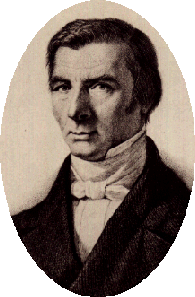
"They will come to learn in the end, at their own expense, that it is better to endure competition for rich customers than to be invested with monopoly over impoverished customers. The state is the great fictitious entity by which everyone seeks to live at the expense of everyone else."
FREDERIC BASTIAT

"Individualism resulted in the fall of autocratic government, the establishment of democracy, the evolution of capitalism, technical improvements, and an unprecedented rise in standards of living. It substituted enlightenment for old superstitions, scientific methods of research for inveterate prejudices."
LUDWIG von MISES
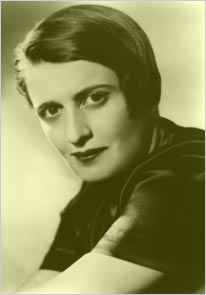
"The moral justification of capitalism does not lie in the altruist claim that it represents the best way to achieve the “common good”. It is true that capitalism does—if that catch-phrase has any meaning—but this is merely a secondary consequence. The moral justification of capitalism lies in the fact that it is the only system consonant with mans rational nature, that it protects mans survival qua man, and that its ruling principle is: justice."
AYN RAND
Wednesday, May 31, 2006
FORTIS ET LIBER: IRELAND - THE CASE STUDY OF AN INVINCIBLE ECONOMIC FREEDOM
 Viewed from Washington, it's hard to believe the Ireland depicted in the film The Commitments even existed 15 years ago. When the 20-somethings depicted in that movie discussed career opportunities, the inevitable question was: "When are you going?’' As in - to the US for a job. Not any more.
Instead of hampering unemployment Ireland imports foreign skilled labor force today. Irish economic growth is no little or just even a bit, but it increasingly puts world average out of business. Once the sick man of Europe now rapidly became the bite-roaring Celtic tiger, with prosperous future far better than continental economies. In my opinion Irish conventional wisdom went directly to the point and enabled people to pursue their dreams easier. The key instruments for such a welcoming philosophy have been pro-growth and pro-market oriented reforms that let Ireland third-freest economy in the world (Heritage, 2006).
In the previous year Irish economy grew steadily at a rate of approximately 5% which is very much better than the vast majority of world economies. Ireland now remains a U.S. center for foreign investment and it present nearly a third of U.S. investment in the EU. According to close ties with the U.S., Ireland remains world largest exporter per capita. In the last decade Ireland attracted about 25% of fresh and new U.S. investment. The flow of the latter was nearly 9,1$ billion in 2003 which is two and a half times the amount of U.S. investment capital flows into China nowadays.
Ireland is also one of the easiest places to start doing business. It only takes a few days to start it. Very strongly recognized component of Irish economic boom is advanced and competitive financial system. Banking industry is diverse with around 90 banks and other credit institutions authorized to conduct business in 2002, most of which are foreign. Dublin has attracted a number of foreign banks through its International Financial Services Center, which offers banks a corporate tax rate of 12.5 percent. European Commission unfortunately failed when she has treated this very low corporate tax rate as an aid to banking industry. Irish deserves its place among open-market countries. Around 100 banks currently operate in China; most of them are situated elsewhere. Their licensed credit institutions have financial assets that result 400% of Irish GDP which is the second-best such ratio in Europe, only behind Luxemburg (Miles, 2006). Ireland has successfully resisted adopting EU efforts to harmonize taxes at a single tax rate.
Ireland is probably a world record holder when the question takes place in government intervention. Quite remarkably Irish government consumed 14, 4% of the GDP. Only about 2% total revenues were received from state-owned enterprises. Irish cut in government consumption could have been even more impressively improved if Ireland reduced its top marginal income tax rate from its current 42%.
Another increasingly important sustainability of Irish economic growth is flexible labor market and low social security payments. The major origins of Irish dynamic economic growth take place in the early 1990s when Irish government slashed corporate tax down to 12, 5% and continually took other measurements to unleash nation’s competitive entrepreneurial wealth.
Irish judicial and civil service system is continually regarded as fair, highly professional, competent and sound. Foreign and domestic investors can thus be safe that their property will not be expropriated. Even legal obligations take high place in terms of moral values according to Irish strong dedication to Anglo-Saxon way of living. Contractual agreements are safe and judicial staff is of high quality. Corruption is by and large not a serious problem for investors in Ireland. Especially significant effect on Irish competitive market has (compared to EU) less restrictive labor force regulation which lets labor market to be one of the most dynamically flexible among world economies.
My opinion is that free market policies allow economies to absorb financial and other stocks more quickly with less long term negative circumstances. Thanks to this economic flexibility Ireland remains a well-confident friend of economic freedom based upon the foundations of impressive economic growth and enhanced market prosperity.
Sunday, May 28, 2006

IT CAN'T BE TRUE ... BUT IT IS!
You can fool some people all of the time
or you can fool all people some of the time,
but you cannot fool all the people all of the time,
says an old American proverb.
Check out the latest attempt to disqualify new fresh foreign investment in Slovenia. Gosh, it gives me a headache when I read the article listed below...
http://www.finance-on.net/?MOD=show&id=153913
or you can fool all people some of the time,
but you cannot fool all the people all of the time,
says an old American proverb.
Check out the latest attempt to disqualify new fresh foreign investment in Slovenia. Gosh, it gives me a headache when I read the article listed below...
http://www.finance-on.net/?MOD=show&id=153913
Saturday, May 27, 2006
A FEW LESSONS OF HOW ESTONIA BECAME A BITE-ROARING BALTIC TIGER UNDER THE LEADERSHIP OF MART LAAR

"TO HAVE SUCCESS YOU MUST BE FREE AND OPENED TO THE WORLD."
"FREE COUNTRIES GROW FASTER!"
"GIVE US NO AID BUT TRADE!"
"FREE TRADE AND ECONOMIC GROWTH ARE MAKING NATIONS PROSPERIOUS, NOT FOREIGN AID."
"FREE ECONOMIES GROW FASTER AND ARE RICHER."
"TO MAKE YOUR ECONOMY FREE YOU MUST MAKE YOUR PEOPLE FREE!"
PLEASENT IS YOUR NAME: FREE ISRAEL

Israel was not created in order to disappear. Israel will endure and flourish. It is the child of hope and the home of the brave. It can neither be broken by adversity nor demoralized by success. It carries the shield of democracy and it honors the sword of freedom.
PRESERVING LIBERTY...

"To deal with men by force is as impractical as to deal with nature by persuasion."
AYN RAND
"Talk about how various people have been 'winners' in 'the lottery of life' or have things that others don't have just because they 'happen to have money' is part of the delegitimizing of property as a prelude to seizing it."
THOMAS SOWELL
"Socialism is a philosophy of failure, the creed of ignorance, and the gospel of envy."
WINSTON CHURCHILL
"In those wretched countries where a man cannot call his tongue his own, he can scarce call anything his own... Who ever would overthrow the liberty of a nation must begin by subduing the freeness of speech."
BENJAMIN FRANKLIN
"Recession is when your neighbor loses his job. Depression is when you lose yours. And recovery is when Jimmy Carter loses his."
RONALD W. REAGAN
"It is not from the benevolence of the butcher, the brewer, or the baker that we expect our dinners but from their regard to their own interest. We address ourselves not to their humanity but to their self love, and never talk to them of our own necessities but of their advantages."
ADAM SMITH
"The argument for collectivism is simple if false; it is an immediate emotional argument. The argument for individualism is subtle and sophisticated; it is an indirect rational argument. And the emotional faculties are more highly developed in most men than the rational, paradoxically or especially even in those who regard themselves as intellectuals."
MILTON FRIEDMAN
"Government is a disease masquerading as its own cure."
L. NEIL SMITH
"Individuals have rights, and there are things no person or group may do to them (without violating their rights). So strong and far-reaching are these rights that they raise the question of what, if anything, the state and its officials may do. How much room do individual rights leave for the state? Our main conclusions about the state are that a minimal state. limited to the narrow functions of protection against force, theft, fraud, enforcement of contracts, and so on, is justified; that any more extensive state will violate person's rights not to be forced to do certain things, and is unjustified; and that the minmal state is justified as well as right. Two noteworthy implications are that the state may not use its coercive apparatus for the purpose of getting some citizens to aid others, or in order to prohibit activities to people for their own good or protection. Despite the fact that it is only coercive routes towards these goals that are excluded, while voluntary ones remain, many persons will reject our conclusions instantly, knowing they dont want to believe anything so callous towards the needs and suffering of others. I know the reaction; it was mine when I first began to consider such views. With reluctance I found myself becoming to be convinced of Libertarian views, due to various considerations and arguments."
ROBERT NOZICK
Monday, May 22, 2006
THE TRUTH ABOUT THE 'MYTH' OF SOCIAL JUSTICE

"Social justice is the trojan horse through which totalitarian governments are formed."
Friedrich August von Hayek
Friday, May 19, 2006
THE VALUE OF FREEDOM: THE ESTABLISHMENT OF FREE MARKET ECONOMY AS AN ARGUMENT AGAINST ECONOMIC ERRORS OF SOCIALISM
“The World has never had a good definition of the word Liberty. In fact, we all declare for Liberty, but in using the same word, we do not mean the same thing. Here are two, not only different but also incompatible things called by the same name, Liberty."
ABRAHAM LINCOLN
The very basic premise of socialist thought is that socialist institution can establish entirely just society. The latter argument is totally false as we shall see in the incoming chapters. The experiment of socialism is in general political as well as economic. From political perspective socialism would accordingly be underpinned as an endless community that would pave the road to proletarian apparatus. But in the real sense the latter component is just a shadow that covers-up all the realistic arrangements of socialism that presumably remain the opposition to private property, individualism and economic order of free entrepreneurship.
No legal protection, no responsibility
Free and dynamic system of free market economy demands detailed knowledge of asymmetric market information that will reward each businessman for productive behavior such as risk-taking, entrepreneurship and work. Each free market system first demands an effective protection of property. Milton Friedman, a Chicago economist, firmly underpinned the importance of legal security -“…a dynamic system of free market economy can only be let going where the legal protection of private property is paramount for the state” (Friedman, 2002). There’s a core of Western tradition that shows an important aspect of the rule of law. As the primary objective of classical liberalism remains an expanded world order, the primary goal of neosocialism remains an invisible “promotion” of world disorder. This actually uncovers the truest face of socialism. The ideology of the latter has no taken place in free market economy in terms of economic context. Socialist leaders have granted power only when there has been disorderly caused chaos coming under way. The apparatus that firms socialism’s devastating approach towards the protection of private property remains a wavering bureaucracy that forces entrepreneurs, managers, successful businessmen and other citizen to become a slave of a highly active state that penalizes every productive behavior with bureaucratic procedures that influence each individual in order to put off his vision for the future. By such confusing and the denunciation of private property each neosocialist protects his fear. And after continuing such practice citizen have begun to become feeling very fearful of doing what their truest desire is in order to participate their interest and put it into practice. Neosocialism is afraid of innovations that’s why it firstly shakes the foundations of legal security and secondly produces fear by sending bureaucracy into the eyes of citizen that are aftermath afraid of expressing productive behavior, such as entrepreneurship, work and risk-taking. The most recognized legal feature of neosocialism is that offers no legal security and causes severe disorder of the rule of law, which remains hidden curtain that shows the real legal face of neosocialism – confusion, legal disorder and very weak protection of private property rights. Neosocialists actually don’t deny their opposition to private property, because sovereign protection of it would damage the project of neosocialism.
"A major source of objection to a free economy is precisely that group thinks they ought to want. Underlying most arguments against the free market is a lack of belief in freedom itself."
MILTON FRIEDMAN
Economic basis of destructive economic thinking of neosocialism
In essence, economic ideologists of neosocialism are not pretty much up to research and economic improvement. Their economic ideology mainly consists of economic nationalism as pinpointed in Karl Marx’s writings. Neosocialist basis of economic thought is fully dedicated to the proposition that it is personally impossible for certain individuals to penetrate into the market and organize productive behavior such as risk-taking and competitive entrepreneurship. The underlying of most of their arguments against free market activity is actually a lack of believe in market competition and private initiative itself. Another strong apparatus in the hands of neosocialist policy-makers is their destructive tax system, based upon progressive taxation. Progressive taxation is a key figure when we try to identify the economic policy of neosocialism which continues to be conducted upon strong egalitarianism and extreme progressive taxation which underestimates business success and blames the function of the latter to be the most commonly appeared reason for “social instability” and “social crises”. Neosocialists argue that taxes are totally static issue and have no effect on how things are run. This only shows how staunchly “socialistonomics” denies classical principles of ‘revenue-rate’ relationship usually displayed within the Laffer curve. The most bizarre argument against lowering tax rates, which boost productive behavior, is that it would be too expensive. This faulty argument presents a moral problem. It implicitly assumes that private income belongs to government until and unless politicians decide they can “afford” to let taxpayers the money they earn. Another bizarre argument that is proposed by socialists is the opposition against the flat tax. Socialists often argue that flat tax would hit the poor people and depreciate their revenues. Such a misperception is truly an economic error that reveals strong how economically illiterate neosocialists really are. First, a single flat tax would not lower the tax revenue collected by the government. Increased tax revenues demands wider tax base. The Government can choose what type of taxation will impose. It can choose between higher tax rates imposed on a smaller fraction of population with higher incomes and it can choose pro-growth type of smaller tax rates on a larger tax base. And this is what all is about. Increased tax revenue certainly needs larger tax base. With lower tax rates people start to work rapidly faster and penetrate with productive behavior because more income remains in their own hands. Flat tax would simply eliminate all the coded provisions and provide equal tax treatment for all. Taxpayers would fill their tax returns on a postcard-size form and so they would get rid of hundreds of pages of writing their tax returns. Furthermore, flat tax would boost the economic growth. Especially current uncompetitive tax system is a very discriminatory taxation of savings and investment with reducing rates of growth that devastates jobs and lower personal incomes. A flat tax would not eliminate the damaging impact of taxes altogether, but by dramatically lowering rates and ending tax code’s bias against saving and investment it would boost economy’s performance when compared with the present tax code. Socialists simply put up with this very simply facts. Instead of rational judgment they rather search their basis of philosophy within the textbooks of Karl Marx, John Maynard Keynes and their followers. If Keynes was wrong on just about everything, his followers have been wrong on absolutely everything. One of the strongest economic components of neosocialist economic policy is “so called” system of collective bargaining that makes decision upon which the live style of certain citizens depends. A system of collective bargaining is very harmful to society and destructive to economic growth. It wastes a lot of time that could have been used for penetration onto competitive market by involving highly productive behavior into the process of competitive advantage. It is highly questionable how can few privileged individuals bargain about daily schedules of all employees? In the market economy, each individual is solely responsible for job searching and taking responsibility in his own hands. The only action required to the state is to enforce labor contracts and abolish minimum wage. It’s economically unreasonable to force entrepreneurs to become some sort of “social service” by paying minimum wages. In terms of economic framework, the Government should continue lowering tax rates on both personal and corporate income and allow individuals to rely solely on private charity. Any kind of governmental financial aid to certain fraction of population must firmly underpin its nature of positive externalities. As to tax rates, Government should immediately approve flat tax and allow faster economic growth because flat tax would spur increased work, saving and investment. By increasing incentives to engage in productive economic behavior, it also would boost the economy’s long-term growth rate. Neosocialist policymakers continuously keep talking about growing the economy. Well they evenly missed the point accordingly. Growing the economy demands government intervention, increased regulation and increasingly jumping tax rates. Free marketers take a different and far simpler step. We just let the economy grow instead growing the economy.
"The socialists have a certain kind of logic on their side: if the collective sacrifice of all to all is the moral ideal, then they wanted to establish this idea in practice, here and on this earth. The arguments that socialism could not and would not work, did not stop them: neither has altruism ever worked, but this has not caused men to stop and question it. Only reason can ask such questions - and reason, they were told on all sides, has nothing to do with morality, morality lies outside the realm of reason, no rational morality can ever be defined."
AYN RAND
Another economic demise of neosocialist experiment is their vision of self-managed enterprises and the promotion of workers’ profit participation. Neosocialist simply cannot understand contemporary model of entrepreneurship. Its objective is to maximize the owner’s profit, to increase working productivity, to increase investment in research and development and to restructure the production towards more value-added power. Workers are not able to obtain detailed knowledge of supply and demand so they are also not able to understand how to organize the production by bearing certain measure of risk. If workers truly show their interest then they should show it as consumers and not as owners. The only thing workers as owners want is higher wages without any reflection on business output of each firm. That’s how the philosophy of workers as owners cannot replace rationally understated entrepreneurial decisions. Entrepreneur is always exposed to the question of risk and capital yields so the best way is to let business minds to be in charge of making decisions without government intervention or workers’ ownership.
“The transfer of ownership to the workers of an enterprise by law would create a very rigid economy, especially if they were not allowed to sell their newly acquired property and use the proceeds for themselves. It would not create economic responsibility in the way that is inherent in separate ownership of capital.”
LJUBO SIRC
The economic demise of neosocialism is more than obvious. In fact socialist’s solution to the problem is invariably to create an even bigger monopoly belonging to the Government. Neosocialists are afraid of private education system because essentially neosocialists are afraid of technological revolutions and improvements. The latter would ultimately mean the transformation of public toward productive behavior which is something what neosocialists usually call “dirty neoliberalism”. In fact it is very hard to define the word neoliberalism which is only used by economically illiterate and intellectually unknowledgeable people. Neosocialists (un)fortunately undertake their duties by reading Marx and Hegel. Telling a neosocialist is not difficult at all. That’s someone who reads Marx and Lenin. And telling an anti-socialist is even easier. That’s someone who understands Marx and Lenin. Neosocialist paradigm takes place within the selection of ideas of economic nationalism that express extreme hostility towards foreign investment as “foreign invasion”. Neosocialism is evenly destructive to itself. When neosocialist looses his high-flying hopes, then he becomes the victim of himself. Libertarian initiative offers different path. Instead of pessimism it states the importance of shining optimism and hopeful stream into every new day. Instead of “night parties” we, free marketers suggest hard study and knowledgeable approach into every day ahead. Neosocialists tell themselves to be economic patriots. Well as Samuel Johnson said, “Patriotism is the last shelter of scoundrel”.
Literature
Milton Friedman (2002), Capitalism and Freedom, 40th Anniversary, University of Chicago Press
Friedrich August von Hayek (1978), The Constitution of Liberty, Chicago University of Chicago Press
Friedrich August von Hayek (1991), Fatal Conceit: The Errors of Socialism, University of Chicago Press
Ludwig von Mises (1996), Human Action: A Treatise on Economics, Fox&Wilkies
Karl R. Popper (2002), Open Society and its enemies. Volume 2: From Hegel to Marx, Routledge Classics
Ayn Rand (1986), Capitalism: An Unknown Ideal, Signet
Joseph Schumpeter ( 1962), Capitalism, Socialism and Democracy, Harper Perrenial
Ljubo Sirc (1994), Criticism of Self-Management Still Relevant?, The Centre for Research into Communist Economies
ABRAHAM LINCOLN
The very basic premise of socialist thought is that socialist institution can establish entirely just society. The latter argument is totally false as we shall see in the incoming chapters. The experiment of socialism is in general political as well as economic. From political perspective socialism would accordingly be underpinned as an endless community that would pave the road to proletarian apparatus. But in the real sense the latter component is just a shadow that covers-up all the realistic arrangements of socialism that presumably remain the opposition to private property, individualism and economic order of free entrepreneurship.
No legal protection, no responsibility
Free and dynamic system of free market economy demands detailed knowledge of asymmetric market information that will reward each businessman for productive behavior such as risk-taking, entrepreneurship and work. Each free market system first demands an effective protection of property. Milton Friedman, a Chicago economist, firmly underpinned the importance of legal security -“…a dynamic system of free market economy can only be let going where the legal protection of private property is paramount for the state” (Friedman, 2002). There’s a core of Western tradition that shows an important aspect of the rule of law. As the primary objective of classical liberalism remains an expanded world order, the primary goal of neosocialism remains an invisible “promotion” of world disorder. This actually uncovers the truest face of socialism. The ideology of the latter has no taken place in free market economy in terms of economic context. Socialist leaders have granted power only when there has been disorderly caused chaos coming under way. The apparatus that firms socialism’s devastating approach towards the protection of private property remains a wavering bureaucracy that forces entrepreneurs, managers, successful businessmen and other citizen to become a slave of a highly active state that penalizes every productive behavior with bureaucratic procedures that influence each individual in order to put off his vision for the future. By such confusing and the denunciation of private property each neosocialist protects his fear. And after continuing such practice citizen have begun to become feeling very fearful of doing what their truest desire is in order to participate their interest and put it into practice. Neosocialism is afraid of innovations that’s why it firstly shakes the foundations of legal security and secondly produces fear by sending bureaucracy into the eyes of citizen that are aftermath afraid of expressing productive behavior, such as entrepreneurship, work and risk-taking. The most recognized legal feature of neosocialism is that offers no legal security and causes severe disorder of the rule of law, which remains hidden curtain that shows the real legal face of neosocialism – confusion, legal disorder and very weak protection of private property rights. Neosocialists actually don’t deny their opposition to private property, because sovereign protection of it would damage the project of neosocialism.
"A major source of objection to a free economy is precisely that group thinks they ought to want. Underlying most arguments against the free market is a lack of belief in freedom itself."
MILTON FRIEDMAN
Economic basis of destructive economic thinking of neosocialism
In essence, economic ideologists of neosocialism are not pretty much up to research and economic improvement. Their economic ideology mainly consists of economic nationalism as pinpointed in Karl Marx’s writings. Neosocialist basis of economic thought is fully dedicated to the proposition that it is personally impossible for certain individuals to penetrate into the market and organize productive behavior such as risk-taking and competitive entrepreneurship. The underlying of most of their arguments against free market activity is actually a lack of believe in market competition and private initiative itself. Another strong apparatus in the hands of neosocialist policy-makers is their destructive tax system, based upon progressive taxation. Progressive taxation is a key figure when we try to identify the economic policy of neosocialism which continues to be conducted upon strong egalitarianism and extreme progressive taxation which underestimates business success and blames the function of the latter to be the most commonly appeared reason for “social instability” and “social crises”. Neosocialists argue that taxes are totally static issue and have no effect on how things are run. This only shows how staunchly “socialistonomics” denies classical principles of ‘revenue-rate’ relationship usually displayed within the Laffer curve. The most bizarre argument against lowering tax rates, which boost productive behavior, is that it would be too expensive. This faulty argument presents a moral problem. It implicitly assumes that private income belongs to government until and unless politicians decide they can “afford” to let taxpayers the money they earn. Another bizarre argument that is proposed by socialists is the opposition against the flat tax. Socialists often argue that flat tax would hit the poor people and depreciate their revenues. Such a misperception is truly an economic error that reveals strong how economically illiterate neosocialists really are. First, a single flat tax would not lower the tax revenue collected by the government. Increased tax revenues demands wider tax base. The Government can choose what type of taxation will impose. It can choose between higher tax rates imposed on a smaller fraction of population with higher incomes and it can choose pro-growth type of smaller tax rates on a larger tax base. And this is what all is about. Increased tax revenue certainly needs larger tax base. With lower tax rates people start to work rapidly faster and penetrate with productive behavior because more income remains in their own hands. Flat tax would simply eliminate all the coded provisions and provide equal tax treatment for all. Taxpayers would fill their tax returns on a postcard-size form and so they would get rid of hundreds of pages of writing their tax returns. Furthermore, flat tax would boost the economic growth. Especially current uncompetitive tax system is a very discriminatory taxation of savings and investment with reducing rates of growth that devastates jobs and lower personal incomes. A flat tax would not eliminate the damaging impact of taxes altogether, but by dramatically lowering rates and ending tax code’s bias against saving and investment it would boost economy’s performance when compared with the present tax code. Socialists simply put up with this very simply facts. Instead of rational judgment they rather search their basis of philosophy within the textbooks of Karl Marx, John Maynard Keynes and their followers. If Keynes was wrong on just about everything, his followers have been wrong on absolutely everything. One of the strongest economic components of neosocialist economic policy is “so called” system of collective bargaining that makes decision upon which the live style of certain citizens depends. A system of collective bargaining is very harmful to society and destructive to economic growth. It wastes a lot of time that could have been used for penetration onto competitive market by involving highly productive behavior into the process of competitive advantage. It is highly questionable how can few privileged individuals bargain about daily schedules of all employees? In the market economy, each individual is solely responsible for job searching and taking responsibility in his own hands. The only action required to the state is to enforce labor contracts and abolish minimum wage. It’s economically unreasonable to force entrepreneurs to become some sort of “social service” by paying minimum wages. In terms of economic framework, the Government should continue lowering tax rates on both personal and corporate income and allow individuals to rely solely on private charity. Any kind of governmental financial aid to certain fraction of population must firmly underpin its nature of positive externalities. As to tax rates, Government should immediately approve flat tax and allow faster economic growth because flat tax would spur increased work, saving and investment. By increasing incentives to engage in productive economic behavior, it also would boost the economy’s long-term growth rate. Neosocialist policymakers continuously keep talking about growing the economy. Well they evenly missed the point accordingly. Growing the economy demands government intervention, increased regulation and increasingly jumping tax rates. Free marketers take a different and far simpler step. We just let the economy grow instead growing the economy.
"The socialists have a certain kind of logic on their side: if the collective sacrifice of all to all is the moral ideal, then they wanted to establish this idea in practice, here and on this earth. The arguments that socialism could not and would not work, did not stop them: neither has altruism ever worked, but this has not caused men to stop and question it. Only reason can ask such questions - and reason, they were told on all sides, has nothing to do with morality, morality lies outside the realm of reason, no rational morality can ever be defined."
AYN RAND
Another economic demise of neosocialist experiment is their vision of self-managed enterprises and the promotion of workers’ profit participation. Neosocialist simply cannot understand contemporary model of entrepreneurship. Its objective is to maximize the owner’s profit, to increase working productivity, to increase investment in research and development and to restructure the production towards more value-added power. Workers are not able to obtain detailed knowledge of supply and demand so they are also not able to understand how to organize the production by bearing certain measure of risk. If workers truly show their interest then they should show it as consumers and not as owners. The only thing workers as owners want is higher wages without any reflection on business output of each firm. That’s how the philosophy of workers as owners cannot replace rationally understated entrepreneurial decisions. Entrepreneur is always exposed to the question of risk and capital yields so the best way is to let business minds to be in charge of making decisions without government intervention or workers’ ownership.
“The transfer of ownership to the workers of an enterprise by law would create a very rigid economy, especially if they were not allowed to sell their newly acquired property and use the proceeds for themselves. It would not create economic responsibility in the way that is inherent in separate ownership of capital.”
LJUBO SIRC
The economic demise of neosocialism is more than obvious. In fact socialist’s solution to the problem is invariably to create an even bigger monopoly belonging to the Government. Neosocialists are afraid of private education system because essentially neosocialists are afraid of technological revolutions and improvements. The latter would ultimately mean the transformation of public toward productive behavior which is something what neosocialists usually call “dirty neoliberalism”. In fact it is very hard to define the word neoliberalism which is only used by economically illiterate and intellectually unknowledgeable people. Neosocialists (un)fortunately undertake their duties by reading Marx and Hegel. Telling a neosocialist is not difficult at all. That’s someone who reads Marx and Lenin. And telling an anti-socialist is even easier. That’s someone who understands Marx and Lenin. Neosocialist paradigm takes place within the selection of ideas of economic nationalism that express extreme hostility towards foreign investment as “foreign invasion”. Neosocialism is evenly destructive to itself. When neosocialist looses his high-flying hopes, then he becomes the victim of himself. Libertarian initiative offers different path. Instead of pessimism it states the importance of shining optimism and hopeful stream into every new day. Instead of “night parties” we, free marketers suggest hard study and knowledgeable approach into every day ahead. Neosocialists tell themselves to be economic patriots. Well as Samuel Johnson said, “Patriotism is the last shelter of scoundrel”.
Literature
Milton Friedman (2002), Capitalism and Freedom, 40th Anniversary, University of Chicago Press
Friedrich August von Hayek (1978), The Constitution of Liberty, Chicago University of Chicago Press
Friedrich August von Hayek (1991), Fatal Conceit: The Errors of Socialism, University of Chicago Press
Ludwig von Mises (1996), Human Action: A Treatise on Economics, Fox&Wilkies
Karl R. Popper (2002), Open Society and its enemies. Volume 2: From Hegel to Marx, Routledge Classics
Ayn Rand (1986), Capitalism: An Unknown Ideal, Signet
Joseph Schumpeter ( 1962), Capitalism, Socialism and Democracy, Harper Perrenial
Ljubo Sirc (1994), Criticism of Self-Management Still Relevant?, The Centre for Research into Communist Economies
Monday, March 20, 2006
THE ETHICS OF CAPITALISM versus THE MISERY OF SOCIALISM
"Reagan and I knew, too, what did not work, namely socialism in every shape or form. Nowadays socialism is more often dressed up as environmentalism, feminism, or international concern for human rights. All sound good in the abstract. But scratch the surface and you will as likely as not discover anti-capitalism, patronising and distorting quotas, and intrusions upon the sovereignty and democracy of nations."
Margaret Thatcher
The main characteristic of socialism and of communism is public ownership of the means of production, and therefore, the abolition of private property. The right to property is the right to use and disposal. Under fascism man retained the semblance or pretense of private property, but the Government held total power over its use and disposal. Another importantly underpinned characteristic is that Fascism and Communism were not the two opposites. They were two rival gangs fighting over the same territory. But turning to the point, both were just comparative variants of socialism based upon the pure formulation of collectivist principle that man is ought to be a rightless slave of the state. When we talk about Capitalism we discuss about pure, full, free, uncontrolled, unregulated laissez-faire Capitalism, with a staunch separation of state and economics, in the same way and for the same reasons as the separation of state and church. The foremost mistakable interpretation that tries to define Capitalism is an altruist version that Capitalism represents the fittest way to attain common good. The most convincible explanation of Capitalism lies within the layer of of moral justification that Capitalism is the only system being always constant with the rational nature of the man: Another important aspect that finally does set the definition of Capitalism is that protects the survival of the man and that its most systematically ruling principle is Justice. The Ethics of Capitalism does not mainly emphasize a method of how to behave accordingly to fulfill the purpose of Ethics. Relevancy of Ethics of Capitalism sustains guiding principles of how (with the assistance of ethical intercourse) to find the grain of hope that would boost the potential of every individual towards the fulfillment of what he or she wants to achieve. The mainstream of Capitalist philosophy is a spontaneous course that enables every individual to be rewarded accordingly for what he's standing for. Traditionally socialism and its defective program of misery would reject such principles and support altruism instead. And what is the moral code of altruism? The basic principle of altruism is that man has no right to exist for his own sake that service to others is the only justification of his existence, and that self-sacrifice is his highest moral virtue, duty and value. It would be a disastrous mistake to confuse altruism as the basic component of Socialism with kindness, good will or even respect for the rights of others. The irreducible primary of altruism is self-sacrifice which means that self is a standard of evil and selfless is the ruling principle for good. The Misery of Socialism mainly consists of altruism and collectivism. The latter is the miserable theory that collective group has a moral primacy over the individual. Collectivism holds that in human affairs, the society, the community, the nation, the proletariat, the race etc. - is the unit of reality and the standard of value. In fact such units are the most grounding base of Socialism's ideological performance. On the view of the standard of value, the individual has reality only as part of the group, and value only insofar as he serves it. On his own, he has no political or economic grounds. He is to be sacrificed for the group whenever its representative, the state deems this desirable. So Collectivism means the boldest deception that puts subjugation of the individual to a group ahead of vice versa. Wheatear this may be race, class, or state – it doesn't matter. Collectivism holds that man must remain chained to collective action and collective thought for the sake of what is called the common good. In Socialist theory, common good is oftenly compared to and equaled with social justice. Social justice is just a torjan horse which has been established by totalitarian governments in order to assure the survival of their defective propaganda. The essence of Socialism was and presumably remains the denunciation of Private Property, which remains central to Economic Growth and Prosperity. Ethics of Capitalism cannot institute free-thinking individuals, but it can furthermore help them to encourage their mind and follow the goals they have and ambitions that they attain.
"How do you tell a Communist? Well, it's someone who reads Marx and Lenin. And how do you tell an anti-Communist? It's someone who understands Marx and Lenin."
Ronald Reagan
Margaret Thatcher
The main characteristic of socialism and of communism is public ownership of the means of production, and therefore, the abolition of private property. The right to property is the right to use and disposal. Under fascism man retained the semblance or pretense of private property, but the Government held total power over its use and disposal. Another importantly underpinned characteristic is that Fascism and Communism were not the two opposites. They were two rival gangs fighting over the same territory. But turning to the point, both were just comparative variants of socialism based upon the pure formulation of collectivist principle that man is ought to be a rightless slave of the state. When we talk about Capitalism we discuss about pure, full, free, uncontrolled, unregulated laissez-faire Capitalism, with a staunch separation of state and economics, in the same way and for the same reasons as the separation of state and church. The foremost mistakable interpretation that tries to define Capitalism is an altruist version that Capitalism represents the fittest way to attain common good. The most convincible explanation of Capitalism lies within the layer of of moral justification that Capitalism is the only system being always constant with the rational nature of the man: Another important aspect that finally does set the definition of Capitalism is that protects the survival of the man and that its most systematically ruling principle is Justice. The Ethics of Capitalism does not mainly emphasize a method of how to behave accordingly to fulfill the purpose of Ethics. Relevancy of Ethics of Capitalism sustains guiding principles of how (with the assistance of ethical intercourse) to find the grain of hope that would boost the potential of every individual towards the fulfillment of what he or she wants to achieve. The mainstream of Capitalist philosophy is a spontaneous course that enables every individual to be rewarded accordingly for what he's standing for. Traditionally socialism and its defective program of misery would reject such principles and support altruism instead. And what is the moral code of altruism? The basic principle of altruism is that man has no right to exist for his own sake that service to others is the only justification of his existence, and that self-sacrifice is his highest moral virtue, duty and value. It would be a disastrous mistake to confuse altruism as the basic component of Socialism with kindness, good will or even respect for the rights of others. The irreducible primary of altruism is self-sacrifice which means that self is a standard of evil and selfless is the ruling principle for good. The Misery of Socialism mainly consists of altruism and collectivism. The latter is the miserable theory that collective group has a moral primacy over the individual. Collectivism holds that in human affairs, the society, the community, the nation, the proletariat, the race etc. - is the unit of reality and the standard of value. In fact such units are the most grounding base of Socialism's ideological performance. On the view of the standard of value, the individual has reality only as part of the group, and value only insofar as he serves it. On his own, he has no political or economic grounds. He is to be sacrificed for the group whenever its representative, the state deems this desirable. So Collectivism means the boldest deception that puts subjugation of the individual to a group ahead of vice versa. Wheatear this may be race, class, or state – it doesn't matter. Collectivism holds that man must remain chained to collective action and collective thought for the sake of what is called the common good. In Socialist theory, common good is oftenly compared to and equaled with social justice. Social justice is just a torjan horse which has been established by totalitarian governments in order to assure the survival of their defective propaganda. The essence of Socialism was and presumably remains the denunciation of Private Property, which remains central to Economic Growth and Prosperity. Ethics of Capitalism cannot institute free-thinking individuals, but it can furthermore help them to encourage their mind and follow the goals they have and ambitions that they attain.
"How do you tell a Communist? Well, it's someone who reads Marx and Lenin. And how do you tell an anti-Communist? It's someone who understands Marx and Lenin."
Ronald Reagan
Friday, March 10, 2006
THOUGHT OF THE DAY - FOLLOW ITS WAY

Excellence demands competition. Without a race there can be no champion, no records broken, no excellence - in education or in any other walk of life.
Ronald Reagan
LET FREEDOM RING: GOD BLESS RONALD REAGAN
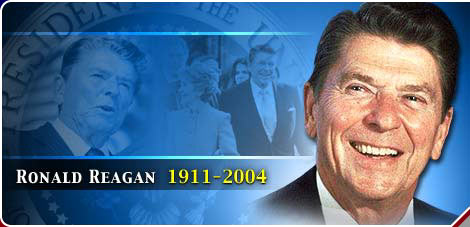
“Whatever else history may say about me when I’m gone, I hope it will record that I appealed to your best hopes, not your worst fears; to your confidence rather than your doubts. My dream is that you will travel the road ahead with liberty’s lamp guiding your steps and opportunity’s arm steadying your way.”
Ronald Reagan




“...When I saddle up and ride into the sunset it will be with the knowledge that we’ve done great things. We kept faith with a promise as old as this land we love and as big as the sky. A brilliant vision of America as a shining city on a hill. Thanks to all of you, and with God’s help, America’s greatest chapter is still to be written, for the best is yet to come.”
Ronald Reagan, December 1, 1988

"In closing let me thank you, the American people, for giving me the great honor of allowing me to serve as your president. When the Lord calls me home, whenever that may be, I will leave with the greatest love for this country of ours and eternal optimism for its future. I now begin the journey that will lead me into the sunset of my life. I know that for America there will always be a bright dawn ahead."
Ronald Reagan, Nov. 5, 1994
Sunday, March 05, 2006
EX SCIENCIA TRIDENS: THE PROPER APPLICATION OF KNOWLEDGE IN SOCIETY
"Honesty is the first chapter of the book of Wisdom."
Thomas Jefferson
In the traditional treatment of equilibrium, analysis is apparently avoided by the assumption that the data, in the form of demand schedules representing individual tastes and technical facts, are equally given to all individuals and that their acting on the same premises will somehow lead to their plans becoming adapted to each other. Since the very beginning of the civilizations, knowledge has comprehensively contributed its major portion to prosperity that has been delivered by men who kept on trying where there seemed to be no help at all. The knowledge as an object of competition in terms of scientific discovery is ultimately the best defense against totalitarian myths and destructive ideologies that put the preference of anarchism ahead of Individual Liberty that insures everyone from the bottom to the top to move ahead and enjoy fuller and happier portion of his or her life. The function of knowledge is one of the most central parts of comprehensive components that determine the prosperity of the future growth and happiness. Ultimately knowledge is indeed a coherent object that grants power granted from Liberty. But the use of knowledge seems to be to some certain extense "the tool of manipulation". Such cases are perfectly displayed in the intercourse of History. Marxism as a source of evil attempted to institute subjective data as a form of "scientific socialism". But as we shall see later, the fittest function of knowledge is to develop it, put it forward and promote it as much as possible in order to assure the sovereignty of individualism and proper Economic order, that is and presumably remains, free entrepreneurial capitalism. It is also impossible to set arguments that try to imply the structure of free market as an outsplit or a kind invention. Free market was nonetheless instituted, developed or set - it evolved. When people began to launch production they indeed felt a need for exchanging goods. The exchange of goods is the most suitable example of how "laissez-faire" can fulfill the happiness and prosperity of freely sovereign individual subjects. The theoretical approach of the interpretation of knowledge shall be begun with the exposition of knowledgeable "general equilibrium".General equilibrium of knowledge widely exists from subjective and objective data. Those significant types of data cause external effects in spreading the hypothetical construction of potential output of knowledge. In fact, knowledge is a magnificent type of scientific discovery and argument. Knowledge is the most helpful institution to avoid clashes and revolutionary violence that most certainly prefer evil and the reshifting of knowledge in order to reinstitute it as a tool for propaganda ("scientific socialism").Communist-driven doctrine emphasized such devolution, most centrally in Law. Law is, according to Aristotle, a reason free from passion. In other words, law is the concentration of morality. But communist leadership modeled law as a propaganda that is always ultimately correct. Despite describing different conceptions of knowledge, communist ideologists reffered that destructive propaganda as knowledge. That's why left-leaning and communist-minded people will never accept the concept of total privatization of education system, because their education model spreads their miserable ideology and dialectical dogmatism that is the most poisenous way to affect free society that leans its consistence on knowledge, sovereignty and individual prosperity.Imre Lakatos adopted an important concept of "identifying knowledge". Lakatos extracted from the point, that knowledge that is not keenly aware of adopting newly generated hypothesis is definitely not knowledge, because philosophically knowledge requires innovative elaboration and pure measurement of its certain extense. According to Karl Popper, Marxism and Psycho-analysis are perfectly settled example of "non-knowledge" or "pseudo-science" and they present the "deadline", because they are both unaware of adopting dynamic elaborations and newly developed consolations of knowledge. Extensive knowledge must be affirmed on certain events and their dynamic analysis and emphasis. The only condition about the necessity of which for the establishment of equilibrium economists seem to be fairly agreed is the "consistency of data." But after what we have seen about the vagueness of the concept of "datum" we shall suspect, and rightly, that this does not get us much further. Knowledge is further more underlayed on its relevancy and irrelevancy. Irrelevancy of knowledge is seen as an unwelcoming approach to put the knowledge in practice, while relevant conception requires certain optimality that consists of proper combination of subjective and objective data, because both desire logical irritatition. But let's not mix the pure logical theory with compulsory reflections of both subjective and objective data that largely create the instance of certain event. Pure logical theory denies the obvious understanding of subjective data, because logical theory as a theorem consists of objective data exclusively. For example, it's impossible for sociology to be accepted objectively, while this is possible for Mathematics that is the basis of all sciences. If knowledge is not having an objective argument that knowledge cannot consist properly. Thus all the applicable elaborations of knowledge require its mathematical approach, subjective and objective platform, if we speak about social science. In terms of social sciences objective platform of knowledge is reduced to a minimum, with a decent exception of Economics that can be partially researched with "naturalist experiment" that was brilliantly defined by Frank Ramsey (1928). Another part of methodology and research represents "subjective economic elaboration" that interprets Economics as Neoclassical, Chicago, Austrian, Keynesian... Of course it depends on certain methodological structures that usually differ in different schools of Economics.Scientific program that is not keenly aware of generating newly adopted and verified hypothesis is called "degenerated program of pseudoscience" that is and presumably remains dogmatic and nonetheless based upon the analytical value of knowledge. Such cases are astrology and Marxism. Most constantly adopted mistakes that demises analytical value of scientific research in certain science is the wrongfulness and the disagreement on framework. Without agreement on framework, it's never possible to verify the agreement on specifics.But of course, there's certainly a problem of division of knowledge almost as similar as the problem of division of labor firstly observed by Adam Smith in his study called "The Wealth of Nations". Each individual must posses clearly certain optimality of knowledge, wheatear it should be practical or theoretical. In order to assure the survival of knowledge it's clearly impossible to speak about the planning of knowledge, because knowledge as itself is not a dogmatic complex of irrational behavior, but it requires innovation and adopting new and freshly recognized hypothesis. As to that subject knowledge following the mind of rational behavior and the fittest combination of subjective and objective data and certain optimality of amount of arguments, will be ready and steady to become a scientific program that will put "the- competition-of knowledge-in-mind" ahead as a scientific discovery of challenging new conceptions and elaborations, beyond which knowledge will adopt its extensive analytically added value upon which the individual distribution of knowledge depends.
Reference:
Friderich August von HAYEK, Economics and Knowledge, Presidential address delivered before the London Economic Club; November 10 1936, Economica IV (new ser., 1937), pp 33-54.
Friderich August von HAYEK, Competition as a Discovery Procedure
http://www.mises.org/journals/qjae/pdf/qjae5_3_3.pdf
Karl R. POPPER, The Logic of the Scientific Discovery, Routledge, 1992
Karl R. POPPER, Objective Knowledge: An Evolutionary Approach, Oxford University Press USA, 1972
Brendan LARVOR, Lakatos: An Introduction, Routledge, London, 1998
Frank P. RAMSEY: Truth and Probability, The Foundations of Mathematics and other Logical Essays, Ch. VII, p.156-198, New York: Harcourt, Brace and Company, 1926
http://cepa.newschool.edu/het/texts/ramsey/ramsess.pdf
Steve PEJOVICH, After Socialism: Where Hope for Individual Liberty lies
Steve PEJOVICH, Law, Tradition and the Transition in Eastern Europe, The Independent Review, v.II, n.2, Fall 1997
Thomas Jefferson
In the traditional treatment of equilibrium, analysis is apparently avoided by the assumption that the data, in the form of demand schedules representing individual tastes and technical facts, are equally given to all individuals and that their acting on the same premises will somehow lead to their plans becoming adapted to each other. Since the very beginning of the civilizations, knowledge has comprehensively contributed its major portion to prosperity that has been delivered by men who kept on trying where there seemed to be no help at all. The knowledge as an object of competition in terms of scientific discovery is ultimately the best defense against totalitarian myths and destructive ideologies that put the preference of anarchism ahead of Individual Liberty that insures everyone from the bottom to the top to move ahead and enjoy fuller and happier portion of his or her life. The function of knowledge is one of the most central parts of comprehensive components that determine the prosperity of the future growth and happiness. Ultimately knowledge is indeed a coherent object that grants power granted from Liberty. But the use of knowledge seems to be to some certain extense "the tool of manipulation". Such cases are perfectly displayed in the intercourse of History. Marxism as a source of evil attempted to institute subjective data as a form of "scientific socialism". But as we shall see later, the fittest function of knowledge is to develop it, put it forward and promote it as much as possible in order to assure the sovereignty of individualism and proper Economic order, that is and presumably remains, free entrepreneurial capitalism. It is also impossible to set arguments that try to imply the structure of free market as an outsplit or a kind invention. Free market was nonetheless instituted, developed or set - it evolved. When people began to launch production they indeed felt a need for exchanging goods. The exchange of goods is the most suitable example of how "laissez-faire" can fulfill the happiness and prosperity of freely sovereign individual subjects. The theoretical approach of the interpretation of knowledge shall be begun with the exposition of knowledgeable "general equilibrium".General equilibrium of knowledge widely exists from subjective and objective data. Those significant types of data cause external effects in spreading the hypothetical construction of potential output of knowledge. In fact, knowledge is a magnificent type of scientific discovery and argument. Knowledge is the most helpful institution to avoid clashes and revolutionary violence that most certainly prefer evil and the reshifting of knowledge in order to reinstitute it as a tool for propaganda ("scientific socialism").Communist-driven doctrine emphasized such devolution, most centrally in Law. Law is, according to Aristotle, a reason free from passion. In other words, law is the concentration of morality. But communist leadership modeled law as a propaganda that is always ultimately correct. Despite describing different conceptions of knowledge, communist ideologists reffered that destructive propaganda as knowledge. That's why left-leaning and communist-minded people will never accept the concept of total privatization of education system, because their education model spreads their miserable ideology and dialectical dogmatism that is the most poisenous way to affect free society that leans its consistence on knowledge, sovereignty and individual prosperity.Imre Lakatos adopted an important concept of "identifying knowledge". Lakatos extracted from the point, that knowledge that is not keenly aware of adopting newly generated hypothesis is definitely not knowledge, because philosophically knowledge requires innovative elaboration and pure measurement of its certain extense. According to Karl Popper, Marxism and Psycho-analysis are perfectly settled example of "non-knowledge" or "pseudo-science" and they present the "deadline", because they are both unaware of adopting dynamic elaborations and newly developed consolations of knowledge. Extensive knowledge must be affirmed on certain events and their dynamic analysis and emphasis. The only condition about the necessity of which for the establishment of equilibrium economists seem to be fairly agreed is the "consistency of data." But after what we have seen about the vagueness of the concept of "datum" we shall suspect, and rightly, that this does not get us much further. Knowledge is further more underlayed on its relevancy and irrelevancy. Irrelevancy of knowledge is seen as an unwelcoming approach to put the knowledge in practice, while relevant conception requires certain optimality that consists of proper combination of subjective and objective data, because both desire logical irritatition. But let's not mix the pure logical theory with compulsory reflections of both subjective and objective data that largely create the instance of certain event. Pure logical theory denies the obvious understanding of subjective data, because logical theory as a theorem consists of objective data exclusively. For example, it's impossible for sociology to be accepted objectively, while this is possible for Mathematics that is the basis of all sciences. If knowledge is not having an objective argument that knowledge cannot consist properly. Thus all the applicable elaborations of knowledge require its mathematical approach, subjective and objective platform, if we speak about social science. In terms of social sciences objective platform of knowledge is reduced to a minimum, with a decent exception of Economics that can be partially researched with "naturalist experiment" that was brilliantly defined by Frank Ramsey (1928). Another part of methodology and research represents "subjective economic elaboration" that interprets Economics as Neoclassical, Chicago, Austrian, Keynesian... Of course it depends on certain methodological structures that usually differ in different schools of Economics.Scientific program that is not keenly aware of generating newly adopted and verified hypothesis is called "degenerated program of pseudoscience" that is and presumably remains dogmatic and nonetheless based upon the analytical value of knowledge. Such cases are astrology and Marxism. Most constantly adopted mistakes that demises analytical value of scientific research in certain science is the wrongfulness and the disagreement on framework. Without agreement on framework, it's never possible to verify the agreement on specifics.But of course, there's certainly a problem of division of knowledge almost as similar as the problem of division of labor firstly observed by Adam Smith in his study called "The Wealth of Nations". Each individual must posses clearly certain optimality of knowledge, wheatear it should be practical or theoretical. In order to assure the survival of knowledge it's clearly impossible to speak about the planning of knowledge, because knowledge as itself is not a dogmatic complex of irrational behavior, but it requires innovation and adopting new and freshly recognized hypothesis. As to that subject knowledge following the mind of rational behavior and the fittest combination of subjective and objective data and certain optimality of amount of arguments, will be ready and steady to become a scientific program that will put "the- competition-of knowledge-in-mind" ahead as a scientific discovery of challenging new conceptions and elaborations, beyond which knowledge will adopt its extensive analytically added value upon which the individual distribution of knowledge depends.
Reference:
Friderich August von HAYEK, Economics and Knowledge, Presidential address delivered before the London Economic Club; November 10 1936, Economica IV (new ser., 1937), pp 33-54.
Friderich August von HAYEK, Competition as a Discovery Procedure
http://www.mises.org/journals/qjae/pdf/qjae5_3_3.pdf
Karl R. POPPER, The Logic of the Scientific Discovery, Routledge, 1992
Karl R. POPPER, Objective Knowledge: An Evolutionary Approach, Oxford University Press USA, 1972
Brendan LARVOR, Lakatos: An Introduction, Routledge, London, 1998
Frank P. RAMSEY: Truth and Probability, The Foundations of Mathematics and other Logical Essays, Ch. VII, p.156-198, New York: Harcourt, Brace and Company, 1926
http://cepa.newschool.edu/het/texts/ramsey/ramsess.pdf
Steve PEJOVICH, After Socialism: Where Hope for Individual Liberty lies
Steve PEJOVICH, Law, Tradition and the Transition in Eastern Europe, The Independent Review, v.II, n.2, Fall 1997
Subscribe to:
Posts (Atom)